


The towing industry didn’t ask for permission to come in. It’s already here.
Take Our Polls!
EDITORIAL
There is a conversation beginning in the repossession industry that probably needs to happen sooner rather than later. The towing industry is looking more seriously at the repossession space. This isn’t something that might happen someday. It is already happening.
American Towman’s Tow Industry Week recently published an article by longtime repossession veteran Mark Lacek titled “Get Ready for Repos , Training and Tools for Tow Firms” (last page.) American Towman has also moved beyond simply writing about the opportunity. At its 2026 TowXpo in San Antonio, it offered a dedicated Safety and Compliance in the Repossession Industry program taught by Lacek and Eagle Group XX’s Ron Brown. The curriculum included repossession law, voluntary and self-help recovery, confrontational avoidance, dealing with irate consumers, trespass, breach of peace and commercial collateral.
The intended audience included tow truck personnel, and that changes the nature of this discussion. Perhaps asking whether towing companies should enter repossession is no longer the right question. Some already have, more appear interested, and one of the towing industry’s most established media and trade-show organizations is now showing them how to enter the business more professionally.
The question for the established repossession industry may instead be whether to embrace that growth or fight it. If the choice is to fight it, we should also ask whether that fight can realistically be won.
They Were Already Here
Towing and repossession have never been strangers. Many repossession companies perform towing, many towing companies perform repossessions, and both operate recovery equipment, transport vehicles, maintain storage facilities and work at all hours under significant insurance and liability exposure.
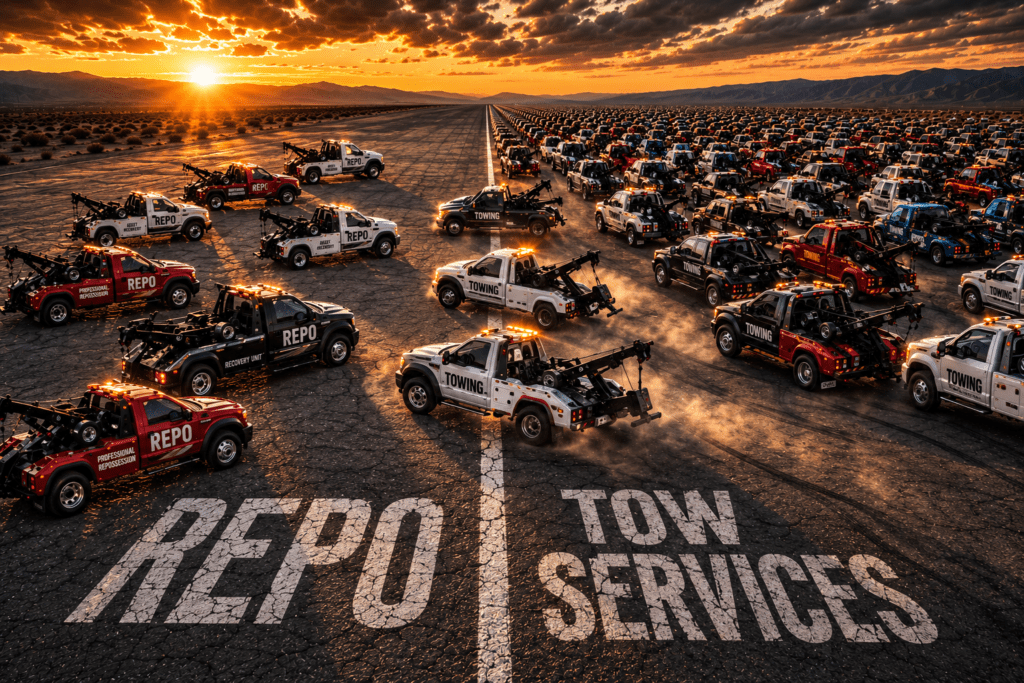
As some of you may remember, during the peak of Covid, many repossession agencies left the industry and converted over to tow services and never came back. Some returned, some didn’t.
Commercial collateral blurs the distinction even further. In the absence of commercial repossession certification, recovering a tractor-trailer, construction equipment or other heavy collateral may require equipment and expertise that a traditional automobile repossession agency non-certified in commercial collateral recovery doesn’t possess. In those situations, the overlap between the industries isn’t merely convenient; sometimes it is necessary.
So, the towing industry’s arrival in repossession isn’t really an arrival at all. What appears to be changing is the scale, visibility and organization of its participation.
American Towman is openly presenting repossession as a potential business opportunity for tow companies while simultaneously warning operators that repossession requires specialized knowledge and training. That creates an interesting contradiction because the professional repossession industry has spent decades making essentially the same argument: Repossession isn’t just towing.
American Towman Actually Agrees with Repo on Something Important
Lacek’s article doesn’t suggest that anyone with a wheel lift should start grabbing cars. Quite the opposite. It distinguishes between being capable of operating a tow truck and being qualified to perform a repossession.
That difference is important because a professional recovery agent isn’t simply someone who knows how to take a vehicle. A professional also has to know when not to take one.
Breach of peace, consumer confrontation, personal property, privacy, documentation, state law, lender requirements, assignment verification, insurance and compliance are not minor additions to the towing process. They are fundamental parts of repossession.
That is why American Towman’s emphasis on training may actually present the professional repossession industry with an opportunity. If more towing companies are entering the business anyway, there is an argument that established repossession organizations should welcome those willing to meet professional standards rather than attempt to keep them outside the tent.
The Case for Opening the Door
The repossession industry has spent years discussing driver shortages, insurance costs, stagnant fees, compliance expenses, lender contracts, forwarding, safety, regulation and training. Behind many of those problems is another issue that receives less attention: scale and leverage.
Repossession is a relatively small industry negotiating with enormous financial institutions, national forwarders, insurance companies, technology providers and government agencies. The difference in scale between professional repossession and the larger towing industry illustrates the point.
The professional recovery industry already has two established national associations in the American Recovery Association (ARA) and Allied Finance Adjusters (AFA), along with The Eagle Group XX, RSIG and many active state and regional associations. AFA traces its history to 1936, while ARA, founded by the ACA in 1965, has developed its own extensive national infrastructure around education, certification, advocacy and industry relations.
Those organizations provide something extremely important if a larger population of towing companies is going to enter repossession: an existing professional infrastructure.
The Towing and Recovery Association of America estimates that the broader U.S. towing industry consists of more than 35,000 companies operating approximately 210,000 commercial vehicles and employing around 350,000 professionals. Those aren’t comparable association membership numbers, but they demonstrate the enormous difference in the size of the underlying industries.
If even a relatively small percentage of those towing companies became properly trained repossession operators, ARA, AFA, The Eagle Group XX, RSIG and the state associations could potentially see significant membership growth. Training participation could increase, conferences could expand, lobbying resources could improve and the industry’s political footprint could become much harder for legislators, regulators and lenders to ignore.
For an industry that has frequently complained that nobody outside repossession understands its problems, having thousands more people with a financial interest in those problems might not necessarily be a bad thing.
Fresh Eyes on Old Problems
Perhaps one of the most valuable things the towing industry could bring to repossession isn’t more trucks, more drivers or even greater political numbers.
It may simply be fresh eyes.
Every mature industry develops practices that eventually stop being questioned. People who have worked within the same system for decades learn what clients will pay for, what they won’t pay for and which battles they believe are no longer worth fighting. What began as a concession can eventually become an expectation, and after enough time that expectation starts looking like an industry standard.
Repossession has plenty of those.
Imagine an established towing operator looking at the economics of professional repossession for the first time. He understands what a truck costs. He knows what insurance costs. He knows the value of a driver’s time, secured real estate, fuel, specialized equipment and storing someone else’s vehicle while assuming responsibility for it.
Then he starts examining how repossession agencies are compensated.
His first reaction may not be, “How can I get some of this work?” It might be, “Why aren’t you charging for that?”
Storage may be the clearest example. Towing companies are accustomed to storage being a legitimate source of revenue because storing vehicles consumes real estate, requires security and creates liability. Portions of the repossession industry have spent years accepting limitations on storage compensation that might look completely foreign to someone coming from traditional towing.
The same fresh examination could extend to mileage, multiple attempts, waiting time, after-hours work, specialized equipment, administrative requirements and other expenses professional recovery agencies have gradually learned to absorb.
That doesn’t mean repossession agencies willingly created this economic model. Competitive pressure, lender demands, forwarding relationships and the constant fear that another agency would accept the assignment have all contributed to it.
But sometimes an industry can become so accustomed to fighting the same battles that it stops recognizing how unusual the battlefield looks to someone arriving for the first time.
What Happens When Tow Companies See Repo Pricing?
This is where the traditional argument that more competitors automatically mean lower fees becomes less certain.
Adding hundreds of potential providers would increase the theoretical supply of recovery vendors. From a basic supply-and-demand perspective, that should weaken the negotiating position of individual agencies.
But bargaining power isn’t determined by numbers alone. It also depends on what those providers are willing to accept.
Seven hundred new companies willing to perform repossessions for less would certainly be bad news for existing agencies. Seven hundred companies looking at current recovery fees, limited or uncompensated storage, mileage restrictions and other absorbed expenses and saying “We’re not doing that” could have an entirely different effect.
They could validate arguments professional repossession agencies have been making for years.
A towing company accustomed to charging for its equipment, time, mileage and storage may not arrive in repossession conditioned to accept the existing compensation structure. Some may examine the economics and decide not to enter at all. Others may enter but insist upon being compensated for services the established repo industry has gradually accepted as part of the cost of doing business.
Ironically, the very economics that discourage some towing companies from entering repossession could ultimately benefit the professional agencies already there.
Maybe Repo Needs the Tow Industry’s Reaction More Than Its Trucks
There is something potentially powerful about another recovery industry independently examining repossession economics and reaching the same conclusions repo agencies have expressed for years.
When existing agencies complain about fees, lenders have heard the argument before. When a completely different population of recovery businesses looks at the same work and starts asking why storage isn’t compensated, why mileage isn’t paid, why multiple attempts aren’t recognized or why certain administrative costs are simply absorbed, the conversation changes.
It is no longer only the existing repo industry complaining about its fees. It becomes an outside benchmark questioning whether some of those practices make economic sense in the first place.
That doesn’t prove what an appropriate repossession fee should be, and tow companies certainly won’t all react the same way. But they haven’t spent decades adapting their businesses to the lender’s definition of what is and isn’t compensated
They arrive without the history.
That could make them disruptive in ways that have nothing to do with taking assignments away from existing agencies.
Sometimes fresh eyes don’t discover a new problem. They simply remind everyone how long the old one has been sitting there.
The Associations Could Gain More Than Members
This is also where the potential role of ARA, AFA, The Eagle Group XX, RSIG and the state associations becomes much larger than simply recruiting new members.
Imagine bringing hundreds of additional businesses into the conversations the repossession industry is already having about fees, insurance, safety, regulation, compliance and lender contracts. Those businesses bring employees, equipment, economic activity and relationships with existing towing associations at the state and national levels.
That potentially creates political leverage.
A repossession issue affecting a relatively small specialized profession can be easy for a legislator or regulator to overlook. An issue affecting professional repossession agencies alongside a much larger population of towing and recovery companies carries different political arithmetic.
The associations could also provide something tow operators need. The ARA, AFA and the state associations possess decades of institutional knowledge about collateral recovery that can’t be learned simply by operating a wheel lift. Bringing qualified tow operators into those organizations could increase association resources while giving new entrants access to the professional knowledge they need to perform repossessions correctly.
That could be a mutually beneficial exchange: Tow brings scale. Repo brings specialization.
But There Are Risks
None of this means the established repossession industry should blindly celebrate a large influx of new competitors.
There is a legitimate danger that some tow operators will see repossession primarily as supplemental revenue and accept pricing that established agencies cannot economically sustain. There is also the risk that lenders or forwarders could interpret a larger pool of trucks as a larger pool of qualified repossession professionals.
Those are not necessarily the same thing.
Knowing how to safely hook and transport a vehicle is only one part of repossession. Breach of peace, consumer interaction, personal property, privacy, assignment verification, lender compliance and state law create risks that don’t disappear because someone is an experienced tow operator.
The professional standard therefore cannot be diluted simply because more companies want access to the work. If anything, a larger pool of potential providers makes standards more important.
The towing industry is extremely heavy into training and certification and the American Towman three conferences in Texas, Las Vegas and Baltimore all have over 25 seminars on training and knowledge at each event. The American towman conferences are miles ahead of the largest repossession yearly conference when talking about training, education and attendance.
Don’t Lower the Bar, Make It the Price of Admission
This may be where ARA, AFA, The Eagle Group XX, RSIG and the state associations have their greatest opportunity.
A towing company wants to begin performing repossessions? Fine. Give it a professional path into the industry.
Get trained. Get certified. Carry the appropriate insurance. Understand breach of peace and consumer protection. Meet background requirements. Establish proper personal-property procedures. Learn lender compliance. Follow applicable state licensing laws. Join the professional community and participate in its training, conferences and legislative efforts.
Under that scenario, the towing industry’s growing interest in repossession doesn’t necessarily weaken the profession. It could represent one of the greatest opportunities for association growth the recovery industry has seen in decades.
There is no reason existing organizations should have to weaken their standards because the potential recovery population becomes larger. The better approach could be exactly the opposite: Don’t lower the bar to accommodate new entrants. Make meeting the bar the price of admission.
But What If Repo Decides to Fight Them?
This is where the strategic question becomes uncomfortable.
Suppose the established repossession industry responds defensively and attempts to discourage tow companies from entering. Let’s just look at how effective they’ve been against the unlicensed and uninsured Buy Here Pay Here used car dealership sector. Crickets…
Fight as you might, but the tow industry is even bigger and more organized than them and the tow companies foray into the repo space will likely continue anyway.
Their organizations can develop repossession education. Their conferences can offer more recovery courses. Their publications can devote greater coverage to repossession. Their insurers can develop products around the work. Their associations can eventually represent repossession-related issues legislatively, while lenders and forwarders develop direct relationships with their members.
American Towman’s current efforts demonstrate that at least part of that infrastructure is already beginning to develop.
At some point, the question could change from whether the towing industry has entered repossession to whether repossession has simply become another specialty within the much larger towing industry.
Scale matters here. Again, the membership of ARA and AFA should not be directly compared with estimates for the entire towing-company population. But the difference in the size of the two underlying industries illustrates why the possibility can’t simply be dismissed.
If only 2% of an estimated 35,000 towing companies seriously entered repossession, that would represent approximately 700 companies. At 5%, it would be approximately 1,750.
Those aren’t predictions. They’re illustrations of scale.
A professional repossession industry in which ARA, AFA and the state associations welcome and help shape qualified entrants could potentially become larger and more influential. An industry that rejects them could eventually find itself competing not only against individual tow companies, but against a parallel training, association and political infrastructure backed by a substantially larger population.
Repo Has Something Tow Needs, Too
This shouldn’t become a story about the towing industry rescuing repossession. The exchange goes both ways.
Professional repossession has spent decades accumulating specialized knowledge about consumer confrontation, breach of peace, lender compliance, assignment management, personal property, skip tracing and collateral recovery. Much of that knowledge was learned through experience, litigation and sometimes tragedy.
AFA has been part of the professional recovery community since 1936. ARA, since 1965, and the industry’s state associations have likewise developed decades of experience, training programs, lender relationships and regulatory knowledge.
That institutional memory has tremendous value to anyone entering repossession.
The principle should therefore remain simple: everyone performing repossessions should be held to appropriate legal, insurance, compliance and professional standards regardless of what is written on the side of the truck.
If a towing company wants to become a professional repossession company, welcome it. But becoming a repossessor should mean learning the profession rather than simply adding another service to a towing company’s website.
At the same time, repossession shouldn’t overlook what towing brings to the relationship: equipment, geographic coverage, heavy-duty expertise, a larger workforce, established associations, political relationships, different economic expectations and a substantially larger footprint.
Maybe these industries have more to offer each other than either side initially wants to admit.
Fight Them or Lead Them?
I understand why professional repossessors might look at this development and see a threat. They built businesses around a specialized profession, invested in training and compliance, endured rising insurance expenses and survived years of stagnant fees. Now a much larger neighboring industry is being openly told that repossession represents a business opportunity.
Being protective of that profession is understandable. But protectionism only works when you have the ability to protect the border, and I’m not convinced this industry does.
American Towman isn’t asking the repossession industry’s permission to train tow operators in repossession, they’re already doing it. Tow companies aren’t waiting for an invitation to perform repossessions. Some already do. Lenders aren’t likely to ignore qualified new recovery capacity simply because established agencies would prefer they did.
American Towman’s current efforts demonstrate that at least part of that infrastructure is already beginning to develop. An industry that rejects them could eventually find itself competing not only against individual tow companies, but against a parallel training, association and political infrastructure backed by a substantially larger population.
Perhaps the strategic response, then, isn’t to fight an expansion that may ultimately prove impossible to stop. Perhaps it is to shape it.
ARA, AFA and the state associations have an opportunity to welcome companies willing to become professional recovery operators, train them, certify them and hold them accountable. Bring them into the associations, legislative fights, fee discussions and conversations with lenders while insisting that whether the name on the building says towing, recovery, repossession or some combination of all three, the professional standards of repossession still apply.
The tow industry is coming to repo, and in many places it is already here. The professional repossession industry now has an opportunity to decide what that means.
Maybe the greatest contribution these newcomers make won’t be additional trucks or additional recovery capacity. Maybe it will be looking at things this industry has accepted for years and asking questions that have become too easy to stop asking.
If the repossession industry brings them into the profession, their numbers, economic expectations and fresh perspective could make repossession stronger and more influential than it has been in decades.
If the industry chooses to simply fight to keep them out, it may eventually discover a larger truth. The towing industry didn’t ask for permission to come in. It’s already here.
The Tow Industry Is Coming into the Repo Space. Will It Make the Industry Stronger, or Absorb It? – The Tow Industry Is Coming into the Repo Space. Will It Make the Industry Stronger, or Absorb It? – The Tow Industry Is Coming into the Repo Space. Will It Make the Industry Stronger, or Absorb It?
Kevin Armstrong
Publisher
The Tow Industry Is Coming into the Repo Space. Will It Make the Industry Stronger, or Absorb It? – Repossess – Repossession – Repossession Agency – Repossessor – Repossession – Repossession News – Forwarder – Lending – Auto Loan – Training – Compliance –





More Stories
Why Fight LPR? Join It — But What Happens When the Car Repossesses Itself?
In The Future Will There Be Anyone Left to Recover Vehicles?
The Broken Bond Between Lenders and Agents – Positive Resolution
The Repos That May Never Come
A Repossession Is a Repossession
When “Partner” Is Just Another Word for Vendor