


Imagine All Three Industries Standing in the Same Courtroom
GUEST EDITORIAL
The argument that towing companies entering repossession may bring “fresh eyes” to repo economics is probably correct. But be careful what you wish for. Because those fresh eyes may start asking questions the repossession industry has spent decades avoiding.
And towing companies may not be the only ones asking. Private investigators might start asking them. Locksmiths might start asking them. Perhaps transportation companies, storage operators and other service providers should ask them too.
The larger question is this:
How many separately valuable services can a repossession company perform for a lender for free, or at rates that bear little relationship to the cost of providing them, before somebody asks whether those practices are unfairly competing with businesses that actually charge for those services?
That question becomes particularly interesting in California.
California’s Unfair Practices Act does not merely concern tangible merchandise. Business and Professions Code section 17024 expressly defines an “article or product” to include a service or the output of a service trade.
So perhaps the towing industry’s entrance into repossession will produce something nobody expected.
Instead of tow companies learning how to price like repossessors, maybe other licensed industries will start asking why repossessors have been giving their services away.
Start With Storage
Storage remains the easiest example.
Put a vehicle on a licensed towing company’s secured lot and storage has value.
Someone pays for the real estate, someone pays for fencing, someone pays for insurance, someone pays for lighting, someone pays for cameras, someone pays employees and someone assumes liability for the vehicle.
The towing company charges a daily storage rate because storing a vehicle costs money.
Then the lienholder sends a repossession company.
The repossessor removes the vehicle from the towing company’s lot and moves it to another secured facility.
Same vehicle, same California real estate market, same need for fencing, same insurance. same security and same liability.
Except suddenly: FREE STORAGE!
Why? Did the cost disappear? Of course not.
The repossession company simply decided not to separately charge the lender for it.
If that occurs occasionally as an incidental part of a properly priced recovery service, that is one thing. But if an industry systematically markets free storage to obtain lender business and divert vehicles away from businesses that charge for storage, perhaps tow companies should start asking attorneys a different question:
Are repossession companies competing by giving away a service that unquestionably costs money to provide?
And if so: Why shouldn’t towing companies challenge that practice?
Then the Private Investigation Industry Might Ask the Same Question
Now things get more interesting.
What does a repossession company actually do before it recovers a difficult vehicle?
It investigates, it searches databases, it develops addresses, it researches relatives and associates. It searches phone information, it analyzes vehicle sightings, it reviews registration information, it conducts skip tracing and it develops leads.
It may spend hours, or days, attempting to determine where a debtor and collateral are located.
California repossession law expressly contemplates that an assignment may authorize a repossessor to “skip trace, locate, or repossess” collateral.
So this isn’t an argument that licensed repossession agencies necessarily lack authority to perform legitimate skip-tracing work associated with their assignments.
The question is economic.
What is that investigative work worth?
Ask a licensed private investigator to spend four hours locating a difficult subject and there will ordinarily be an invoice. And there should be.
Afterall, the investigator has training, licensing, databases, employees, insurance, software subscriptions, telephone expenses, research expenses, overhead and professional expertise.
Investigation is a service.
Yet a repossession company may receive an assignment from a multibillion-dollar financial institution and spend hours performing investigative work without charging one additional dollar.
“No locate, no fee.”
“No recovery, no charge.”
“Skip tracing included.”
Think about what that means economically.
The lender obtains investigative services without necessarily paying separately for the investigation. And the repossession company may absorb those investigative costs because it hopes eventually to obtain the recovery fee.
So perhaps California private investigators should start looking at this arrangement too.
What Happens When the PI Industry Says, “Wait a Minute”?
Imagine a licensed private investigator tells a lender: “I will locate your debtor for $150.”
The lender responds: “Why would I pay you $150? My repossession company will investigate the debtor for free because they hope to recover the car.”
That should get the PI industry’s attention.
The repossession company may have every legal right to perform skip tracing within its repossession assignment.
But having authority to perform a service and being entitled to use that service as an unlimited loss leader are two different questions.
Suppose an agency spends:
- two hours of employee investigative time;
- paid database charges;
- LPR costs;
- telephone and data expenses;
- software expenses;
- management time;
and charges the lender: $0.00 investigative fee.
Meanwhile, a PI company offering substantially similar investigative services must charge enough to pay investigators, maintain licenses, purchase databases, carry insurance and operate a business.
How does that company compete with zero?
Maybe the answer is that it doesn’t.
And perhaps that is precisely the question California competition law should eventually be asked to address.
“But We Make It Back on the Repo”
That’s probably going to be the response.
Storage is free because we make money on the repossession. Investigation is free because we make money on the repossession. Mileage is free because we make money on the repossession. Keys are included because we make money on the repossession.
Multiple attempts, administrative work, transportation, photographs, condition reports and personal-property handling is included.
Everything is included!
At some point, though, someone should ask:
Included in what?
If a recovery pays $400, how many separate commercially valuable services can realistically be buried inside that $400?
Investigation, transportation, towing, storage. administrative processing, vehicle inspection. Photography, inventory, personal-property handling, vehicle release, key services, compliance work, reporting and multiple field visits.
Suddenly that $400 recovery fee isn’t compensation for one service. It is compensation for an entire bundle of professional services that other industries ordinarily sell individually.
That’s where the economics become fascinating.
Maybe the PI Industry Has Been Competing Against “Free” for Decades
The repossession industry frequently complains about contingency pricing. Perhaps private investigators should examine it from their perspective.
A PI may conduct an investigation and get paid for the investigation regardless of whether the information ultimately produces a vehicle recovery.
A repossession company frequently investigates on contingency:
Find the vehicle and recover it, get paid.
Spend five hours investigating it and fail to recover it, get zero.
That arrangement certainly benefits the lender. But consider what it does to the marketplace for investigative services.
A traditional investigator has to tell the financial institution:
“Pay me for my professional time.”
The repossessor says:
“I’ll perform the investigation for nothing unless I ultimately recover your collateral.”
Who is the lender likely to choose?
Perhaps private investigators should start asking whether they have been losing investigative business not because repossessors are better investigators, but because repossessors have conditioned lenders to expect professional investigative services for free.
That is a very different conversation.
Now Let’s Talk About Keys
The locksmith example is admittedly more complicated.
Not every repossession-related key function is necessarily equivalent to hiring a retail locksmith, and California has specific statutes regulating locksmith work and key duplication.
So nobody should claim that every key made in connection with a repossession automatically creates a locksmith-industry lawsuit.
But economically, the question is still worth asking.
A vehicle is recovered without keys.
Someone needs to: decode it, cut a key, program a transponder, program a fob, gain access or otherwise provide a functional replacement key.
Those services have value.
Call an automotive locksmith and ask for a modern programmed vehicle key.
The locksmith isn’t likely to say:
“Don’t worry about it. It’s included free because maybe you’ll hire me for something else.”
There is equipment involved: Key programmers, software, subscriptions, key blanks, transponders, technician labor, training, vehicles, insurance and licensing requirements.
Yet some repossession arrangements may include keys for free or at heavily discounted rates as part of winning or retaining lender volume.
So locksmiths might reasonably ask:
If a professional service normally costs $150, $250, $400 or more in the open market, how is another business sustainably providing that same service for $25, or zero?
Again, the answer might be perfectly legitimate.
Volume.
Efficiency.
Wholesale pricing.
Different equipment costs.
Bundled compensation.
Actual lower costs.
Those possibilities matter.
But “that’s what the lender requires” isn’t an economic explanation.
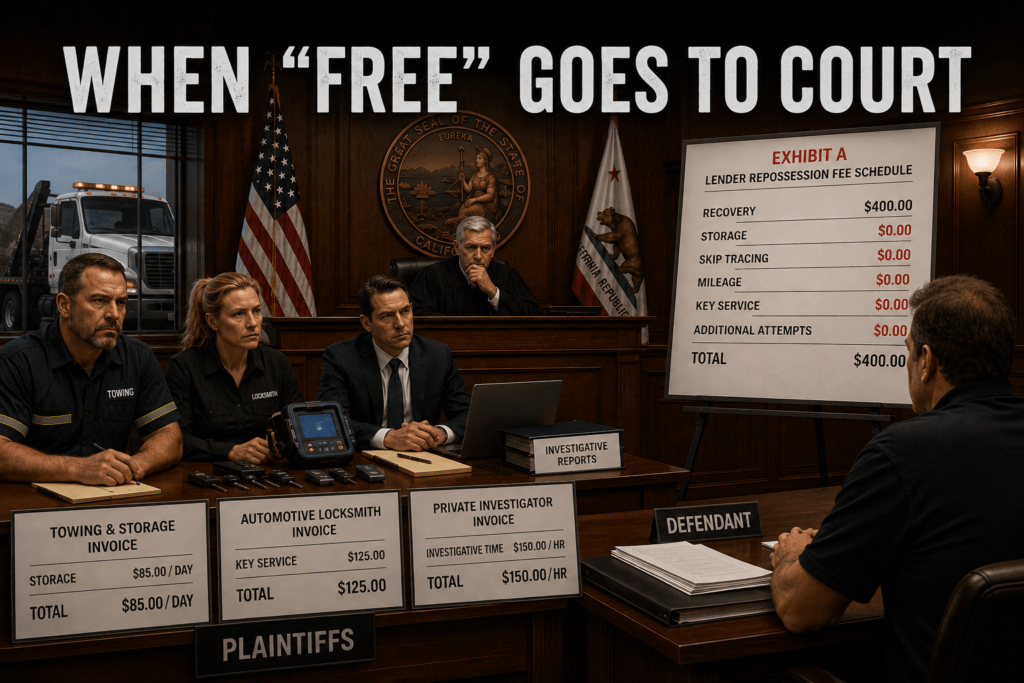
Imagine All Three Industries Standing in the Same Courtroom
Now the hypothetical gets interesting.
A tow company says: “They took storage business from me by offering storage for free.”
A private investigation company says: “They took investigative business from me by providing skip tracing for free.”
An automotive locksmith says: “They obtained lender volume by providing key services at prices below what it costs legitimate providers to perform the work.”
And the repossession industry responds: “We weren’t trying to compete with any of you. Those services were simply included in our repossession package.”
Maybe that wins, maybe it doesn’t. But someone should probably test the argument.
Because labeling something “included” doesn’t make its cost disappear.
What Does It Actually Cost?
This is where discovery would become interesting.
Don’t debate philosophy. Open the books.
For storage:
- What is the facility cost?
- How many square feet are dedicated to collateral?
- What does insurance cost?
- Security?
- Cameras?
- Utilities?
- Payroll?
- Property taxes?
What is the real daily cost per stored vehicle?
For investigations:
- How much does the agency spend on skip-tracing software?
- Databases?
- LPR information?
- Investigative employees?
- Telephone research?
- Management?
- How many investigative hours are spent on unsuccessful assignments?
- How much investigative labor does the lender receive for zero compensation?
For keys:
- What equipment is being used?
- What did it cost?
- What subscriptions are required?
- What does the blank cost?
- What does the technician cost?
- What would the service cost if sold independently?
- What is the lender actually being charged?
Then ask the critical question:
Why was that price chosen?
The Emails Could Tell the Story
Imagine what lender negotiations might reveal.
“Competitor A offers 10 days free storage. We’ll offer 30.”
“Don’t charge them for the skip. We’ll make it up on recoveries.”
“They want keys included if we want the portfolio.”
“Competitor B charges mileage. We’ll waive ours.”
“Give them free storage and keys so they’ll move the account.”
“Don’t bill investigative time. The lender won’t pay it.”
At some point, an attorney is going to read correspondence like that and ask whether this is simply aggressive competition or whether professional services are deliberately being given away to obtain business and injure competitors who charge for them.
That distinction matters.
And Here Is the Greatest Irony
The repossession industry has spent years saying:
We’re underpaid.
Insurance costs too much.
Trucks cost too much.
Labor costs too much.
Compliance costs too much.
Technology costs too much.
Fuel costs too much.
Real estate costs too much.
LPR costs too much.
Forwarders take too much.
Lenders won’t increase fees.
Maybe all of that is true.
But then repo agencies turn around and compete for accounts by offering:
Free storage.
Free investigations.
Free mileage.
Free attempts.
Free keys.
Free transportation.
Free administrative services.
Free waiting time.
At what point does the industry have to acknowledge that it helped create the pricing problem it now complains about?
Perhaps lenders didn’t independently decide that all of these services were worthless.
Perhaps repossession companies taught them they were worthless by giving them away.
Tow’s “Fresh Eyes” May Create an Unexpected Problem
The original argument says towing companies could enter repossession and ask:
“Why aren’t you charging for that?”
Exactly.
But don’t stop with towing.
Let the PI industry look at repo skip tracing and ask:
“Why aren’t you charging for that?”
Let automotive locksmiths look at discounted or included vehicle keys and ask:
“Why aren’t you charging for that?”
Let transportation companies look at uncompensated mileage and ask the same thing.
And eventually someone may ask the more uncomfortable question:
“Are you allowed to give all of this away merely because you package it inside something called a repossession?”
That isn’t protectionism.
It is a legitimate question about competition.
Maybe the Lawsuit Comes From Outside Repo
For years, repossession agencies have attempted to convince lenders that fees need to increase.
Maybe the catalyst won’t come from repossessors at all.
Maybe it comes when other industries realize what is happening.
A tow association may ask counsel to examine uncompensated storage.
A private-investigator association may examine free contingent skip tracing.
A locksmith association may examine below-market vehicle-key programs.
Perhaps individual businesses that can demonstrate actual lost business begin exploring claims.
Perhaps regulators begin looking at how separately regulated services are being packaged and priced.
And perhaps lenders suddenly discover that requiring every vendor to provide more and more professional services for the same recovery fee carries consequences.
Nobody should misunderstand the argument.
Charging less than a competitor is not automatically illegal.
Being efficient is not illegal.
Bundling services is not automatically illegal.
Providing incidental services without a separate line-item charge is not automatically illegal.
And nobody should file lawsuits merely because they dislike a competitor’s pricing.
But California law expressly recognizes services within its unfair-pricing framework.
So where there is evidence that a business is deliberately providing economically significant services below cost or giving them away to obtain business and injure competing providers, the question deserves legitimate legal analysis.
Perhaps Repo Needs to Stop Calling Everything “Free”
There’s also a solution that doesn’t involve anybody suing anybody.
Charge for the work.
Recovery fee.
Investigative fee.
Mileage.
Storage.
Transportation.
Key service.
Special equipment.
Additional attempts.
Administrative work.
After-hours service.
Personal-property processing.
Whatever legitimate professional service is actually being provided.
Price it responsibly.
Document it.
Explain its value to the lender.
And compete on service, compliance, performance and results instead of determining which agency can give away the greatest number of services.
That would certainly make the repossession industry stronger.
So Welcome the Tow Industry
Bring the towing companies in.
Let them learn repossession.
Let them become properly licensed and trained.
Let them bring their equipment and resources.
But also let them bring their understanding that professional services cost money.
And while we’re at it, perhaps invite a few private investigators and automotive locksmiths to the discussion.
They may have the same question:
“Why are you doing for free what our industries have to charge for?”
Maybe towing’s entrance into repossession will finally force lenders and forwarders to recognize the true cost of professional collateral recovery.
Or maybe it will produce something the repo industry never anticipated:
Tow companies, investigators and other service providers looking at decades of uncompensated repo services and asking whether “free” really means free, or whether someone else has been paying the price all along.
And if the answer is that professional services have intentionally been given away to win business from competitors who cannot economically compete with zero, perhaps the question won’t end at an industry conference.
Perhaps somebody eventually asks it in court.
Be careful inviting fresh eyes into an old industry.
They may notice more than you expected.
If Tow Is Coming Into Repo, Maybe Other Industries Should Start Looking at Repo Pricing Too – If Tow Is Coming Into Repo, Maybe Other Industries Should Start Looking at Repo Pricing Too – If Tow Is Coming Into Repo, Maybe Other Industries Should Start Looking at Repo Pricing Too
Anonymous Agency Owner
If Tow Is Coming Into Repo, Maybe Other Industries Should Start Looking at Repo Pricing Too – Repossess – Repossession – Repossession Agency – Repossessor – Repossession – Repossession News – Locksmith – Skip – Skip



More Stories
Three Million Repossessions: A New Measure of America’s Recovery Industry
Why Fight LPR? Join It — But What Happens When the Car Repossesses Itself?
In The Future Will There Be Anyone Left to Recover Vehicles?
The Broken Bond Between Lenders and Agents – Positive Resolution
The Repos That May Never Come
A Repossession Is a Repossession