



Technology Can Find More Cars Than Ever. The Real Question Is Who Finds the Ones It Can’t.
GUEST EDITORIAL
The recent article, “In The Future Will There Be Anyone Left to Recover Vehicles?”, raises an important question about the future of the repossession industry. But perhaps we’re asking the wrong question. Instead of asking how we protect traditional assignments from LPR, maybe we should ask whether the traditional assignment model still makes sense at all.
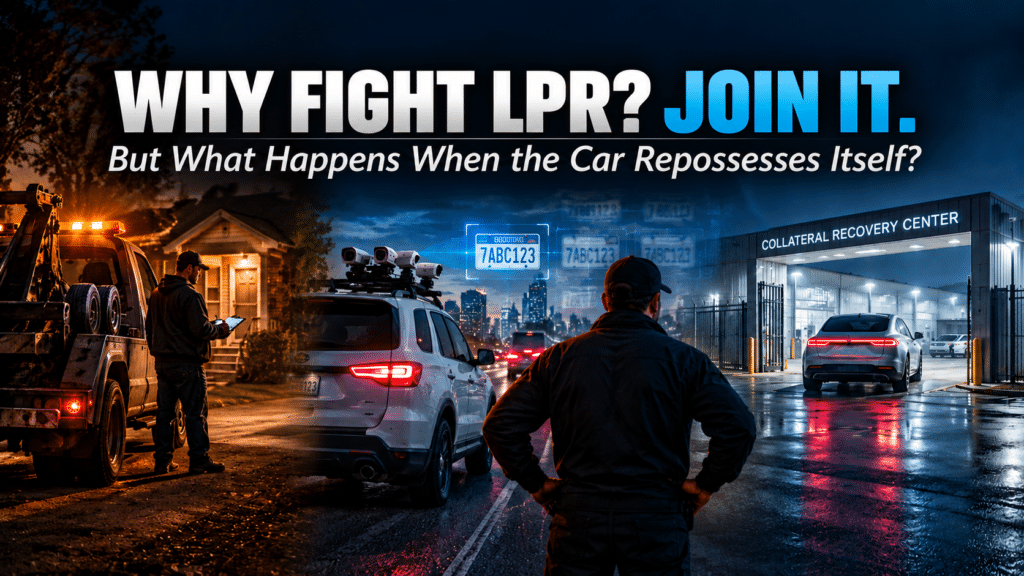
Why fight LPR? Join it.
And while we’re thinking about the future, let’s look farther ahead than the next assignment cycle.
What happens when license plates eventually disappear? What happens when vehicles increasingly know exactly where they are?
And what happens when an autonomous vehicle can simply drive itself back to the lienholder or to a designated storage facility?
At that point, are we still repossessors? Or have we become storage yards?

Those questions may sound futuristic, but so did scanning millions of license plates from moving vehicles and instantly matching them against repossession accounts. Until it wasn’t.
Maybe There Shouldn’t Be Traditional Assignments at All
Consider a completely different recovery model. Instead of lenders simultaneously issuing traditional assignments while opening the same collateral to competing LPR networks, perhaps vehicles simply enter an LPR recovery pool.
Let the technology work.
If an LPR operator finds the vehicle, a qualified recovery company gets the opportunity to recover it. No argument about who “owned” the assignment. No agency spending a week checking addresses while another company’s camera happens across the vehicle.
No pretending five companies simultaneously competing for the same collateral somehow each possess an exclusive “assignment.”
It’s an open recovery opportunity. Call it what it is.
But then something important happens. LPR gets first crack at the easy ones. And whatever LPR doesn’t find becomes substantially more expensive.
As it should.
When LPR Fails, You’re No Longer Buying a Repossession
You’re buying an investigation. That’s a completely different service.
If cameras have been searching for a vehicle for 30, 60 or 90 days and haven’t located it, why would anyone expect a human being to perform the much harder work for the exact same contingency fee?
Now someone has to research. Verify addresses. Develop leads. Travel.
Interview people when appropriate. Review records. Check locations. Conduct surveillance where appropriate.
Connect information that a computer didn’t connect. And sometimes spend an entire day discovering where the vehicle isn’t.
Investigators have historically understood this concept.
They get paid for their time and legitimate expenses because investigative work has value even when the desired result isn’t produced. Why shouldn’t today’s repossessors?
We somehow developed an economic model that can effectively say:
Spend six hours investigating this account. Drive 150 miles. Check four addresses. Document everything.
Find us our $40,000 collateral.
And if you don’t find it? We’ll pay you nothing.
Then we’ll send it to somebody else and ask them to do the same thing.
That’s not a sustainable investigative model.
Perhaps the Future Has Two Different Recovery Products
Maybe lenders should stop purchasing everything under the umbrella of “repossession.”
There could be two distinctly different products.
- LPR Recovery
High volume. Technology driven. Competitive. Primarily contingency based.
Let cameras do what cameras do exceptionally well.
Then there is:
- Investigative Recovery
No meaningful LPR activity?
Bad addresses?
Multiple prior attempts?
Expired registration?
Vehicle apparently intentionally concealed? Then somebody needs to actually investigate.
That should be compensated differently, perhaps hourly, plus mileage and reasonable expenses, with an additional recovery fee when successful.
The exact numbers can be negotiated by the market.
The important principle is that the difficult work cannot continue being priced as though it were the easy work.
We Keep Tripping Over Dollars to Pick Up Pennies
This industry will argue about $25.
It will debate mileage. Question a locate fee. Delay an approval. Ask whether an agency can absorb another 30 miles.
Meanwhile, a $30,000, $50,000 or $80,000 depreciating asset is disappearing.
We’re constantly tripping over dollars to pick up pennies.
The question shouldn’t always be: “How cheaply can we get somebody to work this account?”
It should be: “What is the economically rational amount to spend recovering this asset?”
Those are very different questions.
Paying an experienced investigator $100 an hour sounds expensive compared with paying nothing for an unsuccessful contingency assignment. Until four hours of investigation recovers a $60,000 vehicle.
Then it looks remarkably inexpensive.
But We’re Ignoring an Even Bigger Technological Risk
The repossession industry has become extraordinarily dependent on license plates.
Think about that for a moment. License plates were never designed for us. The government didn’t create license plates so repossessors could locate collateral.
The recovery industry simply discovered that a government-mandated visual identifier attached to nearly every vehicle could be photographed, digitized, compared against databases and transformed into one of the most powerful repossession tools ever created.
Brilliant. But we don’t control it. What happens if the license plate eventually becomes obsolete?
Maybe law enforcement and motor vehicle agencies eventually move toward encrypted digital vehicle identification.
Maybe vehicle-to-infrastructure communication replaces some of the visual identification functions plates provide today. Maybe privacy legislation significantly changes commercial access to plate-location information. Maybe the next technology is something none of us has thought of.
Whatever eventually happens, there is absolutely no guarantee that the next identification system will provide the repossession industry with the same opportunity. Then what?
What happens to companies that spent decades replacing investigators with cameras?
What happens to lenders whose recovery strategies became dependent upon massive LPR databases?
What happens when a lender asks: “Where’s my car?”
And the camera doesn’t have the answer?
And Then Comes the Autonomous Vehicle
There’s an even more disruptive question. What happens when the car can repossess itself?
We’re already moving toward vehicles that are increasingly connected, software-controlled and capable of performing driving functions with decreasing human involvement. Take that trend far enough and the implications for this industry become enormous.
Imagine a future default.
The lender satisfies whatever notices, waiting periods and legal requirements apply.
The vehicle receives an authenticated instruction.
At 3:00 in the morning, while the borrower is asleep, the vehicle starts.
It backs out of the driveway.
It drives 17 miles and it pulls into a designated secured facility.
Recovery complete.
No tow truck.
No LPR car.
No repossessor.
Potentially no confrontation whatsoever.
That’s obviously not the world we universally live in today, and there would be enormous legal, safety, consumer-protection and technical issues to resolve before anything resembling that became commonplace.
But anyone planning the future of this industry should at least be asking the question. Because technology doesn’t have to eliminate every repossession to transform the economics of repossession.
It only has to eliminate enough of them.
Maybe We’ll Become Storage Yards
Suppose that future arrives. What remains?
Perhaps recovery companies evolve into collateral-management facilities.
The vehicle drives itself to us.
We receive it.
Secure it.
Photograph it.
Inventory its condition.
Remove and document personal property.
Process releases.
Coordinate transportation.
Handle redemptions.
Prepare vehicles for auction.
Manage keys.
Provide charging infrastructure.
Maintain secure custody.
Maybe that’s where part of the industry goes. From repossession company to collateral logistics company.
But think about what that means.
If the vehicle can locate itself, report its own condition, unlock itself, immobilize itself and eventually transport itself, enormous portions of today’s recovery process could disappear.
The truck isn’t necessarily the irreplaceable asset. The camera isn’t necessarily the irreplaceable asset. Even the storage yard isn’t guaranteed to remain irreplaceable if lenders and auctions develop their own automated receiving infrastructure.
Which brings us back to the one capability technology has repeatedly struggled to completely eliminate: Human investigation and judgment when everything else fails.
We May Be Training Ourselves to Forget How to Find Cars
This is the danger I believe deserves far more discussion. Experienced repossessors know things that aren’t contained in an LPR database.
They recognize patterns.
They know when an address doesn’t make sense.
They understand how people hide vehicles.
They know neighborhoods.
They develop sources.
They recognize behavioral clues.
They know how to turn one small piece of information into another.
Most importantly, they understand the difference between checking an address and investigating an account. Those skills take years to develop. But today’s economic model frequently places little value on them.
Why spend hours investigating when another provider’s camera might locate the vehicle tomorrow and you receive nothing?
Why send an experienced employee 70 miles into a rural area when an unsuccessful trip isn’t compensated?
Why develop investigators when adding another camera car produces a more predictable return?
Those are rational business decisions. But collectively, they could leave the industry with an enormous capability gap.
The Easy Cars Will Keep Getting Easier
Technology will continue making easy recoveries easier. That’s good. We should embrace it.
LPR.
Connected vehicles.
Telematics.
Better databases.
Artificial intelligence.
Predictive analytics.
Potentially autonomous movement.
Use all of it.
But every technological improvement creates another category: The accounts the technology couldn’t solve.
Those accounts don’t become easier. They become disproportionately harder.
If technology automatically resolves 80% of the easy and moderate cases, the humans aren’t left with an average portfolio anymore.
They’re left with the worst 20%.
And yet we’ll probably still hear: “Can you do it for the standard repo fee?” Which makes no economic sense.
The better technology becomes at removing easy work, the more valuable human investigative work should become, not less.
Price Difficulty Like Every Other Industry Does
Perhaps recovery pricing should eventually look something like this:
Fresh LPR recovery?
- Standard competitive recovery fee.
- Recent verified address?
- Standard field recovery.
No LPR activity after a defined period?
- Investigative tier.
- Multiple agencies unsuccessful?
- Higher investigative tier.
Rural location requiring significant travel?
- Travel time and mileage.
- Special equipment?
- Pay for it.
- Surveillance?
- Pay for the investigator’s time.
Vehicle recovered after investigation?
- Add a success or recovery fee.
An account that has circulated through six agencies for nine months with no sightings shouldn’t arrive at Agency Number Seven carrying the same compensation as a fresh account received yesterday.
Its history is evidence that the account is difficult.
Difficulty should increase price. Not decrease the chance anybody gets paid.
Stop Calling Everything an Assignment
Maybe even the terminology needs to change. If five agencies and three LPR networks can simultaneously recover the same collateral, nobody has really been “assigned” anything. It’s an open bounty.
There’s nothing inherently wrong with that. But be transparent about it.
Then when a lender actually wants a company to dedicate resources to an account, make that a genuine investigative assignment.
Now the agency is being paid to perform work.
In exchange, the lender has every right to demand performance:
- Documented investigation.
- Meaningful updates.
- Timely field activity.
- Professional standards.
- Measurable results.
That’s a real business relationship.
What Business Are We Actually In?
Maybe that’s the question recovery company owners should be asking themselves now.
Are we tow companies?
Investigators?
LPR companies?
Storage facilities?
Transportation companies?
Data companies?
Collateral-management companies?
Or some combination of all of them?
Because the answer is probably going to change. LPR changed it once already.
Connected vehicles will change it again. Autonomous vehicles may change it dramatically. And eventually the physical license plate we’ve built so much technology around may itself become irrelevant.
Trying to freeze the industry at today’s technological moment isn’t going to work.
The Asset We Cannot Afford to Lose
Tow trucks can be replaced.
Cameras can be purchased.
Software can be licensed.
Another storage facility can be built.
Technology will continue changing all of them.
But a seasoned investigator with 20 years of experience finding people and collateral is not something you can order next-day delivery. Once those people leave, their knowledge leaves with them.
And someday, whether because the plate is gone, the vehicle is disconnected, the autonomous system doesn’t work, the data is wrong or someone has deliberately defeated every technological solution available, a lender will still have a missing piece of collateral.
The lender will ask: “Where is my car?”
And somebody will need to know how to find it.
Why Fight the Future? Join It.
The original article is correct about something fundamental: The current recovery model is under tremendous pressure.
But I’m not convinced the answer is protecting yesterday’s model from tomorrow’s technology. Maybe we should do exactly the opposite.
Let LPR compete. Let technology handle everything it can handle.
Let autonomous vehicles someday return themselves if technology, law and public policy ultimately permit it. Let efficiency drive down the cost of the easy recoveries.
But then recognize something equally important: Every time technology removes another easy recovery from the system, the work remaining for human beings becomes harder and more valuable.
Pay accordingly.
If you need a camera, pay for a recovery.
If you need a secure facility, pay for storage.
If you need transportation, pay for transportation.
And if you need an investigator? Pay for an investigator.
Don’t ask someone to spend an entire day locating your collateral and then tell them their labor was worth nothing because they didn’t hook the car. And don’t allow an entire profession to become so obsessed with today’s technology that it eliminates the people who know what to do when that technology fails.
Maybe the future has fewer traditional repossessors. Maybe it has more investigators.
Maybe it has massive automated collateral centers. Maybe cars eventually drive themselves back to the lender.
Maybe today’s recovery agencies become tomorrow’s collateral logistics companies.
Nobody knows exactly where this goes.
But one thing should be obvious: Building the future of an entire industry around the assumption that today’s license plate, today’s LPR network and today’s tow truck will always be necessary is every bit as shortsighted as pretending LPR never changed the industry in the first place.
Don’t fight technology.
Use it.
Adapt to it.
Price around it.
And preserve the human expertise required for the day technology says: “Vehicle not found.”
Because that may ultimately be the most valuable service the recovery industry has left to sell.
Why Fight LPR? Join It — But What Happens When the Car Repossesses Itself? – Why Fight LPR? Join It — But What Happens When the Car Repossesses Itself? – Why Fight LPR? Join It — But What Happens When the Car Repossesses Itself?
Anonymous
Why Fight LPR? Join It — But What Happens When the Car Repossesses Itself? – LPR – Repossess – Repossession – Repossession Agency – Repossessor – Repossession – Repossession News – Skip – Skip






More Stories
The Cost of Collecting LPR Data Has Gone Up. Why Hasn’t the Pay?
WHEN IS ENOUGH, ENOUGH? A Question Worth Asking Across the Repossession Industry
Three Million Repossessions: A New Measure of America’s Recovery Industry
In The Future Will There Be Anyone Left to Recover Vehicles?
The Broken Bond Between Lenders and Agents – Positive Resolution
The Repos That May Never Come