
The Repossession Industry Talks Partnership. Its Business Relationships Tell a More Complicated Story.
EDITORIAL
There may be no word used more freely in the repossession industry today than “partner.”
Lenders have recovery partners. Forwarders have agency partners. Recovery agencies have lender and forwarder partners. And virtually every company providing services somewhere along the repossession chain is an industry partner.
Apparently, everybody is somebody’s partner.
It sounds good. It sounds collaborative. It suggests that everyone involved in the repossession process recognizes that they depend upon one another.
But there is a problem.
Calling someone a partner does not make them one.
And if the repossession industry is serious about creating a sustainable future, perhaps we need to stop for a moment and ask what that word actually means.
What Does Partnership Mean?
A business partnership does not necessarily mean equal authority, equal revenue or equal responsibility.
A lender and a recovery agency obviously occupy very different positions. So do a forwarder and an agency. So do an agency and the companies providing the products and services necessary for it to operate.
But partnership should imply something.
At minimum, it suggests mutual dependence, communication, transparency, reciprocal obligations and some recognition that the continued health of one participant matters to the other.
That is considerably different from a traditional vendor relationship.
A vendor is hired to perform a service at an agreed price.
A partner has a stake in whether the relationship remains viable.
Somewhere along the way, the repossession industry began using the language of the second while retaining many of the economics of the first.
Partnership Upward, Vendor Management Downward
There is an interesting change in language depending upon which direction you look through the repossession chain.
Recovery agencies tell lenders they want to be more than vendors. They want to be partners.
Forwarders tell lenders essentially the same thing.
But as responsibility moves downstream, the vocabulary often changes.
Assignments. Requirements. Scorecards. Service levels. Compliance mandates. Approved fees. Authorizations. Performance standards.
Those things are not inherently wrong. Most are necessary components of managing a modern repossession operation.
But they describe a hierarchy considerably better than they describe a partnership.
The modern repossession system generally flows from lender to forwarder to recovery agency and then, increasingly, to additional service providers.
Authority tends to move downward.
Requirements tend to move downward.
And often, so does cost.
Consider the recovery agency. The cost of putting a properly trained employee in a properly equipped truck and sending that person into the field has increased substantially. Behind that one employee are insurance, wages, equipment, technology, facilities, compliance and all the other expenses necessary to operate a professional recovery company.
Yet the compensation for performing the recovery does not necessarily move with those costs. That is where the word “partner” starts becoming uncomfortable.
Partners Usually Talk About Money
You don’t need to know another company’s profit margin to have a legitimate business relationship. But genuine partners usually understand enough about each other’s economics to know when the relationship is becoming unsustainable.
That transparency is often missing in repossession.
A recovery agency may know what it is being paid for an assignment without knowing what the lender is paying upstream for that same recovery. But it may not know which services have already been included in another agreement.
It may not know how fees were established or why certain expenses are reimbursable while others are considered part of the base recovery fee.
It simply knows what it will receive.
This problem was described particularly well by Vaughn Clemmons in his August 2025 editorial, Have Recovery Agents Become the Third Wheel?
Clemmons described the modern repossession ecosystem as: Lender ◊ Broker-Forwarder ◊ Agent
He did not argue that forwarders lack value. Quite the opposite. He specifically acknowledged the efficiency, uniformity and technological advantages they can bring to the recovery process.
His concern was the information gap created inside that three-party relationship.
As Vaughn wrote: “A lack of information breeds frustration, suspicion, and distrust in any relationship.”
That may be one of the most important sentences written about the repossession industry’s current economic problem.
Because without transparency, there really isn’t a partnership, there is only a transaction.
Follow the Risk
There is another way to test the meaning of partnership. Follow the risk.
For all the technology that has transformed repossession, the fundamental transaction remains remarkably physical, somebody still has to take the car.
Ultimately, someone has to leave the office, find the collateral, enter an unpredictable environment and physically take possession of it.
The lender owns the loan and the security interest. The forwarder may manage the assignment and the process. Technology may help locate the collateral, document the recovery and move information between everyone involved.
But eventually the digital chain ends and the physical recovery begins. That is where a significant portion of the operational, financial, legal and physical risk becomes concentrated.
If everyone involved is truly a partner, then an important question follows: How is that risk reflected in the economics of the relationship?
If the cost of performing the work increases while compensation remains largely static, that increased burden has not disappeared.
Someone is absorbing it.
Obligations Are Another Test
There is nothing unreasonable about requiring recovery agencies to meet high standards.
Quite the opposite.
Recovery agencies should be properly insured, trained, secure, compliant and professional. Lenders have enormous regulatory, reputational and litigation exposure associated with repossession and should care deeply about who represents them in the field.
But partnership requires us to ask the question in the opposite direction as well.
What obligation does the assigning party have toward the company performing the work?
Not necessarily guaranteed volume. Not guaranteed profits. Not protection from competition.
But what happens when the cost of fulfilling the requirements of the relationship materially changes?
What happens when additional responsibilities are added?
What happens when an agency repeatedly invests time and resources into assignments that produce no recovery and little or no compensation?
And what happens when the agency finally says the economics no longer work?
Those are partnership questions.
If the answer is simply that another provider can be found willing to accept the existing terms, then perhaps the relationship was never really a partnership at all.
Perhaps it was a vendor relationship.
And there is nothing wrong with calling someone a vendor.
Just don’t call them a partner when it is convenient and treat them exclusively as a vendor when money enters the conversation.
Essential Until Price Is Discussed
Perhaps the greatest contradiction is the way recovery agencies can simultaneously be treated as essential and interchangeable.
When the discussion is about compliance, borrower treatment, breach of peace, litigation, lender reputation or collateral protection, the professionalism of the recovery agent is critical.
And it should be.
The recovery agent may be the only person involved in the entire loan transaction who ever stands face-to-face with the borrower during the default process. At that moment, the recovery professional isn’t simply moving collateral.
That person is representing the lender.
But when pricing enters the conversation, that same highly trained, insured and compliance-sensitive professional can suddenly begin looking like a commodity.
Who can perform the assignment cheaper?
Who will accept the lower rate?
Who will absorb the additional requirement?
Who will take the assignment anyway?
You cannot indefinitely demand premium responsibility while purchasing it as a commodity. Eventually those two philosophies collide.
Forwarders Are Caught in the Middle Too
It would be easy to turn this into an argument about forwarders.
That would also miss the larger point. Forwarders occupy perhaps the strangest position in the entire chain. They are downstream from lenders and upstream from recovery agencies.
That means they can experience the exact same pressures from lenders that agencies experience from them.
When expectations increase without corresponding changes in compensation, the forwarder has its own economics to protect.
There are only so many places for that pressure to go. Eventually some of it moves downstream.
That suggests the industry’s economic problem may be much larger than any dispute between agencies and forwarders.
It may be structural.
Each participant naturally attempts to protect its own economics by pushing cost and risk toward the next participant in the chain.
The problem is that eventually the chain ends.
And standing at the end of it is the company that still has to put a truck and an employee on the street.
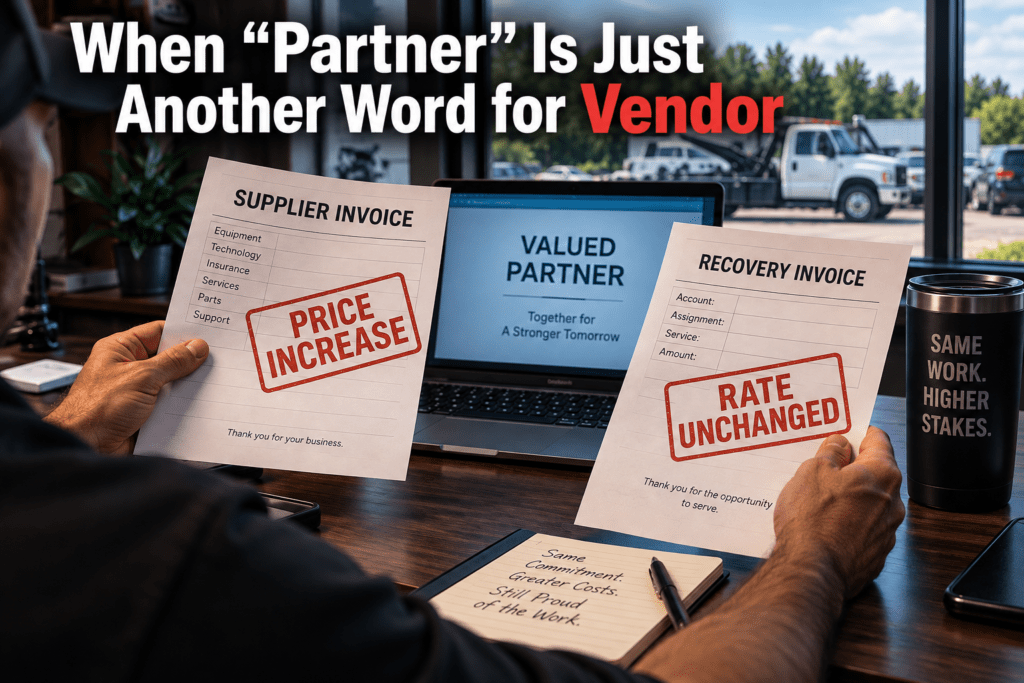
The Other Side of the Invoice
There is another useful way to look at the contradiction. Recovery agencies are not only service providers, they are customers too.
They purchase nearly everything necessary to operate their businesses from companies that adjust their pricing when economic conditions require it.
That is generally accepted as an ordinary fact of business. The agency may not like an increase, but it understands the principle behind it.
Costs changed, therefore, prices changed.
The recovery agency operates in that market when it is paying an invoice. But when it is sending one, the economic rules can look very different.
Its own increased costs may become a negotiation rather than an accepted fact of business.
That leaves the recovery agency caught between two pricing environments: one in which it must absorb market increases and another in which its ability to pass those increases forward may be extremely limited.
Over time, something has to give and it that point in time has come and gone long ago.
So, What Would Partnership Actually Look Like?
It doesn’t require lenders, forwarders and recovery agencies to disclose every dollar they make. It doesn’t require everyone to earn the same margin.
It doesn’t require lenders to surrender control over their portfolios. It doesn’t require the elimination of forwarders.
And it certainly doesn’t mean recovery agencies should be protected from competition.
It means recognizing that every participant must remain economically healthy enough to perform its role.
It means greater transparency about who is performing which functions and who is being compensated for them.
It means understanding the actual cost created when new requirements are imposed.
It means periodically examining compensation instead of allowing rates established years ago to become permanent simply through inertia.
It means distinguishing between companies based upon performance, compliance, professionalism and capability rather than reducing everything to price.
And perhaps most importantly, it means being willing to discuss another participant’s economics even when the contract doesn’t require you to care about them.
Everybody Is a Partner Until the Invoice Arrives
The repossession industry doesn’t suffer from a shortage of partnerships. At least not according to our vocabulary. It’s built an entire industry of “partners.”
But partnership cannot simply describe the relationship when everyone is standing together at a conference, sitting on a panel or talking about industry cooperation.
The word has to survive the invoice.
It has to survive the fee negotiation.
It has to survive the new requirement.
It has to survive the unsuccessful assignment.
And most importantly, it has to survive the moment when one participant finally says: “I cannot continue doing this at this price.”
That is when you find out whether you actually have a partner or just a client or vendor who is only calling themselves one.
So, as the AFA and ARA seek to lean into their industry “partners” for help in solving the industries long-festering and boiling over financial sustainability problems, let’s hope that they prove themselves worthy of the title.
And for those who choose not to participate in solving these problems, please quit calling yourself “partners” until it is earned.
When “Partner” Is Just Another Word for Vendor – When “Partner” Is Just Another Word for Vendor – When “Partner” Is Just Another Word for Vendor
Kevin Armstrong
Publisher
When “Partner” Is Just Another Word for Vendor – Compliance – Forwarder – Fuel Costs – Gas Prices – Repossess – Repossession – Repossession Agency – Repossessor – Repossession – Repossession News – Lending – Auto Loan





More Stories
Why Fight LPR? Join It — But What Happens When the Car Repossesses Itself?
In The Future Will There Be Anyone Left to Recover Vehicles?
The Broken Bond Between Lenders and Agents – Positive Resolution
The Repos That May Never Come
A Repossession Is a Repossession
Welcome to the Repossession Casino — But Who Is Really Paying the Losing Bets?