

From a New Mexico Walmart parking lot to a California federal courtroom, the question of who controls access to collateral is more complicated than a sign.
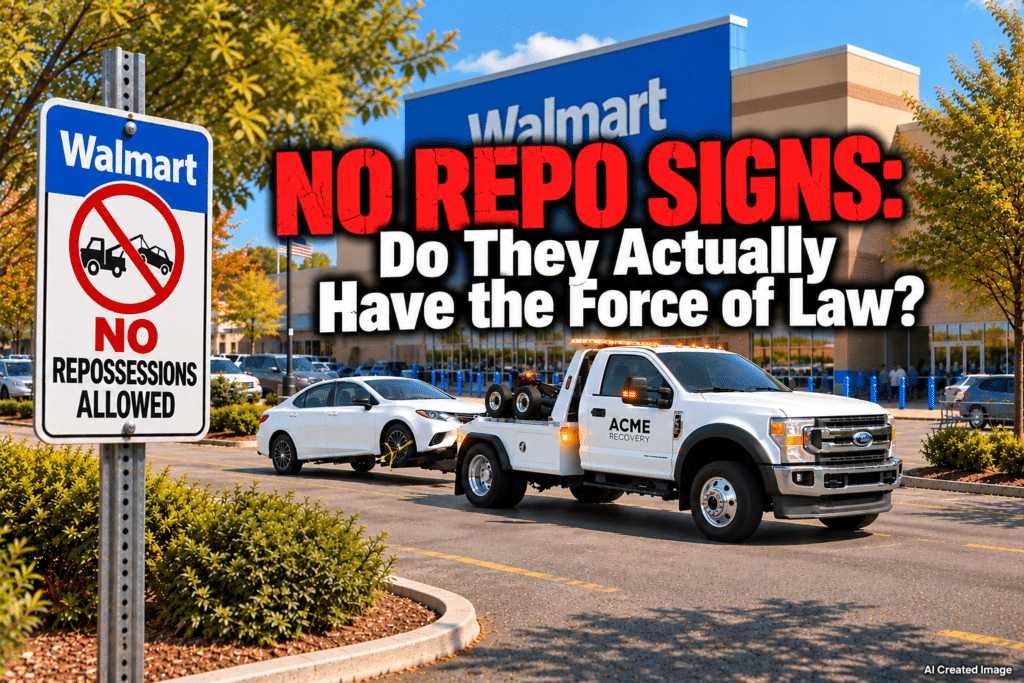
Gallup, NM – October 8, 2026 – A recent Facebook post from a Gallup-area resident has raised an interesting question for the repossession industry: Can a retailer prohibit vehicle repossessions on its property simply by posting a sign, and what happens when repossession agents disregard it?
The October 7 post, published in the Chinle Online Yard Sale Facebook group, alleged that a repossession truck was operating in a Walmart parking lot in Gallup, New Mexico, despite signs reportedly prohibiting repossession activity.
“Repo truck at Walmart and it is Allowed even though signs are posted,” the author wrote, adding that police could not do anything about it.
Several commenters claimed that Walmart had posted “No Repo” signs, while others questioned why those restrictions were apparently not being enforced.
The incident itself has not been independently verified. There is no confirmation that Walmart management authorized or prohibited the truck’s presence, that police responded, or that a vehicle was actually repossessed.
But the discussion raises a legitimate question that extends far beyond one Walmart parking lot.
Does a property owner’s right to exclude repossession agents override a secured creditor’s right to recover collateral?

A California Case Put the Signs to the Test
The issue is not entirely hypothetical.
In the federal case Brooks v. Leon’s Quality Adjusters, Inc., decided in 2016, a vehicle repossession became the subject of litigation involving signs specifically restricting repossession activity.
The property involved reportedly displayed several warnings, including “No Repo Vehicles,” “No Trespassing,” “Private Property,” and instructions to check with a guard before entering the plant.
The plaintiff argued that the repossession agents’ entry onto the property despite those restrictions constituted trespass and a breach of the peace.
The court examined the physical circumstances surrounding the repossession, including the placement and visibility of the signs, the accessibility of the parking lot, and whether the agents had entered a restricted area.
One important consideration was that the parking lot could be accessed without passing through the facility’s guard shack. The court also questioned whether the signs were sufficiently visible to provide adequate notice of the restrictions.
Ultimately, the court granted summary judgment in favor of Leon’s Quality Adjusters on the claims before it.
The ruling did not establish that repossession agents may universally disregard “No Repo” signs. Rather, it demonstrated that the existence of a sign does not necessarily resolve whether a particular repossession was unlawful.
The circumstances of entry, the nature of the property, and the applicable law all remain relevant.
The Creditor’s Right Versus the Property Owner’s Right
Under Uniform Commercial Code § 9-609, adopted in some form throughout the United States, a secured creditor generally may take possession of collateral following default through judicial process or without judicial process if the repossession can be accomplished without a breach of the peace.
However, that authority is not an unlimited right of entry.
A creditor’s security interest in a vehicle does not automatically confer ownership or control over property belonging to an unrelated third party.
A shopping center, restaurant, workplace, or privately owned parking facility may have its own property rights and access restrictions. Whether those restrictions can be enforced against a repossession agent depends on the circumstances and applicable state law.
A parking lot open to customers presents different questions from a gated industrial facility, secured employee parking area, or private residential driveway.
Likewise, a posted restriction may have different legal implications depending on whether the agent has received actual notice, whether management has expressly directed the agent to leave, and whether the agent’s conduct creates a confrontation.
A sign may be part of the legal analysis, but it is not necessarily the entire analysis.
Municipal Towing Laws Add Another Layer
Local governments also regulate the removal of vehicles from private property, although those regulations frequently distinguish ordinary towing from creditor-directed repossessions.
In Ogden, Utah, municipal rules governing unauthorized vehicle removal contain an exception for agents conducting lawful repossessions.
Fairfax County, Virginia, similarly distinguishes repossession activity from certain private-property towing requirements.
These provisions are important because a vehicle being removed for violating parking restrictions is not necessarily subject to the same rules as a vehicle being recovered under a lender’s security agreement.
A property owner’s authorization to remove an illegally parked vehicle and a secured creditor’s authority to recover collateral arise from different legal relationships.
Consequently, a municipal ordinance requiring parking signs or property-owner authorization for nonconsensual towing should not automatically be interpreted as applying to lender repossessions.
Nor should an exemption from towing regulations be interpreted as permission to disregard trespass laws or property-owner restrictions.
What About the Police?
The Gallup Facebook post also alleged that police could do nothing about the repossession truck’s presence. That assertion remains unverified, but it introduces another important distinction.
Law enforcement officers generally do not determine the validity of a lender’s security interest or adjudicate civil repossession disputes at the scene.
However, a disagreement over collateral recovery can involve separate questions concerning trespass, threats, disorderly conduct, property damage, or other potential violations of law.
Whether officers have authority to intervene depends on the facts, the applicable statutes, and the conduct involved.
A property owner’s objection to a repossession agent’s presence may create a different situation from a borrower objecting to the repossession of a vehicle parked on someone else’s property.
And an officer declining to intervene in a particular incident does not necessarily establish that the underlying conduct was lawful.
A Sign Is Not a Court Order, but Neither Is It Meaningless
For repossession agencies, the practical problem is that posted restrictions may appear straightforward while the law behind them is anything but.
A sign reading “No Repossessions” communicates an apparent property-owner restriction. Whether that restriction is enforceable, against whom, and under what circumstances may require a much more detailed legal analysis.
The California litigation illustrates how seemingly minor facts can become central to a dispute: Where was the sign? Could the driver see it? Was the parking lot open to the public? Was access controlled? Did the property owner expressly object?
Those questions can become significant long after the vehicle has been recovered.
And while a lender may have a contractual right to possession of collateral, that right does not necessarily settle disputes involving a third-party property owner’s rights.
The Question Remains in Gallup
Whether the reported Walmart signs in Gallup are enforceable, or whether they were disregarded at all, remains unresolved.
The Facebook discussion does not establish that a repossession occurred unlawfully, that Walmart consented to the activity, or that police declined to enforce a valid restriction.
Nevertheless, the controversy illustrates a recurring tension between secured creditors, repossession agencies, commercial property owners, and consumers.
A repossession agent may have a lawful assignment. A retailer may have a posted prohibition. And a borrower may be in default.
None of those facts, standing alone, necessarily resolves the others.
The question isn’t simply whether a repossession agent can read a sign. It’s whether the sign has legal authority over the recovery, and who ultimately has the right to enforce it.
Legal Disclaimer
This article is provided for general news reporting, industry discussion, and educational purposes only. It is not legal advice, does not constitute a legal opinion, and should not be relied upon as guidance for conducting or preventing a repossession. Laws governing repossession, trespass, private-property access, breach of the peace, and municipal towing regulations vary by jurisdiction and may depend on facts not addressed here. Court decisions discussed in this article are fact-specific and should not be interpreted as establishing a universal rule. Repossession agencies, lenders, property owners, and other interested parties should consult qualified legal counsel familiar with the laws of the applicable jurisdiction before making operational or legal decisions.
NO REPO SIGNS: Do They Actually Have the Force of Law? – NO REPO SIGNS: Do They Actually Have the Force of Law? – NO REPO SIGNS: Do They Actually Have the Force of Law?
NO REPO SIGNS: Do They Actually Have the Force of Law? – Repossess – Repossession – Repossession Agency – Repossessor – Repossession – Repossession News – Police – Police – Compliance – Lawsuit – Lawsuit





More Stories
Colorado-Bonded Repossessor Named in $2.5 Million Vehicle Theft and Towing Investigation
Dallas BHPH Dealer Accused of $207K in Illegal Repossessions and Hammer Assault
CFPB Gives Lenders a Lighter Touch. What About the Repo Agents?
NY Repo Agent Allegedly Beaten and Put in Chokehold
Two New LPR Bills in Congress, One Question for Repossession
Bail Collateral Repo Turns Into 100-MPH Fugitive Chase