


Copart May Disagree. Lenders Should Ask Whether the Law Does.
EDITORIAL
There is a persistent disagreement developing over something that, on its face, should be fairly simple: What is a repossession? Copart has taken issue with the characterization of certain voluntary and impound recoveries as repossessions. That disagreement deserves attention because Copart is no longer simply standing at the end of the collateral-recovery process as the auction where a lender sends a vehicle after it has been repossessed.
Through voluntary and impound recoveries, Copart has moved farther upstream into the recovery process itself.
And that creates a question that lenders should be asking before assigning another vehicle:
If a borrower is in default, the lender retains its security interest, and a third party takes possession of that collateral for the lender pursuant to the lender’s rights under the security agreement, what exactly makes that something other than a repossession?
Calling it a pickup doesn’t answer the question.
Calling it transportation doesn’t answer it.
Calling it an impound recovery doesn’t answer it.
And having the borrower hand over the keys voluntarily doesn’t necessarily answer it either.
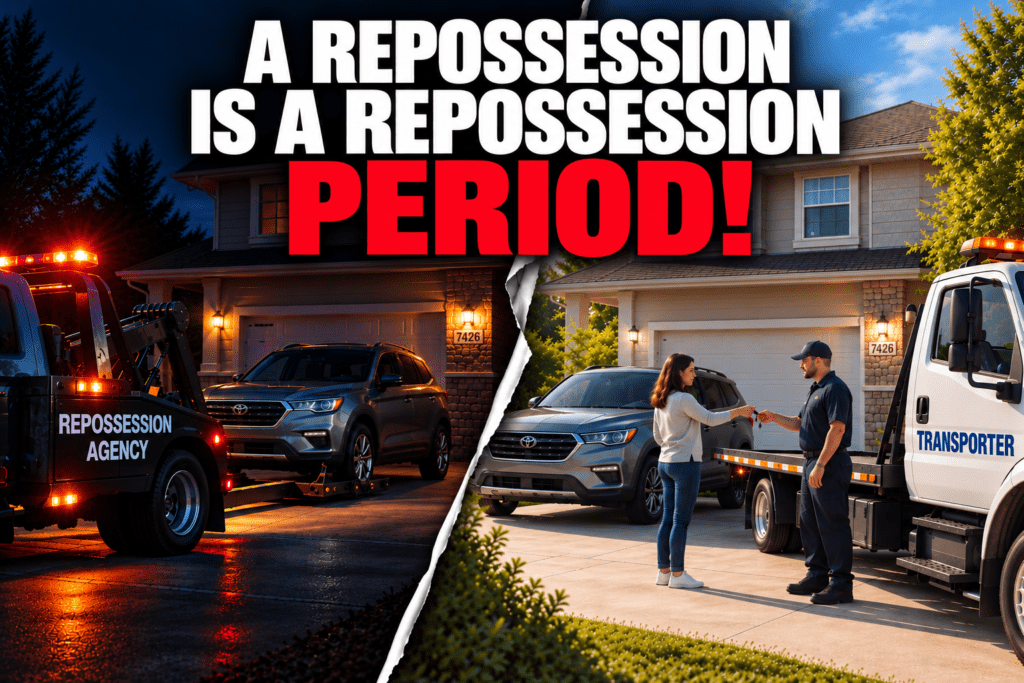
A repossession is a repossession.
The law, not the terminology on the assignment, ultimately determines what occurred.
Voluntary Doesn’t Mean Rights-Free
A borrower cooperating with the lender may make the repossession safer, easier and less expensive. It does not necessarily change the underlying secured transaction.
That distinction is important enough that Copart’s own public material uses the term “voluntary repossession.” That terminology says quite a bit.
The repossession industry has spent decades encouraging borrowers to cooperate with recoveries. The alternative proposition, that cooperation somehow converts repossession into a completely different legal transaction, would create a strange incentive.
A borrower who peacefully turns over the keys should not receive fewer statutory protections merely because he didn’t force a recovery agent to locate and hook the vehicle.
What About an Impound?
This is where the issue becomes even more important.
Consider a common scenario.
A borrower defaults. Separately, the vehicle ends up in a police impound, tow yard or storage facility.
The lender still holds its security interest.
The borrower still has an ownership interest subject to that lien.
The lender pays the towing and storage charges and assigns a vendor to obtain release of the vehicle.
The vendor presents the lender’s documents, obtains custody of the vehicle and transports it to another location where the lender controls what happens next.
What just occurred?
The original tow was not necessarily a repossession. The vehicle may have been towed because of an accident, arrest, abandonment, parking violation or any number of unrelated reasons.
But the subsequent act of obtaining the collateral for the secured creditor is a different transaction.
The lender is not obtaining possession because it owns a towing company. It is not obtaining possession because it happened to find an abandoned automobile. It is exercising rights arising from its security interest.
California law provides an especially interesting example.
When certain impounded vehicles are released to a bank, credit union, acceptance corporation or other lienholder, California Vehicle Code §23118 allows the lender’s agent to use an assignment together with a certificate of repossession, security agreement or title. The person possessing the vehicle may also require the lender’s agent to produce its repossession-agency license or registration, or demonstrate that it qualifies for an exemption.
California’s own Bureau of Security and Investigative Services describes a repossession agency as a business contracting with a legal owner to “locate or recover” property sold under a security agreement.
That raises a fairly obvious question:
If retrieving collateral from an impound for a secured creditor is categorically not repossession, why does California law specifically contemplate a repossession assignment, certificate of repossession and repossession license in connection with the release of impounded collateral to a lender or its agent?
Start With the Security Interest
Strip away Copart, the tow truck, the impound yard and the auction for a moment. Why does the lender have the right to take the vehicle in the first place?
Because the borrower granted the creditor a security interest in the vehicle as collateral for the debt.
Article 9 of the Uniform Commercial Code provides the basic framework. Following default, a secured creditor may take possession of its collateral without judicial process so long as it can do so without breaching the peace.
That framework does not say the collateral must be sitting in the borrower’s driveway.
In fact, the UCC specifically contemplates circumstances in which a debtor assembles collateral and makes it available to the creditor.
Voluntary cooperation does not necessarily transform the underlying exercise of the creditor’s secured rights into something else.
Federal and state courts have reached the same conclusion in the context of voluntary surrender: cooperation in returning collateral does not simply erase the debtor’s Article 9 protections afterward.
That is important because Copart itself publicly markets auctions involving both repossessed vehicles and voluntary repossessions. Its website explains that a borrower unable to make payments can willingly surrender the vehicle to the financing institution, after which the lender may run the vehicle through an auction such as Copart.
The borrower may be cooperating. The borrower may hand over the keys. There may be no confrontation. There may never be a recovery truck in the driveway.
None of those facts necessarily change why the lender is obtaining possession of the vehicle.
Illinois Draws an Even Sharper Line
Illinois may provide an even better illustration of why lenders should not assume that being an auction or towing company answers the question.
The Illinois Collateral Recovery Act generally makes it unlawful for an unlicensed person or entity to repossess or attempt to repossess collateral.
But the legislature also created specific exemptions.
A towing company can participate when an employee or agent of the creditor financial institution is present at the location from which the vehicle is towed.
A salvage auction and towing company acting for a salvage auction have exemptions.
A licensed vehicle auctioneer can sell vehicles repossessed under the Act.
But Illinois specifically qualifies that auction exemption when the auctioneer or its employee directly performs repossessions.
And a forwarder can remain outside the recovery function when it forwards the actual repossession assignment to a licensed repossession agency rather than directly performing the repossession.
That statutory structure is difficult to ignore.
Illinois recognizes towing. It recognizes auctions. It recognizes forwarding. And it separately recognizes repossession.
Simply being authorized to perform one of those functions does not necessarily authorize a company to perform all of them.
Then Come the Borrower’s Rights
This may be the most important issue for lenders. The question is bigger than whether the person picking up the vehicle possesses the correct license.
What happens to the borrower’s rights? Repossession does not normally mean that every interest the borrower has in the vehicle instantly disappears.
Article 9 contains an entire framework governing what happens after the secured creditor obtains possession: notification, redemption, disposition, commercially reasonable sale, application of proceeds, surplus and deficiency.
The CFPB similarly tells consumers that they retain specific rights and protections following repossession and emphasizes that auto servicers must ensure repossessions are lawful.
So consider the complete transaction:
Default → impound → lender assignment → vendor obtains possession → lender controls collateral → auction → proceeds applied against the loan → deficiency or surplus.
If that is what happened, at what point did Article 9 stop applying?
Did the borrower’s rights disappear when the police towed the car?
When the lender paid the storage bill?
When Copart received the assignment?
When someone called the assignment an “impound pickup”?
Or when the vehicle entered an auction yard?
Those are questions lender compliance departments should be able to answer. Because changing the name of the recovery should not be assumed to change the consumer’s statutory rights.
Who Is Responsible? The CFPB Has Already Answered That Question.
Lenders should pay particularly close attention here.
The Consumer Financial Protection Bureau has been explicit that loan holders and servicers are responsible for ensuring that their repossession practices and the practices of their service providers comply with the law.
The Bureau has stated: “Loan holders and servicers are responsible for ensuring that their repossession-related practices, and the practices of their service providers, do not violate the law.”
And it has said it intends to hold lenders and servicers accountable for unfair, deceptive or abusive practices involving repossessions.
That eliminates one comforting assumption.
Outsourcing the recovery does not necessarily outsource the compliance exposure.
Whether the vendor is a traditional repossession agency, forwarder, towing company, auction company or billion-dollar publicly traded corporation doesn’t change that principle.
The lender selected the vendor and the lender issued the assignment. And the lender ultimately needs to know whether the vendor is legally qualified to perform what it has been asked to perform.
Then There Is Insurance
This raises another question lenders should be asking Copart and any other nontraditional provider entering the recovery space.
What insurance actually covers the recovery?
Repossession creates exposures that ordinary transportation and auction operations may not address in the same way.
Traditional professional repossession insurance can contemplate wrongful repossession claims, garagekeepers liability, on-hook exposure, drive-away operations, property damage and other risks arising from taking possession of collateral for a creditor.
Some states make these distinctions more than theoretical.
Illinois regulates collateral recovery as its own business and maintains specific insurance requirements within that regulatory system. The Illinois Commerce Commission administers repossession licensing and specifically maintains collateral-recovery insurance certification requirements.
The question for lenders therefore shouldn’t simply be: “Does Copart have insurance?”
Of course a corporation of Copart’s size carries insurance. The question should be: Does the applicable coverage insure the specific act being performed when Copart obtains possession of collateral pursuant to a lender’s security interest, and does it cover the liabilities that can arise from a repossession?
Those are two very different questions.
And What About Personal Property?
There is another element of repossession that lenders sometimes learn about only after something goes wrong.
Personal property.
Vehicles don’t arrive empty. They contain wallets, paperwork, tools, medications, children’s belongings, electronics, work equipment, license plates and countless other items belonging to consumers.
Repossession agencies have developed procedures around inventorying, safeguarding, documenting and returning personal property because mishandling it creates real liability.
Illinois, for example, expressly recognizes the storage and inventory of personal property recovered with repossessed collateral as part of its collateral-recovery regulatory framework.
That creates another basic due-diligence question for lenders assigning voluntary or impound recoveries outside the traditional recovery channel: What happens to the borrower’s property?
Who inventories it?
Who photographs it?
Who seals it?
Where is it stored?
Who has access to it?
How is the borrower notified?
How is identity verified before release?
How long is the property retained?
What happens when the consumer claims cash, jewelry, tools or other property disappeared?
And most importantly: Whose insurance responds when that claim arrives?
These aren’t theoretical repo industry traditions. They certainly exist because repossession involves taking custody of property that belongs partly to a secured creditor and may contain other property that unquestionably does not.
Buying a Repo Company Wouldn’t Make the Question Go Away
Copart could eventually decide that the easiest way into heavily regulated states is to acquire or establish licensed repossession agencies. That is certainly possible.
But doing so would carry its own implications.
Qualified managers may be required.
Individual recovery personnel may need licenses or registrations.
Branches and storage locations may require additional approvals.
Repossession-specific insurance requirements may apply.
Personal-property procedures would need to comply with applicable law.
Consumer notices and documentation would remain relevant.
And perhaps most significantly, operating through a licensed repossession agency would effectively acknowledge the very premise currently in dispute: The activity being performed is repossession. Changing the corporate entity performing the work doesn’t change the underlying act.
This Isn’t About Protecting Turf
There will undoubtedly be people who characterize objections to Copart’s entry into voluntary and impound recovery as traditional repossession agencies trying to protect their territory.
That misses the larger issue; competition is competition.
If Copart wants to enter the repossession industry, it has the financial resources, technology and infrastructure to become a formidable participant. But entering the industry should mean entering the industry as it actually exists.
That means licensing where required.
Qualified and properly registered personnel where required.
Appropriate insurance.
Consumer-property controls.
Compliance procedures.
Documentation.
Training.
And recognition of the debtor protections that accompany the enforcement of a security interest.
The concern isn’t that Copart is too large to compete with repossession agencies. The concern is whether a company can perform substantially the same function without being held to substantially the same rules.
Lenders, Ask the Question Before Someone Else Does
There is one question every lender using a nontraditional provider for voluntary or impound recoveries should put in front of its compliance department: If our borrower is in default, we still hold the security interest, and we direct a third party to obtain possession of our collateral pursuant to rights created by our security agreement, what legal authority makes that transaction something other than a repossession?
Then ask the harder question: If it isn’t a repossession, exactly what happened to the borrower’s rights that would have existed had we sent a licensed repossession agency instead?
Those aren’t questions for procurement. They aren’t questions for the remarketing department. They are questions for legal and compliance.
Because the CFPB has already made something else very clear: lenders remain responsible for the repossession practices of the service providers they choose.
The name on the truck doesn’t change that. The name on the assignment shouldn’t be assumed to change it either. Neither should the address where the collateral happened to be sitting when the lender exercised its right to take possession.
A voluntary repossession is still a repossession.
An impound lot does not magically extinguish a security agreement.
Transportation can occur after possession without transforming the act of obtaining possession into transportation.
And an auction company moving upstream into collateral recovery shouldn’t be presumed exempt from the laws, insurance requirements, consumer protections and responsibilities that have governed professional repossession agencies for decades.
Copart may disagree but; Lenders should make very certain the law agrees with them before relying on that disagreement.
A repossession is a repossession. PERIOD!
Kevin Armstrong
Publisher
A Repossession Is a Repossession – A Repossession Is a Repossession – A Repossession Is a Repossession
Related:
Copart’s Growing Grip on the Repo Pipeline
FALR Calls for Investigation into COPART of Florida for Unlicensed Repossession Activity
Copart Follow Up – ARA Names Lender
Like a Butcher with a Scalpel – CoPart in Repossessions
Update from the ARA and CoPart Meeting
OneMain Financial & Impounds Follow-Up
CALR Condemns Illegal Repossession Practices
AIR Condemns Unethical and Illegal Repossession Practices by Lenders
ARA’s Stand Against Backdoor Practices
Lenders: A Repossession is a Repossession – Ignore This at Your Own Peril
A Repossession Is a Repossession – Repossess – Repossession – Repossession Agency – Repossessor – Repossession – Repossession News – Transport – Transport – Auction – Auction – Auto Loan – Lending – Compliance





More Stories
Why Fight LPR? Join It — But What Happens When the Car Repossesses Itself?
In The Future Will There Be Anyone Left to Recover Vehicles?
The Broken Bond Between Lenders and Agents – Positive Resolution
The Repos That May Never Come
When “Partner” Is Just Another Word for Vendor
Welcome to the Repossession Casino — But Who Is Really Paying the Losing Bets?