


The BHPH Repo Gap: Federal Reserve Data Shows a Different Recovery Market
Federal Reserve Data Exposes the Other Repossession Industry
When most people think about the repossession industry, they picture assignments flowing from banks, credit unions and national auto finance companies through established forwarding networks to professional recovery agencies.
But new Federal Reserve research suggests there is another repossession industry operating alongside it, one that is larger, more active and often far less visible.
According to a recent Federal Reserve analysis of third-quarter 2025 auto finance performance, approximately 5% of outstanding buy-here-pay-here (BHPH) loan balances were already in active repossession status, compared with less than one-half of one percent for traditional auto lenders.
In other words, BHPH loans were 16.63 times more likely to be in active repossession than conventional auto loans.
Those numbers do more than highlight elevated credit risk.
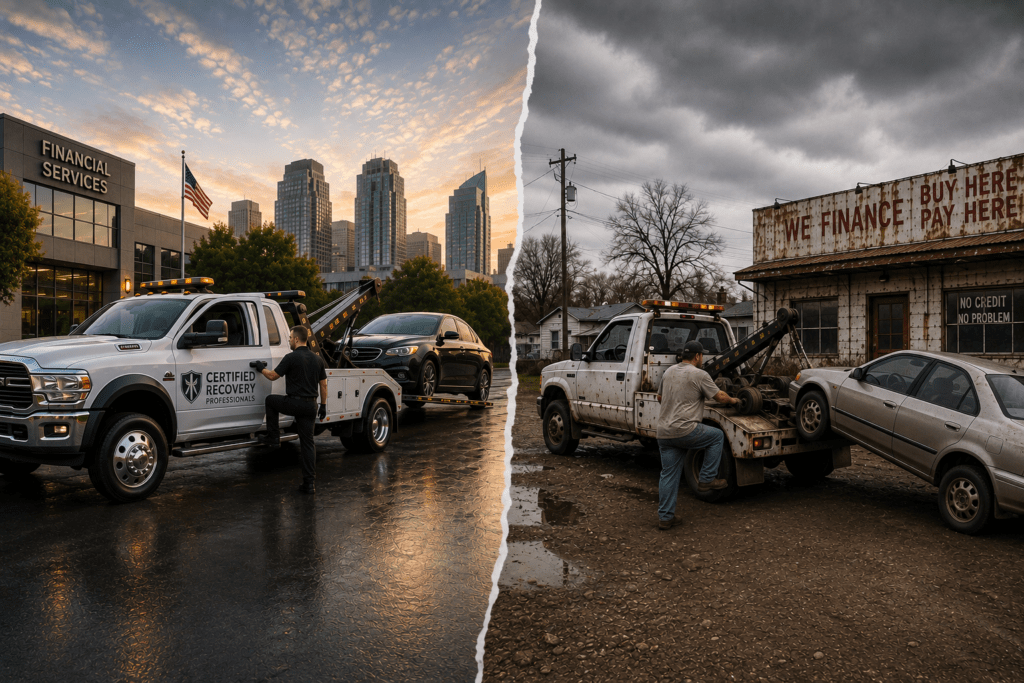
They reveal the existence of a parallel recovery market that operates very differently from the institutional lending world.
The Other Repossession Industry
There are hundreds of professional repossession agencies in the national repossession associations and hundreds more not members of any association with many that do not work for the BHPH dealer industry. But there are clearly hundreds more who are not part of any forwarder or assignment network and operate solely in it.

Traditional banks, credit unions and major finance companies typically rely on structured servicing operations supported by compliance departments, legal counsel, vendor management programs, audit functions and increasingly sophisticated technology.
Repossession assignments often pass through national forwarding companies before reaching certified recovery agencies that operate under detailed client requirements.
The buy-here-pay-here market frequently looks very different.
Many independent dealers originate the loan, collect the payments, manage delinquencies, decide when to repossess the vehicle and arrange the recovery themselves. Recoveries may be performed by local repossession companies, towing operators, dealership employees or long-standing regional contractors.
The result is a recovery ecosystem that often operates outside the institutional channels most lenders monitor.
Federal Reserve Data Exposes the Other Repossession Industry
A Less Visible Recovery Market
That distinction helps explain why many repossession-related incidents never receive national attention.
Across the country, recoveries performed for small dealers are frequently reported simply as “tow truck” incidents, even when they involve repossessions. In many markets, the same towing companies that perform accident recovery and private-property towing also conduct repossessions for independent dealerships.
Because these assignments rarely flow through national lender networks, they can remain largely invisible in broader discussions about repossession volume and industry trends.
The Federal Reserve’s findings suggest that hidden segment may be considerably larger than many have assumed.
Different Structure, Different Risks
The Federal Reserve study does not suggest that buy-here-pay-here operators are inherently less compliant than traditional lenders. It does, however, highlight a business model with fewer institutional layers between the lending decision and the repossession.
Large financial institutions generally employ dedicated compliance officers, legal departments, military-status screening procedures, consumer complaint teams and vendor oversight programs.
Many smaller dealer-finance operations simply do not have the same organizational structure. Likewise, as demonstrated by large national subprime auto dealer and ABS issuer Car Mart’s recent investor statement, neither do they.
That difference can create greater variation in recovery practices from one operation to another.
Recent enforcement actions illustrate the point.
Earlier this year, the U.S. Department of Justice alleged that an auto dealership violated the Servicemembers Civil Relief Act by repossessing a deployed servicemember’s vehicle after receiving her military orders, underscoring the importance of treating military documentation as an immediate stop signal rather than simply another item in a customer file.
In another recent case covered by CURepossession, North Carolina authorities charged the owner of a towing company after investigators alleged a repossession continued while occupants remained inside the vehicle, a case that drew national attention and highlighted the serious legal and operational risks that can arise when recovery procedures break down.
These incidents should not be viewed as representative of the entire buy-here-pay-here industry. Instead, they illustrate how decentralized recovery operations can produce inconsistent practices when compared with larger institutional finance companies.
Why It Matters
For recovery agencies, the Federal Reserve data provides an important reminder that the repossession industry extends far beyond the portfolios of banks and credit unions.
A significant amount of recovery activity is occurring in local dealer-finance operations that receive relatively little attention despite experiencing repossessions at dramatically higher rates.
For lenders, the findings underscore how different the buy-here-pay-here business model truly is.
And for regulators and industry leaders, the research raises a broader question: How much of America’s repossession activity is taking place in a recovery market that remains largely outside the visibility of the institutional lending community and regulators?
Federal Reserve Data Exposes the Other Repossession Industry
Beyond the Numbers
The Federal Reserve data does more than quantify repossession frequency.
It exposes the existence of a parallel repossession economy, one built around independent dealerships, local finance companies, towing operators and regional recovery contractors that rarely appear in national industry conversations.
Understanding that distinction is important.
Because if buy-here-pay-here portfolios are entering active repossession at more than sixteen times the rate of traditional auto lenders, then a substantial portion of America’s recovery industry may be operating quietly in plain sight.
Even measuring the size of the repossession industry remains surprisingly difficult. Federal labor statistics identify hundreds of employer establishments classified as repossession services, while Recovery Database Network (RDN) reported at year end 2024 more than 1,200 active recovery vendors performing at least ten repossessions per month. The figures are not directly comparable, they measure different parts of the industry, but together they illustrate a recovery marketplace that extends well beyond any single dataset.
The Federal Reserve’s findings suggest the “other repossession industry” may be larger than many lenders realize. If buy-here-pay-here portfolios experience active repossessions at more than sixteen times the rate of traditional lenders, and if much of that work is handled by local dealers, towing companies and independent operators, then a significant portion of America’s recovery activity may be occurring outside the institutional channels that typically dominate industry discussion.
Federal Reserve Data Exposes the Other Repossession Industry – Federal Reserve Data Exposes the Other Repossession Industry – Federal Reserve Data Exposes the Other Repossession Industry
Kevin Armstrong
Publisher
Federal Reserve Data Exposes the Other Repossession Industry – Repossess – Repossession – Repossession Agency – Repossessor – Repossession – Repossession News – Subprime Auto Loans – Subprime Auto Loans – Auto Loan – Lending






More Stories
Mall Security Claims Repo Companies are Accessing Their LPR Data
Repo Yard Ram Raid
Hooked, Lifted, and Still Not Yours: Federal Court Rules Against Georgia Repossessor
LPR Helps Rescue Child from Alleged Human Trafficker
Myles Weiss: Remembering a Man Who Helped Build the Repossession Industry
Five Charged in $3 Million Houston Luxury Vehicle Theft and Export Scheme