

The $694 Million Credit Acceptance Settlement May Not Hurt Recovery Volumes Today. The Chilling Effect Could Show Up in 2027 and 2028.
September 18, 2026 – There are repossession assignments sitting in loan portfolios today that haven’t become repossessions yet. The borrower is still paying, maybe they’re thirty days late and maybe they haven’t missed their first payment and maybe the loan was just originated yesterday. Some of those accounts will perform perfectly.
Others will eventually become the assignments that keep recovery trucks moving, employees working and agency lots full.
That is why the $694 million nationwide settlement announced September 17 with Credit Acceptance Corporation should get the repossession industry’s attention for reasons extending far beyond the extraordinary amount of debt being forgiven.
The biggest effect may be something we don’t see for another year or two.
Fewer loans.
Fewer defaults.
And eventually, fewer repossessions.
$388 Million Already Went Through Repossession
Repossession isn’t a footnote in the Credit Acceptance settlement. It’s sitting right in the middle of it.
Of the $694 million in consumer restitution and debt relief announced by a coalition of 40 state attorneys general, $388 million in debt relief is specifically designated for consumers whose vehicles have already been repossessed.
Another $246 million will provide debt relief to qualifying borrowers whose vehicles have not been repossessed, allowing them to keep their cars. Another $60 million will be distributed as restitution to consumers with particularly risky loans.
According to the California Attorney General, the settlement covers certain risky loans made between November 1, 2015, and November 30, 2025.
That $388 million tells the recovery industry something about the scale of what has already happened.
But it doesn’t tell us what happens next.
Credit Acceptance Is a Very Big Faucet
To understand the potential downstream effect, look at the number of loans flowing through Credit Acceptance.
According to the company’s 2025 annual report, CAC received:
332,499 consumer loan assignments in 2023.
386,126 in 2024.
337,411 in 2025.
That’s 1,056,036 loans in three years.
Those aren’t repossession numbers. We shouldn’t pretend they are.
A loan assignment today doesn’t equal a repossession tomorrow, and Credit Acceptance does not publicly report a simple annual number allowing us to say exactly how many of those accounts eventually generate recovery assignments.
But the states have given us another piece of the puzzle.
New York has alleged that nearly half of Credit Acceptance consumers ultimately experienced repossession during their loans.
Even without attempting to extrapolate that allegation across every CAC vintage or every state, it establishes the obvious: Credit Acceptance is an enormous source of potential repossession volume.
And those loans don’t all default immediately.
Repossession Is a Lagging Indicator
That’s the part recovery agencies need to understand.
If a lender tightens underwriting today, nobody necessarily notices it in the repo lot tomorrow morning. Yesterday’s loans are still there.
Last year’s loans are still there. The delinquency pipeline continues moving.
Credit Acceptance’s average initial loan term for 2025 assignments was approximately 60 months, according to the company’s annual report.
That means there is a substantial existing portfolio working its way through the credit cycle.
Some accounts will become delinquent.
Some will cure.
Some will default.
Some will eventually become repossession assignments.
So even a significant change in September 2026 originations wouldn’t necessarily create an obvious September 2026 repo-volume change.
The recovery industry’s workload today was largely created by lending decisions made yesterday.
Likewise, the industry’s workload tomorrow is being created by lending decisions being made today.
That’s why the important window may be 12 to 24 months from now.
What Happens to the Faucet?
The settlement imposes significant requirements involving some of CAC’s riskiest loans, vehicle pricing, dealer behavior, ancillary products and early loan failures.
For certain risky loans beginning with loans made in December 2025, consumers whose accounts fail within specified periods can receive substantial relief after repossession and sale. Qualifying consumers can have 95% of the remaining debt forgiven, and CAC cannot pursue collection lawsuits for the forgiven amount.
Credit Acceptance, importantly, says the settlement does not require material changes to its operations. That could prove correct.
But the repossession industry’s exposure isn’t limited to what CAC itself does.
The larger question is what the rest of subprime auto finance does after watching one of the industry’s largest players agree to a settlement approaching $700 million.
That’s where the chilling effect could begin.
Nobody Has to Order Lenders to Tighten
Imagine you’re running another subprime auto lender.
You weren’t sued. You aren’t covered by the settlement. But like CAC, your underwriting department also predicts losses.
Your company also has borrowers with extremely high probabilities of default. You also know some portion of your loans will eventually result in repossession.
And your lawyers just watched what happened to Credit Acceptance.
Nobody has to issue a regulation ordering you to stop making the riskiest loans. Your compliance department may do it for you.
Your board may ask questions. Your capital providers may ask questions. Your investors may ask questions. Your underwriting department may simply move the credit box a little.
Maybe the lender doesn’t abandon deep subprime.
Maybe it just takes the worst 5% of applicants out.
Or 10%.
Or 15%.
Across one lender, that may not sound enormous. Across an entire lending segment, it could become very large.
And every high-risk loan that isn’t originated today is one less account that can become a repossession assignment tomorrow.
The Math Gets Big Quickly
Credit Acceptance alone originated more than one million loans during 2023 through 2025.
We do not yet know how this settlement will affect future CAC loan volume or eventual repossession frequency. But consider the scale rather than trying to predict a number.
If changes in underwriting eventually reduced repo-producing accounts by only 10%, that’s meaningful.
Twenty percent becomes substantially more meaningful.
And if the response isn’t limited to Credit Acceptance, if competing deep-subprime lenders independently reduce exposure to their highest-risk applicants, the volume implications extend far beyond a single lender.
That is why recovery agencies shouldn’t interpret this as: “$694 million settlement against Credit Acceptance.”
They should also be asking: “How many future assignments just disappeared?”
We won’t know the answer for some time.
We Have Seen This Movie Before
Repossession volume doesn’t originate in the repossession industry; it originates in the finance office.
Recovery agencies can hire agents, they can buy trucks, they can install cameras and they can invest in LPR technology. They can improve compliance and cover more territory, but they cannot repossess a vehicle that was never financed.
That makes the recovery industry uniquely exposed to changes in credit availability.
When lenders expand the credit box, repossession companies eventually feel it.
When lenders contract it, they eventually feel that too. Just not immediately, there’s a lag. And that lag can make the change difficult to recognize until the assignments begin disappearing.
The Paradox for Recovery Agencies
There is another twist.
Tighter underwriting should theoretically create a healthier loan portfolio.
Better-qualified borrowers should default less frequently. Lower LTVs may reduce loss severity. More affordable payments may increase cure rates.
Those are desirable outcomes for lenders and borrowers but what’s good for portfolio performance isn’t necessarily good for repossession volume.
Recovery agencies occupy an unusual place in the credit ecosystem, their demand is created by failure.
Nobody in the repossession industry should hope consumers default simply to create assignments. But businesses still have payroll, insurance, trucks, fuel, technology and facilities that depend upon a certain amount of recovery volume existing.
And the industry is already struggling with another problem: the cost of performing each assignment. Now imagine simultaneously reducing the number of assignments available.
Higher operating costs plus lower volume is not a particularly attractive equation.
And Then There Is BHPH
There is one factor that could offset some of this. Borrowers rejected by traditional subprime lenders don’t necessarily stop buying cars. Some may move farther down the credit spectrum into Buy Here Pay Here.
The Federal Reserve reported in May that BHPH loans were 16.63 times more likely to be in active repossession status than traditional auto-finance loans, although that point-in-time measure should not be confused with the percentage of loans ultimately repossessed over their entire lives.
The Fed described repossession as one of the mechanisms BHPH dealers use to mitigate the considerably greater credit risk of their customers.
So tighter traditional subprime lending could potentially shift some recovery activity rather than eliminate it. But that doesn’t necessarily mean the same recovery agencies receive the work.
BHPH dealers frequently operate very differently from large national finance companies. Some handle recoveries internally. Some rely on local towing and recovery operators. Some use professional repossession agencies.
The assignment channels, fees, compliance requirements and geographic distribution can be entirely different.
So even if some lost traditional subprime volume resurfaces as BHPH repossession activity, the recovery industry shouldn’t assume it will flow through the same pipes.
Watch the Vintage, Not Tomorrow’s Assignment Count
That’s why I wouldn’t watch Credit Acceptance repo volume next month and conclude the settlement had little effect. I’d watch the loans being originated.
Credit Acceptance reported 337,411 consumer loan assignments in 2025, down from 386,126 in 2024.
Its filings also show just how closely the company monitors portfolio performance. CAC says it estimates an expected collection rate for each consumer loan when it is assigned and continually updates those forecasts as actual performance develops.
Those numbers now become worth watching quarter after quarter.
How many loans does CAC originate?
What happens to the borrower risk mix?
What happens to average loan amounts?
What happens to expected collection rates?
What happens to dealer participation?
And eventually: What happens to repossessions?
That’s where we’ll begin seeing whether September 17, 2026 was merely an enormous legal settlement or something much more consequential for the recovery industry.
The Repos That Aren’t There
The most dangerous volume decline is sometimes the one nobody notices beginning.
There is no cancellation notice. No lender sends an email saying: “We’re eliminating 20% of your future assignments beginning eighteen months from now.”
The loans simply aren’t made.
Months pass. The existing portfolio keeps producing assignments. Everything looks relatively normal.
Then the smaller origination vintages begin reaching the periods when defaults historically occur.
The flow starts slowing. One lender sends fewer accounts. Then another.
Nobody necessarily connects the missing assignments to an underwriting decision made a year earlier.
But the trucks, the lot, the payroll and the P&L certainly notices.
The Credit Acceptance settlement may or may not produce that result. CAC itself says the agreement does not require material changes to its operations, and it would be premature to predict a specific decline in its repossession volume.
But the size of this settlement gives every major subprime lender a reason to examine its highest-risk originations.
If those lenders collectively decide that some portion of yesterday’s acceptable risk is no longer worth tomorrow’s regulatory exposure, the repossession industry will eventually inherit the consequences.
Not as another regulation. Not as another compliance requirement. And not as another line item on a repossession assignment.
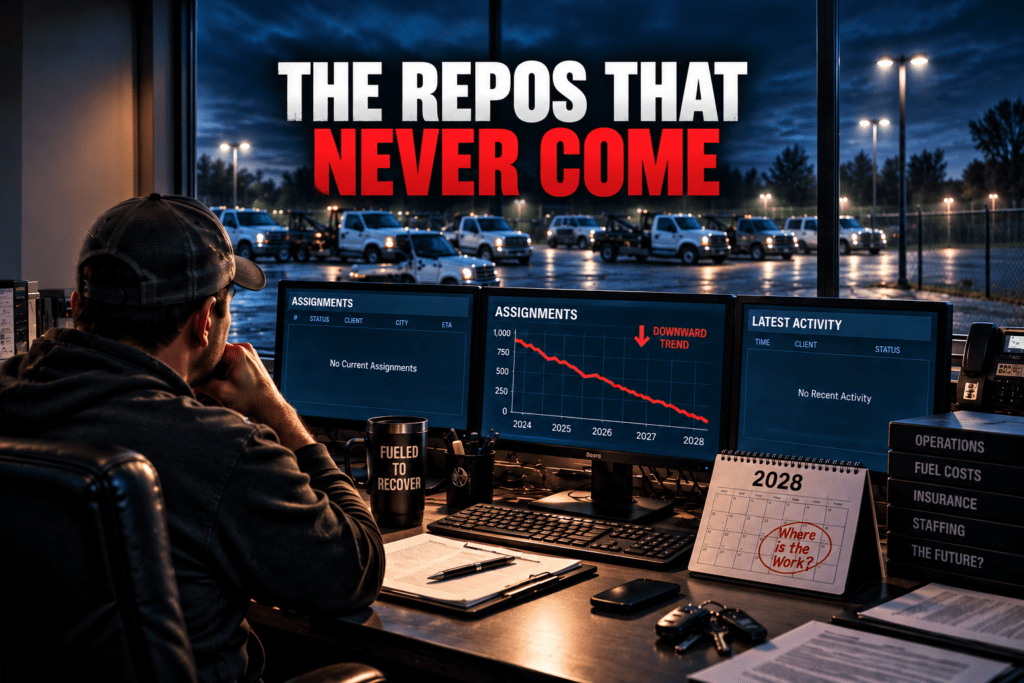
It will arrive much more quietly. As the repos that never come.
The Repos That May Never Come – The Repos That May Never Come – The Repos That May Never Come
The Repos That May Never Come – Subprime Auto Loans – Subprime Auto Loans – Repossess – Repossession – Repossession Agency – Repossessor – Repossession – Repossession News – Lawsuit – Lawsuit






More Stories
Why Fight LPR? Join It — But What Happens When the Car Repossesses Itself?
In The Future Will There Be Anyone Left to Recover Vehicles?
The Broken Bond Between Lenders and Agents – Positive Resolution
A Repossession Is a Repossession
When “Partner” Is Just Another Word for Vendor
Welcome to the Repossession Casino — But Who Is Really Paying the Losing Bets?