
Tow and Repossession May Be Converging, but Insurance Rules Draw a Line in Both Directions
EDITORIAL
Sometimes one story leads naturally into another. And then another.
Recently, we examined the growing movement of towing companies into professional repossession and asked whether the much larger towing industry could strengthen the repo industry or eventually absorb portions of it.
That conversation led us to turn the question around. If towing companies see opportunity in repossession, why shouldn’t professional repossession agencies look across the line at towing?
The argument for doing so can be compelling. Diversification could give recovery agencies additional customers, additional revenue streams and, perhaps most importantly, less dependence upon lenders and forwarders. An agency with somewhere else to put its trucks to work gains something the repossession industry has struggled to develop for decades: the ability to simply say no when the economics of an account no longer make sense.
But as we dug deeper into the idea, another party appeared right in the middle of that line between the two industries.
The insurance company.
As tow and repossession companies increasingly look across the line at each other’s businesses, the insurance programs covering those operations may draw that line considerably harder than either side anticipated.
RSIG: A 15% Limit on Additional Towing
Following our earlier discussions about tow and repo convergence, CURepossession sought clarification about how much conventional towing a professional repossession company could actually perform while remaining within a repossession-oriented insurance program.
Recovery Specialist Insurance Group provided a remarkably clear answer:
“Currently we can only go to a max 15% of additional towing outside of Repo.”
That number changes the diversification discussion considerably.
A repossession agency may already own trucks capable of performing light-duty towing. It may employ experienced drivers, operate around the clock and maintain a secured storage facility. From an operational perspective, adding towing can look like a natural extension of the existing business.
But an agency seeking to generate 25%, 30% or 40% of its revenue from conventional towing could encounter an insurance barrier long before diversification becomes large enough to materially reduce its dependence upon repossession.
The trucks may be capable of crossing the line. The insurance program may not be prepared to cross quite as far.
The Insurance Barrier: When Tow and Repo Try to Cross the Line
Harding Brooks: Preferably 90% Repo
Harding Brooks provided a similar perspective from another carrier.
According to Mike Peplinski of Harding Brooks:
“Our Carrier is the same as any in the repossession space. They want majority of their income (preferably 90%) coming from repossession work.”
The percentages between individual insurance programs may differ, but the broader underwriting philosophy appears similar. If a company is being insured primarily as a professional repossession operation, its carrier may expect repossession to remain overwhelmingly what that company does.
There is, however, an important distinction in what constitutes repossession-related activity.
Peplinski explained that transporting a repossessed vehicle to auction, key cutting and other activities directly involving recovered collateral remain part of the repossession side of the business. As he put it:
“Basically, anything to do with the repossessed vehicle.”
That’s an important clarification because it leaves meaningful room for agencies to broaden the services they provide around the collateral they already recover. Transportation, auction delivery, key services and other collateral-related activities may allow agencies to generate additional revenue without necessarily crossing into conventional towing.
But that’s different from true diversification into another customer base.
And true diversification was the point of the earlier articles.
As an important point, Harding Brooks and RSIG were not the only repossession insurance carriers with limits on diversification. Other carriers also exhibited limits ranging from 15%-20%.
The Diversification Paradox
This creates an unusual contradiction.
The repossession industry’s dependence upon lenders and forwarders is one reason agencies have struggled to gain leverage over pricing and contract terms. Diversification could potentially reduce that dependence.
But the insurance structure supporting professional repossession may itself require agencies to remain overwhelmingly dependent upon repossession.
Consider the circular nature of that problem. A recovery agency wants to generate 30% of its revenue from conventional towing so losing a major lender isn’t catastrophic. That additional business could give the agency greater negotiating power when a lender proposes an inadequate recovery fee, limits storage or adds another uncompensated requirement.
The agency could finally say no because its trucks have somewhere else to go.
But moving 30% of the business into towing could potentially move the company outside the underwriting parameters of its existing repo insurance program.
Diversification could provide greater economic independence from repo while simultaneously threatening access to the insurance program necessary to perform repo.
That isn’t an argument against diversification. It is a reminder that the road between these industries contains barriers that aren’t visible from the driver’s seat.
The Insurance Barrier: When Tow and Repo Try to Cross the Line
Then There’s the Storage Lot
Insurance creates another complication that may be particularly important for established agencies considering towing.
According to the insurance guidance provided to CURepossession, vehicles stored through conventional towing operations must be maintained completely segregated from vehicles held as repossessed collateral.
That requirement complicates one of the most obvious arguments for diversification.
A repo agency owner might look at unused capacity in an existing secured lot and see an easy opportunity. The land is already there. The fencing is there. Cameras and lighting are there. Employees are already monitoring the property.
Why not use some of that capacity for towing?
Because repo and towing inventories may not simply be interchangeable.
If the two classes of vehicles must remain completely segregated, an agency may need separately designated storage areas, additional physical separation, different access procedures or potentially more property depending upon the facility and insurer requirements.
Suddenly the existing repo lot isn’t simply one large pool of available storage spaces.
This is especially significant because storage was one of the strongest economic arguments for repo agencies looking toward towing in the first place. Tow companies generally recognize occupied storage space as a revenue-producing asset, while professional repo agencies have spent years accepting restrictions on what they can charge for storage.
The opportunity may still exist, but monetizing that space isn’t necessarily as simple as opening the gate to another type of vehicle.
The Barrier Works Both Ways
This isn’t simply a repossession insurance problem.
The same basic underwriting issue exists when towing companies move in the opposite direction and begin performing repossessions. Just as a carrier insuring a professional repossession agency may limit the amount of conventional towing it can perform, towing insurers can place similar restrictions on how much repossession activity a towing company can undertake while remaining within a towing-oriented insurance program.
That makes the insurance barrier considerably more important to this entire conversation because neither industry necessarily has an unrestricted path into the other.
A repossession company can’t simply assume that because it owns a wheel-lift truck it can substantially expand into conventional towing under its existing coverage. Likewise, a towing company can’t assume that because essentially the same equipment can physically recover collateral, its towing policy permits it to build a significant repossession operation.
At some point, the revenue mix and activities of the company begin changing the risk the insurer believes it is covering.
That adds an important wrinkle to American Towman’s recent efforts encouraging towing companies to consider repossession. Training can teach tow operators about breach of peace, consumer interaction, personal property and the other specialized risks of professional collateral recovery. It can help a towing company become operationally qualified to perform repossessions.
But training can’t rewrite an insurance policy.
Before a towing company begins accepting meaningful repossession volume, it needs to know whether its carrier permits the activity, how much repossession work is allowed, whether additional or different coverage is required and at what point the company stops looking like a towing risk and starts looking like a repossession risk.
The same questions apply in reverse to repo agencies considering towing.
The line between the industries therefore isn’t merely a professional or cultural distinction. Insurers are drawing their own line, and they’re drawing it from both directions.
Towing Has Another Insurance Problem: Geography
The tow side brings another complication beyond limits on cross-industry activity.
Harding Brooks also shared information from a carrier Peplinski described as having dominated the towing insurance industry for years. According to the information provided, that carrier currently cannot write towing coverage in a number of states.
Some of the states didn’t particularly surprise him. Alaska, Hawaii, Massachusetts, New York and Florida have historically been difficult insurance or regulatory markets in various respects.
What caught his attention were some of the additional states where the carrier couldn’t write the business.
As Peplinski put it:
“Another wrinkle…..”
It certainly is.
This means a towing company considering repossession may have to determine whether its existing carrier permits repo activity. A repossession agency considering towing has to determine how much towing its repo program permits. If the agency eventually wants to transition toward substantially more towing, it may then discover that towing coverage itself is more difficult to obtain in its state.
For multi-state operators, the complexity becomes greater still.
The business opportunity may cross state lines much more easily than the insurance does.
Similar Trucks Don’t Mean Similar Risks
From the outside, towing and repossession can look remarkably similar.
A wheel-lift truck arrives. A vehicle is secured. The vehicle is transported somewhere else.
But insurers don’t necessarily see those operations as interchangeable, and there are good reasons for that.
Repossession carries exposures involving breach of peace, consumer confrontation, lender compliance, personal property, privacy and authority to take possession of the collateral.
Conventional towing brings different exposures involving roadside operations, accident scenes, municipal work, private-property towing, direct consumer transactions and potentially much more complex vehicle recovery.
The equipment may overlap considerably. The underlying risk profiles don’t.
That helps explain why an insurer might be perfectly comfortable with a professional repossession agency performing a limited amount of towing but become less comfortable when towing represents a substantial portion of its business.
The same applies in reverse.
At some point, a towing company performing enough repossessions isn’t simply a tow company occasionally recovering collateral. It has entered another profession with another collection of risks.
The carrier then has to decide whether that’s still the business it agreed to insure.
The Insurance Barrier May Also Protect Professional Standards
There is another side to these restrictions that shouldn’t be ignored. We’ve spent considerable time discussing insurance limits as a barrier to diversification, but they may also function as an important guardrail.
The professional repossession industry has legitimate concerns about tow companies treating repossession as simply another service they can add to a website. Towing companies have equally legitimate reasons to be concerned about inexperienced operators entering accident recovery or other specialized towing work simply because they own similar equipment.
Insurance underwriting forces companies to disclose what they actually do. That matters.
A towing company entering repo has to confront the fact that repossession introduces different risks. A repo company entering towing has to do the same.
The barrier can be frustrating from a business-growth perspective, but removing it entirely isn’t necessarily desirable either.
The challenge is whether the insurance market can distinguish between prudent diversification by professional operators and companies simply wandering into activities for which they aren’t properly trained or insured.
Is the Insurance Market Ready for Convergence?
That may ultimately become the bigger question. Nothing we’ve learned suggests the convergence between towing and repossession is going to stop. The economic incentives remain.
Tow companies see repossession as another potential source of assignments and revenue. Repo agencies can see towing as a route toward diversification, better utilization of trucks and property, and less dependence upon lenders and forwarders.
Commercial collateral already sits somewhere between the two worlds. Transportation, auction delivery, key services and other activities continue blurring the traditional boundaries.
The marketplace appears to be moving toward convergence.
The insurance market still appears structured largely around deciding which side of the line a company primarily occupies.
Perhaps that eventually changes.
If enough professional companies want to generate meaningful revenue from both towing and repossession, insurers may see demand for hybrid programs designed specifically around diversified vehicle-recovery operations.
That doesn’t mean carriers should abandon underwriting discipline or treat the risks as identical. Quite the opposite. A true hybrid product would presumably have to recognize the distinct exposures of both businesses.
Nor should any agency build a diversification strategy today around an insurance product that may or may not exist tomorrow.
But industries evolve, and insurance products often evolve with them.
Perhaps the convergence now occurring between towing and repossession will eventually create a new category of insured: not primarily a tow company that occasionally performs repossessions and not primarily a repo company that occasionally tows, but a genuinely diversified professional vehicle-recovery company.
Call Your Insurance Broker Before You Cross the Line
That may be the most practical lesson from this entire discussion.
The first question for a repossession agency considering towing shouldn’t be whether its trucks can perform the work. The answer may already be yes.
The first question for a towing company considering repossession shouldn’t be whether it can find assignments. The opportunities may already exist.
Before either company crosses very far into the other’s business, it needs to understand what its insurance carrier considers permissible.
How much cross-industry activity is allowed? Is the limitation measured by revenue, operations or another standard? Which services remain within the company’s primary classification? What happens if the permitted percentage is exceeded? Does the carrier need to approve new services before they begin?
For repo agencies moving toward towing, there are additional questions. How must the two inventories be segregated? What physical separation is required? Does the existing property satisfy those requirements? Is towing coverage available in the state where the agency operates?
For tow companies moving toward repo, the questions are just as important. Does the towing policy permit repossession? At what volume? What additional coverage is necessary? Does the carrier understand the breach-of-peace and consumer-contact exposure associated with the work?
Those questions need answers before the business crosses the line, not after a claim.
The Line Is Still Moving
Perhaps that’s the most interesting thing about this entire three-part conversation.
We started by asking what happens when towing crosses into repossession.
Then we turned around and asked whether repossession should cross into towing, using diversification to reduce dependence upon lenders and gain the economic ability to simply say no.
Now we’ve discovered that there is another party standing directly on that line.
The insurer.
That doesn’t mean the industries can’t cross it. It doesn’t mean diversification is a bad idea, and it certainly doesn’t mean tow companies shouldn’t enter professional repossession when properly trained, qualified and insured.
It means convergence is more complicated than simply having the right truck and finding the work.
The towing industry didn’t ask permission to come into repo. In many places, it is already there. Repo agencies looking toward towing may likewise discover opportunities worth pursuing.
But the insurance market is making something very clear: crossing the line isn’t the same thing as erasing it.
For now, insurers still see towing and repossession as sufficiently different businesses to impose limits on movement in both directions, require separation of stored vehicles and, in some markets, restrict where certain towing risks can even be written.
Maybe that changes as the two industries continue to converge.
Maybe new hybrid insurance programs eventually emerge to accommodate businesses operating meaningfully in both worlds.
Until then, the trucks may be ready to cross. The businesses may be ready to cross. The economics may even encourage them to cross.
But before either side goes very far, they’d better make sure their insurance can cross with them.
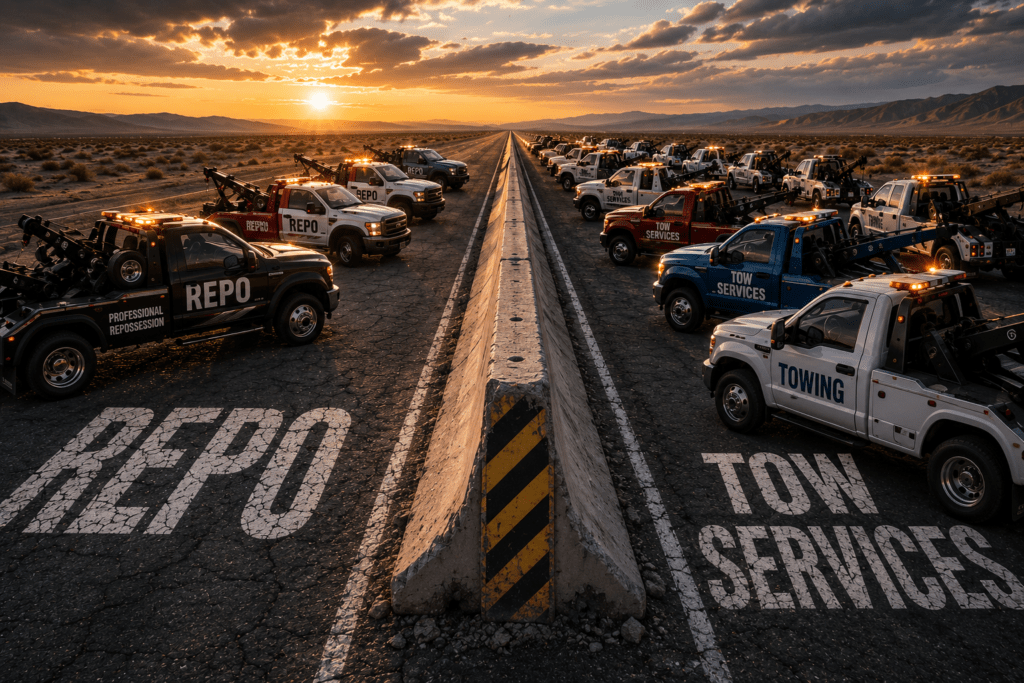
The Insurance Barrier: When Tow and Repo Try to Cross the Line – The Insurance Barrier: When Tow and Repo Try to Cross the Line – The Insurance Barrier: When Tow and Repo Try to Cross the Line
Kevin Armstrong
Publisher
The Insurance Barrier: When Tow and Repo Try to Cross the Line – Repossess – Repossession – Repossession Agency – Repossessor – Repossession – Repossession News
Related:
What Happens When Repo Discovers Towing?
The Tow Industry Is Coming into the Repo Space. Will It Make the Industry Stronger, or Absorb It?






More Stories
Why Fight LPR? Join It — But What Happens When the Car Repossesses Itself?
In The Future Will There Be Anyone Left to Recover Vehicles?
The Broken Bond Between Lenders and Agents – Positive Resolution
The Repos That May Never Come
A Repossession Is a Repossession
When “Partner” Is Just Another Word for Vendor