



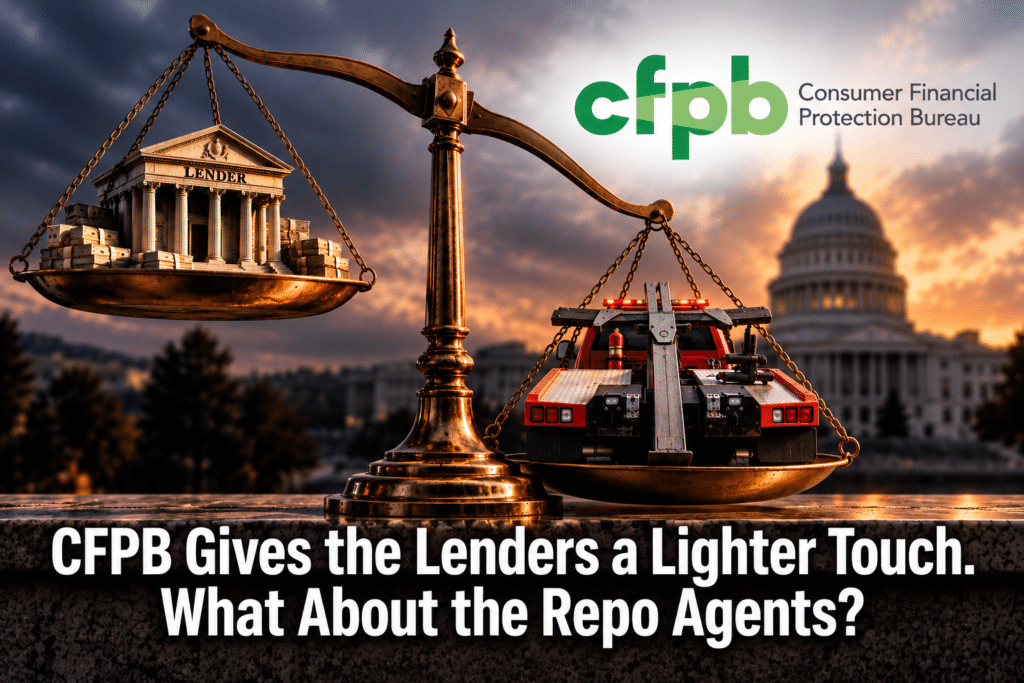
CFPB’s New Examination Policies Could Change Oversight Without Changing Liability in the Field
Washington, DC – October 8, 2026 – The Consumer Financial Protection Bureau (CFPB) is conducting fewer examinations of financial institutions, and an unusually high percentage of those examinations are reportedly concluding with little or no significant regulatory findings.
According to an October 7 Reuters investigation, the agency selected approximately 70 companies for examination in 2026, roughly half its customary number. More than half of examinations conducted during the spring reportedly received expedited reviews, an outcome historically reserved for institutions where examiners identified no violations or only relatively minor concerns.
For the automobile repossession industry, the immediate implications may not be obvious. Recovery agencies are not generally subject to the same CFPB supervisory examination process as the lenders and loan servicers assigning their work. Nevertheless, those examinations have historically played an important role in identifying improper repossessions, servicing errors and failures in the systems lenders use to manage collateral recovery.
The question is whether fewer examinations and a narrower supervisory approach will change how lenders oversee the repossession process.
A Different Kind of CFPB Examination
The shift in examination practices is not entirely unexpected. In April 2025, the CFPB announced plans to reduce supervisory examinations by at least 50%, concentrating its remaining resources on significant consumer harm and clearer violations of federal law.
The agency also announced a preference for examining depository institutions rather than nonbank financial companies, a distinction of particular interest to the auto finance industry, where independent finance companies and nonbank servicers play substantial roles.
In November 2025, the CFPB introduced what it called a Humility in Supervision Pledge, directing examiners toward a narrower, more collaborative and less burdensome approach to supervision.
Supporters of the changes argue that regulatory examinations had become excessively costly and sometimes focused on technical violations with little evidence of actual consumer harm. A more targeted approach, they contend, allows regulators to concentrate resources on meaningful misconduct while reducing unnecessary expenses for compliant financial institutions.
Critics, including people familiar with the agency’s examination process who spoke with Reuters, have raised concerns that examiners are facing pressure to avoid aggressive findings and conclude reviews more quickly.
Reuters reported that the CFPB did not respond to its requests for comment.
The resulting examination numbers are noteworthy, but they do not independently establish whether compliance has improved or regulatory scrutiny has weakened. Determining that would require considerably more information about the institutions examined, the scope of those examinations and the findings that were or were not pursued.
Repossession Has Been a CFPB Examination Target
Although repossession agencies are generally several steps removed from the CFPB’s examination process, the agency has previously used lender and servicer examinations to identify problems directly affecting recovery operations.
Past CFPB supervisory findings have documented wrongful repossessions involving borrowers who had made payments, entered payment arrangements or otherwise taken steps that should have prevented their vehicles from being recovered.
Other examinations identified problems with payment processing, account information and servicing systems that contributed to improper repossession activity.
These findings helped establish the expectation that lenders and servicers must maintain adequate controls over the repossession orders they issue, including those transmitted to third-party recovery providers.
For recovery agencies, those controls can determine whether an assignment is issued, placed on hold, canceled or allowed to proceed.
A servicing error that goes undetected at the lender level can ultimately become a confrontation at a borrower’s residence, a wrongful repossession claim or a legal dispute involving the recovery company that carried out the assignment.
The repossession agent may have followed the instructions provided, but that does not necessarily prevent the agency from becoming involved in subsequent litigation.
The CFPB Has Also Withdrawn Its Repossession Guidance
An important part of the changing regulatory environment predates the latest Reuters investigation.
On May 12, 2025, the CFPB formally withdrew its 2022 compliance bulletin titled Mitigating Harm From Repossession of Automobiles.
The original bulletin had warned lenders and servicers about unlawful repossessions, including situations involving inaccurate loan records, improperly applied payments, and failures to communicate repossession cancellations to recovery providers.
It also addressed the potential consequences of repossessions conducted by third-party service providers acting on behalf of financial institutions.
The withdrawal eliminated that particular guidance document, but it did not repeal the underlying laws governing repossessions or eliminate the possibility of liability for unlawful conduct.
State repossession statutes, applicable provisions of the Uniform Commercial Code, consumer protection laws and contractual obligations remain in effect.
For recovery agencies, the practical distinction is significant. A lender may face less scrutiny from one federal regulator, but that does not necessarily reduce the recovery company’s exposure when something goes wrong in the field.
What Happens When Lender Oversight Changes?
Repossession agencies operate at the end of a much longer process involving loan servicing, collections, default management and collateral recovery decisions.
By the time an assignment reaches an agent, the lender or servicer has generally already determined that the account is eligible for repossession.
Recovery companies ordinarily have limited access to the account information supporting that decision. They may receive a debtor’s name, address, vehicle description, loan status and assignment instructions, but they generally do not independently audit the lender’s payment records or determine whether every contractual requirement for repossession has been satisfied.
That division of responsibility makes accurate lender instructions essential.
A payment arrangement that is not entered correctly, a bankruptcy notice that fails to reach the appropriate department, or a repossession cancellation that is delayed can create problems well beyond the lender’s servicing department.
The CFPB’s previous examinations helped identify systemic weaknesses that could produce those errors. A reduction in examination activity could mean fewer opportunities for regulators to discover similar problems, although there is not yet evidence establishing that such problems have increased under the new approach.
It is also possible that lenders with effective internal compliance programs will experience little operational change. Financial institutions have reasons beyond CFPB examinations to maintain accurate servicing records, prevent wrongful repossessions and monitor their recovery vendors.
Those incentives include litigation risk, state regulatory oversight, insurance considerations and the financial costs of correcting improper recoveries.
A Question of Accountability, Not Simply Regulation
The CFPB’s new supervisory approach raises a legitimate question about how financial institutions should be examined.
More examinations do not necessarily produce better compliance. Lengthy investigations can consume significant resources, and identifying minor technical deficiencies does not always translate into meaningful consumer protection.
Conversely, fewer findings do not necessarily mean fewer violations.
The agency’s own November 2025 supervisory pledge emphasizes identifying patterns of unlawful conduct involving tangible consumer harm. It also encourages resolving problems through supervision rather than enforcement when feasible.
That approach could benefit compliant lenders by reducing unnecessary administrative burdens while still allowing regulators to pursue serious misconduct.
The concern is whether a narrower examination process might overlook problems that become apparent only after reviewing broader servicing practices, including the processes that lead to vehicle repossessions.
There is also the question of nonbank auto lenders. The CFPB’s decision to shift examination resources toward depository institutions could mean less direct federal supervisory attention to certain finance companies operating in the nonprime and subprime markets.
Reuters did not identify which auto finance companies, if any, were included in the 2026 examinations. Nor did its investigation establish whether repossession-related findings have declined or whether examination teams have been instructed to avoid those issues specifically.
Those remain unanswered questions.
The Repossession Industry Still Bears the Consequences
For professional recovery agencies, the significance of this development is not that the CFPB is becoming more accommodating toward financial institutions. It is that changes in lender oversight may eventually affect the procedures governing assignments, cancellations, compliance reviews and vendor management.
A lender operating under less intensive federal supervision may retain every existing control. Another might reassess procedures it originally adopted in response to examination findings or regulatory guidance.
Whether those changes improve efficiency or introduce additional risk will depend largely on how individual institutions manage their operations.
Meanwhile, recovery agents will continue working under the same basic legal requirements governing their conduct in the field.
A wrongful repossession can still generate litigation. A breach of the peace can still expose an agency to liability. And a recovery company can still find itself defending actions taken on an assignment that originated from inaccurate lender information.
The federal regulator’s examination priorities do not change those realities.
The CFPB’s new approach may ultimately prove more efficient, less costly and better focused on significant violations. Or it may allow servicing problems to go undetected longer than they otherwise would.
The available examination data does not yet establish which outcome is occurring.
For the repossession industry, the question is more immediate: If lenders face less regulatory scrutiny over the decisions that put vehicles out for repossession, who will ensure those decisions are correct before recovery agents are sent to act on them?
That responsibility has always existed. The latest changes at the CFPB simply make it worth examining again.
CFPB Gives Lenders a Lighter Touch. What About the Repo Agents? – CFPB Gives Lenders a Lighter Touch. What About the Repo Agents? – CFPB Gives Lenders a Lighter Touch. What About the Repo Agents?
CFPB Gives Lenders a Lighter Touch. What About the Repo Agents? – Consumer Financial Protection Bureau – CFPB – Lending – Repossess – Repossession – Repossession Agency – Repossessor – Repossession – Repossession News





More Stories
NY Repo Agent Allegedly Beaten and Put in Chokehold
Two New LPR Bills in Congress, One Question for Repossession
Bail Collateral Repo Turns Into 100-MPH Fugitive Chase
REPO AMATEUR HOUR: They Repossessed a Chihuahua
“Repo Man” Arrested After Alleged Wrongful Repossession
Philadelphia’s Electronic Repo Reporting Program Expands Again