




At Least Vegas Gives You a Drink.
GUEST EDITORIAL
A question for the lending community: Would you show up for work tomorrow if your employer told you: “We’re not paying you for your time anymore. We’re only paying you when you produce the result we want.”
You still have to show up.
You still need your computer.
You still have deadlines.
You still have compliance requirements.
You still have to do the work.
But if you spend eight hours working and don’t achieve the desired result?
You made $0.
Would you accept that arrangement?

Probably not.
Now imagine something even better.
You have to pay your own expenses while doing it.
Welcome to contingency repossession.
Or perhaps we should give it a more accurate name.
Welcome to the Repossession Casino
Consider a hypothetical portfolio where a financial institution considers a 30% recovery rate acceptable.
One hundred assignments go out. Thirty vehicles come back. Seventy don’t.
The recovery company may generate revenue on the 30 successful recoveries while receiving little or nothing for substantial work performed on the other 70, depending on the contract.
But all 100 cost money.
Employees worked them.
Trucks drove looking for them.
Fuel was burned.
Addresses were checked.
LPR data was purchased and analyzed.
Investigative databases were searched.
Software was used.
Insurance remained in force.
Administrative employees processed updates.
Compliance obligations existed.
Those expenses don’t vanish because the collateral wasn’t recovered.
So the recovery company effectively puts its own money on the table every time it accepts an assignment.
Place your bets.
At Least Vegas Tells You You’re Gambling
Walk up to an American roulette table. There are 38 pockets: numbers 1 through 36, plus 0 and 00.
Bet one number and your odds of hitting it are about 2.63%. Bet red or black and you’ll win about 47.37% of the time.
The casino still has an edge.
Everyone understands the arrangement before the wheel spins. That’s gambling.
But casinos understand something else extremely well:
The gambler has value.
Put enough money into action and the casino may give you drinks, dinner, a hotel room. Entertainment, rewards and comps.
They want you to keep playing.
Now let’s visit a different casino.
Here’s Your Stack of Chips
The repossession casino works a little differently.
First, buy a tow truck. Actually, you buy several.
Hire employees and pay their wages.
Fuel the trucks and insure them.
Buy cameras, pay for GPS, pay for LPR, pay for investigative databases and pay for software.
You maintain a secure storage facility, hire administrative staff, maintain licenses, meet compliance requirements and integrate with multiple platforms.
Now we’ll hand you 100 assignments. Go find our collateral.
Recover 30 and we’ll consider that an acceptable result for purposes of this hypothetical.
What happens with the other 70? 
Depending on the arrangement: Better luck next time.
And here’s the fascinating part. The lender isn’t putting those chips on the table.
The recovery company is.
The lender owns the collateral. The lender wants it located.
But the repossessor may finance much of the search required to find it.
Which raises a fairly obvious question:
Why Is the Repossession Company Financing the Bank’s Search for the Bank’s Collateral?
Financial institutions understand risk better than almost anyone.
They price risk. They finance risk. They analyze default rates. They calculate expected losses.
Yet in contingency repossession, something unusual happens.
The recovery agency advances the capital. It fronts the labor. It fronts the fuel. It fronts the investigative expenses.
It fronts the technology. It fronts the equipment. It assumes the operational risk and then it waits to see whether the assignment produces revenue.
In other words:
The recovery company is financing the financial institution.
We’ve done it for so long that nobody seems to notice how strange that sentence sounds.
What Does the Repossessor Get for Gambling?
Vegas gives its gamblers comps. What does the repossessor get?
More assignments? Another address? Another portal? Another audit?
Another compliance requirement? Another login? Maybe another request to reduce a fee? 
Maybe a necessary equipment charge questioned after the recovery?
Then another stack of assignments and another opportunity to gamble tomorrow.
At least Vegas gives you a drink.
That’s funny until you start following the money.
Because this is where the conversation becomes much bigger than recovery-company compensation.
Those Other 70 Assignments Weren’t Free
Return to our hypothetical 100 assignments. Thirty vehicles recovered. Seventy not recovered.
There is one fact nobody can seriously dispute:
The 70 unsuccessful assignments cost money to service.
Maybe some cost very little. Others may have required multiple field visits, hundreds of miles, database searches, LPR work, employee time and weeks of administration.
But collectively, their cost wasn’t zero. So, here’s the question:
Who paid for them?

There aren’t many possibilities.
The lender absorbed the cost?
The forwarder absorbed it?
The recovery company absorbed it?
The cost was distributed elsewhere in the lender’s operation?
Or the successful recoveries generated enough revenue to help make the unsuccessful work economically sustainable?
Because there’s one answer that isn’t possible:
Nobody. Money doesn’t work that way.
And Now Let’s Talk About the 30%
This is where the contingency model raises a question that should interest consumer advocates just as much as recovery agencies.
Suppose you’re one of the consumers whose vehicle was successfully repossessed.
You fell behind. The lender had a contractual right to recover its collateral. Your vehicle was recovered.
Applicable law and your contract may permit certain reasonable repossession-related expenses to be charged to your account.
Fine.
But you might want to ask another question:
How was the price of my repossession determined?
Because the company that recovered your vehicle isn’t pricing its business in a vacuum. It knows that some percentage of assignments won’t generate recovery revenue.
It knows those assignments still cost money. And like every sustainable business, its overall revenue eventually has to exceed its overall expenses.
That doesn’t mean somebody literally takes the invoice for Borrower #74 and adds it to Borrower #22’s account.
That’s not what we’re suggesting.
We’re talking about economics.
If a business performs 100 jobs but gets meaningfully paid for only 30, the revenue generated by those 30 must somehow contribute to supporting the cost structure required to perform all 100. Otherwise the business eventually ceases to exist.
That’s arithmetic, not accusation.
So Is the Successfully Repossessed Consumer Paying a “Winner’s Penalty”?
Let’s ask the uncomfortable question.
What would repossession cost if the recovery agency received reasonable compensation for legitimate work performed on every assignment, rather than relying so heavily on successful recoveries?
Imagine purely illustrative numbers.
Under contingency:
100 assignments are worked.
30 recoveries generate $400 each.
70 generate $0.
Total gross recovery revenue: $12,000.
Now imagine another model.
Every legitimately serviced assignment generates a modest $50 work fee.
A successful recovery generates an additional $250.
One hundred assignments generate $5,000 in servicing revenue.
Thirty recoveries generate another $7,500.
Total: $12,500.
These aren’t proposed industry rates. They’re simply illustrating the economics.
Under the second model, the cost of searching for delinquent collateral is spread across the accounts requiring work instead of concentrating revenue almost entirely on successful recoveries.
And suddenly we have a fascinating consumer question:
Could the person whose vehicle actually gets repossessed pay less if everybody who required legitimate recovery work contributed something?
If the answer is yes, contingency isn’t merely a recovery-company issue anymore. It’s potentially a consumer issue.
Imagine Explaining This to the Consumer
“Your vehicle was recovered, so there’s a repossession charge.”
Okay.
“How much?”
Let’s say $400 for illustration.
“Why $400?”
Because that’s what it costs.
Except does recovering that particular vehicle really require $400?
Or does the overall business model require successful recoveries to produce enough revenue to compensate for all the unsuccessful work necessary to keep the system functioning?
Those are different questions. And consumers should be allowed to ask them.
Imagine being told:
“Your vehicle was located on the first attempt. But the recovery system also worked numerous other delinquent accounts that didn’t result in recoveries.”
The consumer might reasonably respond:
“What do their unsuccessful recoveries have to do with mine?”
That’s a fair question.
Follow the Money Before Calling It Fair
This is where we need to be careful. We’re not alleging that every lender passes unsuccessful recovery expenses onto successfully repossessed borrowers.
We’re not claiming that contingency repossession is inherently illegal. We’re not suggesting that every repossession fee contains some hidden surcharge.
We’re asking for transparency.
If the successful 30% aren’t economically supporting any portion of the unsuccessful 70%, wonderful. Then show us where the cost of the 70% goes.
Because somebody is paying it.
And if part of that cost is necessarily embedded in the prices charged for successful recoveries, perhaps regulators, lenders and consumer advocates should ask whether there is a more equitable way to structure the system.
Maybe the Debtor and the Repossessor Have Something in Common
That’s the plot twist nobody expects. For years we’ve framed these parties as adversaries.
The repossessor takes the vehicle. The consumer doesn’t want the vehicle taken.
Naturally they’re on opposite sides.
But economically, they may have something in common.
The repossessor might say:
“Why should I finance all the unsuccessful attempts?”
And the successfully repossessed consumer might say:
“Why should the price of my successful repossession help support a system containing all those unsuccessful attempts?”
Those aren’t opposite questions. They’re almost the same question.
Both lead back to the lender:
Who should actually pay the cost of servicing delinquent collateral?
Now Add Safety to the Bet
The economics become even more troubling when safety enters the equation. Sometimes the safest thing a repossession agent can do is walk away.
Consumer appears.
Confrontation begins.
Conditions deteriorate.
Agent disengages.
Everyone agrees that’s what we want. No vehicle is worth somebody getting hurt. But under a pure contingency model, what can the safest decision be worth financially?
$0.
The employee still gets paid. The truck still costs money. Fuel was still burned. Insurance was still required.
Technology may have located the vehicle. The agency may have performed everything correctly. And because the agent made the professional decision to leave? 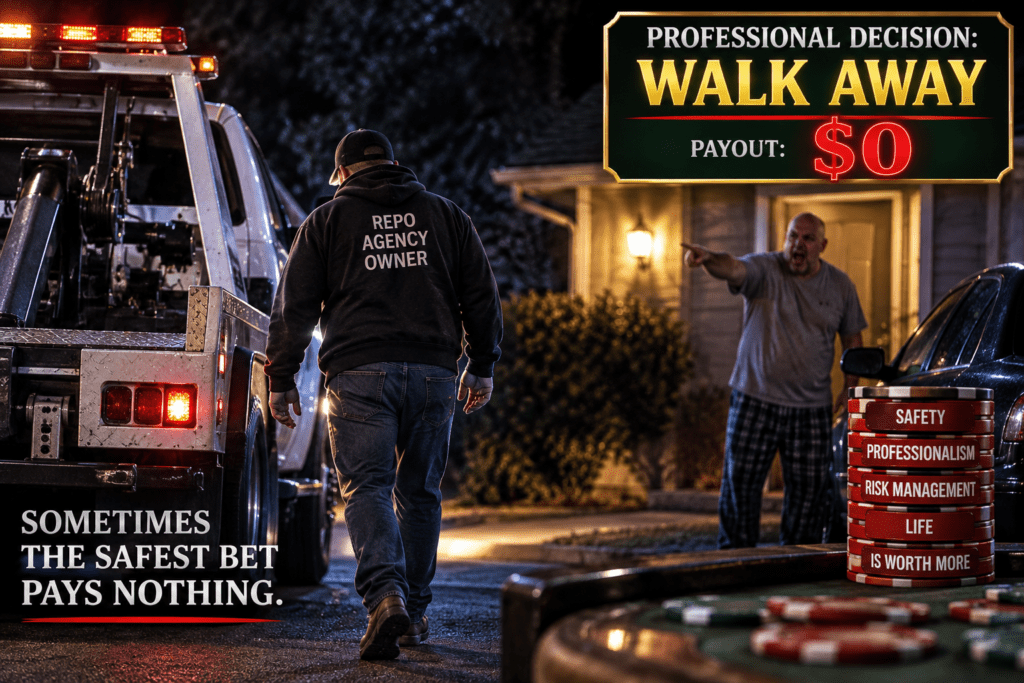
No recovery. Potentially no recovery revenue.
We’ve created a system where one of the behaviors we most want to encourage can be financially punished. That isn’t merely a compensation problem.
It’s a safety problem.
And What Happens When You Win?
Eventually the wheel lands on your number. Vehicle recovered.
Great.
Except maybe dollies were necessary. Maybe additional equipment was needed. Maybe unusual circumstances required extra labor.
Maybe those measures protected the collateral and reduced the chance of confrontation or damage.
Now another wager begins: Will the additional charge be paid?
Imagine Vegas operating this way.
You bet, you win. The dealer pushes the chips toward you.
Then someone from management walks over:
“We know that wager was approved, but we’ve reconsidered whether we’re paying it.”
You probably wouldn’t remain at that table very long.
Yet businesses are sometimes expected to deploy equipment and incur expenses while facing uncertainty over whether those costs will ultimately be reimbursed.
That uncertainty changes behavior.
And again: Economic incentives eventually become safety incentives.
Maybe Contingency Isn’t the Villain
Perhaps contingency doesn’t need to disappear. Maybe it needs to evolve.
Maybe legitimate verified field work deserves modest compensation. Maybe successful recovery deserves substantially greater compensation.
Maybe specialized equipment should have predetermined pricing. Maybe difficult collateral deserves different pricing.
Maybe portfolios with dramatically different expected recovery rates should have different economic structures. Maybe lenders should share some of the unsuccessful-search risk rather than transferring almost all of it downstream.
There are dozens of possibilities.
The industry doesn’t have to agree on the answer today. But we should at least be willing to discuss the question.
Because Here’s the Part Nobody Can Argue With
Take 100 assignments. Recover 30. Don’t recover 70.
The 70 still cost money.
So, somebody pays.
Maybe it’s the repossession agency.
Maybe it’s the lender.
Maybe it’s the forwarder.
Maybe the cost gets distributed through the economics of successful recoveries.
Maybe it’s some combination of all of them.
But somebody pays.

And that’s why this conversation shouldn’t just involve lenders and repossession agencies. Consumer advocates should be at the table. Regulators should be at the table. Forwarders should be at the table.
Because perhaps we’ve spent decades arguing about how much a repossession should cost when we should have been asking something much more fundamental:
Who Should Pay for the Cost of Trying?
If a lender considers a 30% recovery rate acceptable on a particular portfolio, then let’s acknowledge what that means.
Seventy percent may not produce collateral.
But they still produce expense.
If the lender doesn’t pay it and the forwarder doesn’t pay it and the unsuccessful consumer doesn’t pay it and the recovery company can’t survive indefinitely absorbing it…
Where does the money come from?
Follow that question far enough and eventually you arrive back at those 30 successful recoveries.
And if consumers in that 30% are bearing higher successful-repossession costs because of an economic model built around 70% of assignments producing little or no revenue, then maybe they’re entitled to ask:
“Why am I paying more because somebody else’s car wasn’t found?”
That’s not an anti-lender question. It’s not an anti-repossession question. It’s a question about whether the economic incentives we’ve inherited still make sense.
And maybe that’s the strangest thing about the Repossession Casino.
The recovery company puts up the chips.
The lender owns the collateral.
Seventy bets can lose.
Thirty can win.
And somewhere, somehow, the losing bets still have to be paid for.
So before we spin the wheel again, perhaps everybody involved should answer one question:
Who is really paying the losing bets?
Because if the answer eventually leads back to the 30% whose vehicles were actually repossessed…
Maybe the people we call the “successful recoveries” are the ones getting the worst odds of all.
And unlike Vegas?
Nobody even offered them a drink.
Welcome to the Repossession Casino — But Who Is Really Paying the Losing Bets? – Welcome to the Repossession Casino — But Who Is Really Paying the Losing Bets? – Welcome to the Repossession Casino — But Who Is Really Paying the Losing Bets?
Anonymous Agency Owner
Welcome to the Repossession Casino — But Who Is Really Paying the Losing Bets? – Repossess – Repossession – Repossession Agency – Repossessor – Repossession – Repossession News – Forwarder – Auto Loan – Lending






More Stories
The Cost of Collecting LPR Data Has Gone Up. Why Hasn’t the Pay?
WHEN IS ENOUGH, ENOUGH? A Question Worth Asking Across the Repossession Industry
Three Million Repossessions: A New Measure of America’s Recovery Industry
Why Fight LPR? Join It — But What Happens When the Car Repossesses Itself?
In The Future Will There Be Anyone Left to Recover Vehicles?
The Broken Bond Between Lenders and Agents – Positive Resolution