


If Government Demand for License Plate Data Falls, What Happens to the Commercial Networks Repo Agents Help Build?
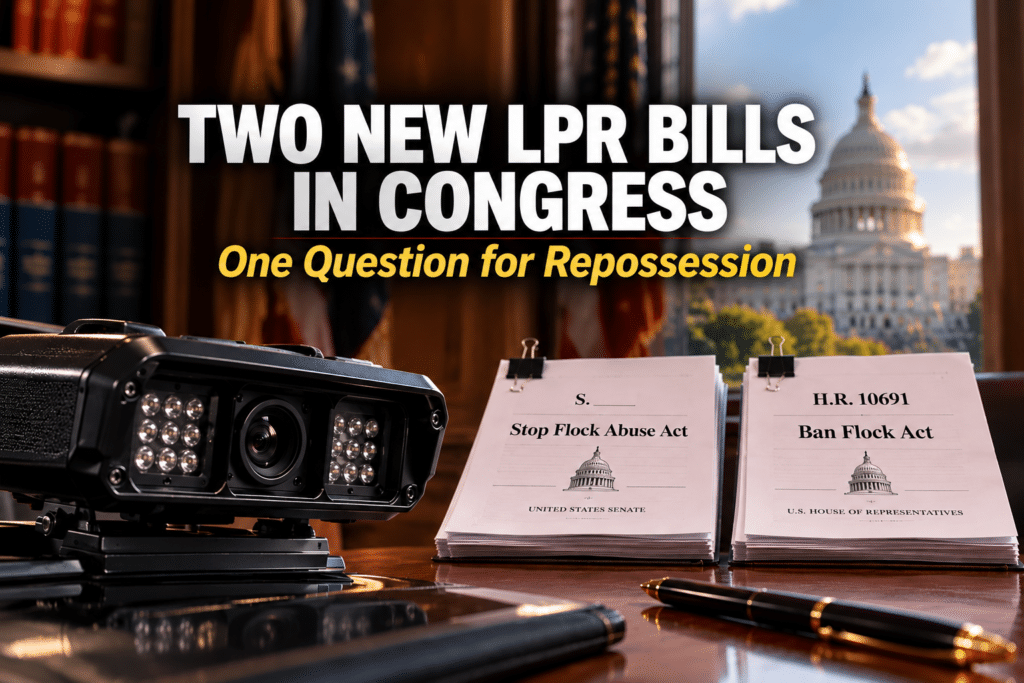
Washington, DC – October 5, 2026 – License plate recognition technology has suddenly drawn bipartisan attention on Capitol Hill, with two very different proposals seeking to place federal limits on how government agencies collect, retain and use vehicle-location data. Neither bill directly prohibits the commercial LPR systems widely used by the repossession industry, but both raise a larger question for recovery agencies: What happens to the economics of commercial LPR if a significant government market for the technology and its data disappears?
Sen. Josh Hawley announced the Stop Flock Abuse Act, legislation intended to regulate rather than eliminate government use of automated license plate readers. Hawley’s proposal would establish safeguards including written authorization for searches, audit requirements, encryption, restrictions on facial recognition and a general 10-day retention period. Of particular interest to the commercial LPR industry, Hawley’s proposal would prohibit local governments from selling or sharing vehicle-location information with nongovernmental third parties. The proposal therefore appears primarily aimed at controlling government surveillance and preventing government-collected plate data from flowing into private hands, not prohibiting privately operated LPR networks used to locate secured collateral.
Rep. Alexandria Ocasio-Cortez has taken a substantially different approach with H.R. 10691, the Ban Flock Act, accompanied by Senate legislation from Sens. Bernie Sanders and Jeff Merkley. Rather than establishing rules for federal ALPR use, the legislation would generally prohibit federal agencies and officials from acquiring, possessing, accessing or using ALPR systems and captured plate data. It would also use federal funding as leverage to encourage similar restrictions at the state and local level. Importantly for repossession, the bill’s definition of captured plate data explicitly recognizes information originating from nongovernmental sources including private security networks, commercial parking operators and data brokers. However, the bill does not appear to establish a general prohibition against private companies collecting and using LPR information for otherwise lawful commercial purposes, such as locating secured collateral.
The basic difference is therefore relatively straightforward. Hawley’s proposal seeks to put guardrails around governmental LPR use; the Ocasio-Cortez proposal seeks to dramatically reduce governmental LPR use altogether. Neither presently appears designed to shut down commercial repossession LPR networks. But both reflect growing congressional concern about enormous searchable databases capable of reconstructing the historical movements of vehicles, and both could affect the financial ecosystem supporting the technology even without directly regulating repossession.
Follow the Money
Commercial LPR companies don’t operate separate universes for every market they serve. Cameras, cloud infrastructure, software development, cybersecurity, databases, mapping systems, customer support and employees all carry costs. Revenue generated through law enforcement and government customers can help support that larger infrastructure.

If federal legislation significantly reduces government purchases of cameras, software subscriptions or access to commercially collected plate information, and particularly if similar restrictions spread into state and local government, LPR providers could lose a meaningful revenue stream while many of their fixed operating costs remain.
At the same time, new privacy, security, auditing and data-retention requirements could actually increase compliance expenses.
The potential equation becomes uncomfortable: Less government revenue + higher compliance costs + largely unchanged infrastructure expenses.
Companies confronted with that combination generally have limited choices. They can reduce expenses, including staffing and investment; accept lower margins; or attempt to generate additional revenue from the customers and markets that remain.
And that is where repossession enters the equation.
Could Repo Agents Eventually Pay the Difference?
The potential downstream effect on repossession is much harder to predict.
Neither the Stop Flock Abuse Act nor the Ban Flock Act (H.R. 10691) directly targets the commercial LPR systems used by recovery agencies. But if either proposal ultimately reduces government purchases of LPR equipment, subscriptions or commercial plate data, providers could face some combination of lost revenue and increased compliance expenses.
How they would respond is unknown. They could absorb the losses, reduce expenses, find replacement markets or potentially look for additional revenue from their remaining commercial customers. For repossession agencies, that raises reasonable questions about future camera costs, subscription fees, data access and the revenue-sharing arrangements associated with collecting plate data, but at this stage, those are possible financial consequences, not foregone conclusions.
There is also a potential network consequence. If operating LPR equipment became less profitable for recovery agencies, some could eventually reconsider how many camera cars they operate, potentially reducing the number of fresh scans entering commercial databases.
None of that is written into either congressional bill, and none of it is certain to occur. But legislation doesn’t have to specifically regulate repossession companies to affect them.
If Congress substantially changes who can buy LPR technology and vehicle-location data, it could also change the economics of producing that data. And somewhere at the other end of that equation are thousands of cameras mounted on vehicles being driven every day by the repossession industry.
Two New LPR Bills in Congress, One Question for Repossession – Two New LPR Bills in Congress, One Question for Repossession – Two New LPR Bills in Congress, One Question for Repossession
Two New LPR Bills in Congress, One Question for Repossession – Repossess – Repossession – Repossession Agency – Repossessor – Repossession – Repossession News – Compliance – Data – Data – Forwarder – LPR – Auto Loan





More Stories
Hooked, Lifted, and Still Not Yours: Federal Court Rules Against Georgia Repossessor
LPR Helps Rescue Child from Alleged Human Trafficker
Myles Weiss: Remembering a Man Who Helped Build the Repossession Industry
Five Charged in $3 Million Houston Luxury Vehicle Theft and Export Scheme
Texas Repo Turns into Armed Standoff, Two Arrested
Car-Mart Buys Another Week. But Is It Running Out of Road?