



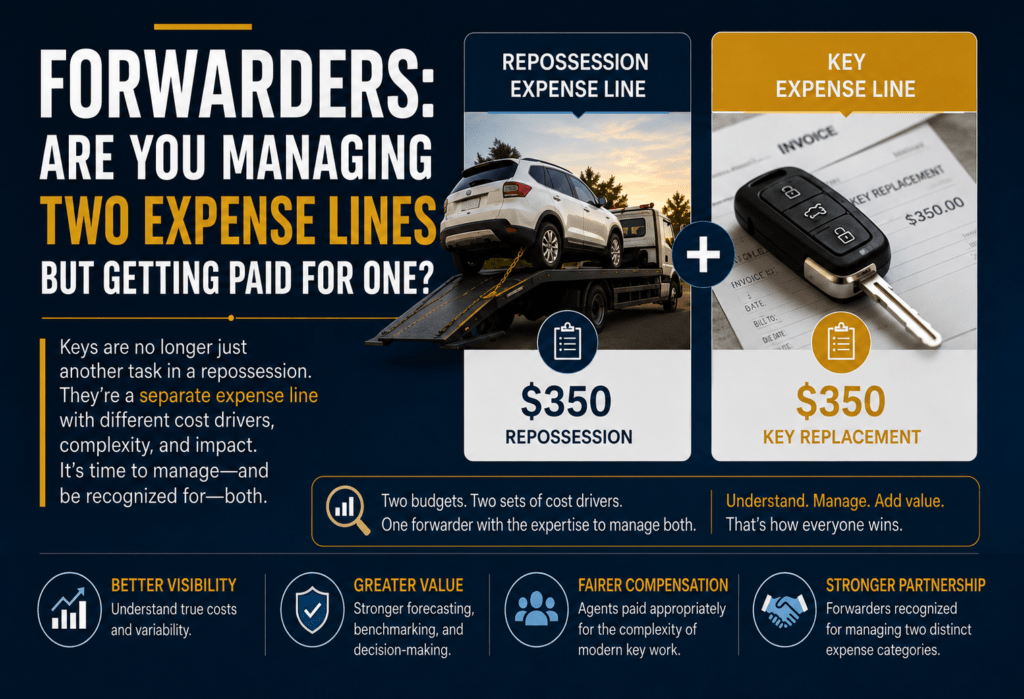
Something significant has quietly changed in repossession forwarding: many forwarders are no longer managing one major lender expense. They’re managing two.
For decades, the role of the repossession forwarder was fairly well defined.
A large lender might have thousands of repossession assignments spread across multiple states and hundreds of recovery agencies. Rather than manage every relationship, invoice, compliance requirement and assignment individually, the lender relies on a forwarder to manage that process at scale.
In simple terms, the forwarder manages the lender’s repossession expense line.
But over the last several years, another major expense has moved into that workflow:
Keys.
Historically, much of the key expense occurred later in the vehicle lifecycle and often fell within the remarketing process.
Today, recovery agents are increasingly being asked to cut and program keys before the vehicle ever reaches auction.

That means forwarders aren’t just managing repossession spend anymore.
They’re managing key spend, too.
And I don’t think our industry has fully recognized the significance of that change.
Keys Aren’t Just Another Step in a Repossession
Operationally, it is easy to look at the process this way:
Recover vehicle → make key → transport vehicle → close assignment.
Financially, however, something very different is happening.
Consider a hypothetical assignment:
Repossession: $350 Replacement key: $350
The forwarder isn’t managing a $350 transaction with an incidental service attached.
It’s managing $700 in lender spend across two completely different expense categories.
And those expenses have completely different cost drivers.
Repossession costs can be influenced by geography, recovery difficulty, transportation, regulation and agent fees.
Key costs can be influenced by the VIN, model year, key availability, aftermarket versus refurbished versus new OEM options, programming procedures, security access, OEM software requirements, technician labor and vehicle-specific complexity.
The fact that both expenses occur during the same assignment doesn’t make them the same expense.
They are two budgets requiring two different areas of expertise.
Think About This in Any Other Part of a Business
Imagine a company hires an organization to manage $50 million in annual transportation spend.
Then, over time, that same organization becomes responsible for managing another $40 million in technology spend.
Nobody would say:
“It’s already part of the workflow, so it’s the same job.”
The company would recognize that the scope of the relationship had expanded.
There would be another budget to understand.
New costs to benchmark.
New vendors to evaluate.
New data to analyze.
New expertise to develop.
And, importantly, additional value being created for the lender.
Why should keys be viewed differently?
There May Be More Money Under Management Than We Realize
Replacement keys are no longer inexpensive pieces of metal.
Modern proximity keys can easily rival the cost of the repossession itself.
On some vehicles, the key can cost more than the recovery.
So imagine a forwarder managing $100 million annually in repossession expenses for its lender clients.
If keys add another $50 million, $75 million or even $100 million in spend, the forwarder’s financial responsibility has changed dramatically.
Yet if key expenses continue to be treated simply as a pass-through attached to the repossession, the forwarder could be managing millions of additional lender dollars without recognizing or being compensated for the additional value being provided.
This Isn’t More Money for the Same Job
It’s recognizing that the job isn’t the same anymore.
Forwarders have spent years building nationwide recovery networks, compliance systems, technology platforms and lender relationships that allow financial institutions to outsource an incredibly complicated process.
That infrastructure has tremendous value.
Now many forwarders are using that same infrastructure to oversee another increasingly complicated expense category.
That should be an opportunity.
If a forwarder is responsible for overseeing both a lender’s repossession spend and its key spend, why shouldn’t those be recognized as two distinct areas of expense management?
Doing so could create a very different relationship between lenders, forwarders and recovery agents.
What Changes When Keys Become Their Own Budget?
Once key spend is recognized as a separate expense category, there is a reason to truly understand it.
The conversation stops being only about the price of an individual key and starts becoming about managing the entire category.
Why did one vehicle require an $85 key while another required a $485 key?
Was new OEM the only option?
Did the vehicle require security credentials, PIN retrieval or paid OEM software?
How much technician time was actually required?
Those aren’t questions designed to make keys more expensive.
They’re questions designed to determine what the expense should actually be.
And that’s an important distinction.
The objective shouldn’t be to make every key cheaper. The objective should be to understand why one key costs $85 and another costs $485.
Understanding Creates Fair Pricing
Treating keys as a separate managed expense could benefit every participant in the transaction.
Lenders gain better visibility into where their money is going and why.
Forwarders gain another service they can actively manage, benchmark, report on and appropriately charge for managing.
And recovery agents gain something equally important:
A pricing structure based on the actual cost and complexity of the work.
That becomes increasingly important as vehicle technology evolves.
Newer vehicles require more sophisticated programming procedures, security access, paid OEM software and specialized equipment.
At the same time, newer model-year keys may have no aftermarket or refurbished alternative, leaving new OEM as the only viable option.
Those costs cannot simply be negotiated away.
They must be understood.
Two Budgets. Two Responsibilities.
For years, much of the replacement-key expense lived downstream within remarketing.
Now that expense has moved upstream into repossession.
But the budgeting mindset hasn’t moved with it.
That is the opportunity I believe forwarders should recognize.
Keys should have their own budget, their own benchmarks, their own data and their own management strategy.
And if forwarders are taking responsibility for managing this additional lender expense, there is nothing unreasonable about recognizing and compensating them for the additional value they provide.
That creates the incentive to truly understand the category.
And when forwarders understand the category, lenders gain better cost controls and recovery agents have a much better opportunity to be compensated fairly for the actual work required.
As OEM software requirements, vehicle security and programming complexity continue to increase, key expense management is only going to become more specialized.
Forwarders are already managing the second budget.
Perhaps it’s time we stopped treating it like part of the first one…


Billie Jo Stoddard
Royal Key Supply
CONTACT
PHONE: 817-779-4758
WEBSITE: www.royalkeysupply.com
EMAIL: info@royalkeysupply.com

About Royal Key Supply
Royal Key Supply is a Texas-based automotive key distributor and training provider serving locksmiths, repossession companies, dealerships, and fleet operators nationwide. The company is known for its hands-on training programs, extensive inventory, and commitment to supporting independent automotive professionals.
Forwarders Are You Managing Two Expense Lines but Getting Paid for One? – Forwarders Are You Managing Two Expense Lines but Getting Paid for One? – Forwarders Are You Managing Two Expense Lines but Getting Paid for One?
Related Articles:
The Standardized Key Price Disconnect
From Auction Cutting to Field Programming: The Structural Shift No One Budgeted For
Look Forward to Locksmith Day at the AFA Mid-Year 2024
Keys in the Repossession Industry
Forwarders Are You Managing Two Expense Lines but Getting Paid for One? – Repossess – Repossession – Repossession Agency – Repossessor – Repossession – Training – Royal Locksmith – Royal Key Supply – Forwarder – Locksmith






More Stories
Why Fight LPR? Join It — But What Happens When the Car Repossesses Itself?
In The Future Will There Be Anyone Left to Recover Vehicles?
The Broken Bond Between Lenders and Agents – Positive Resolution
The Repos That May Never Come
A Repossession Is a Repossession
When “Partner” Is Just Another Word for Vendor