


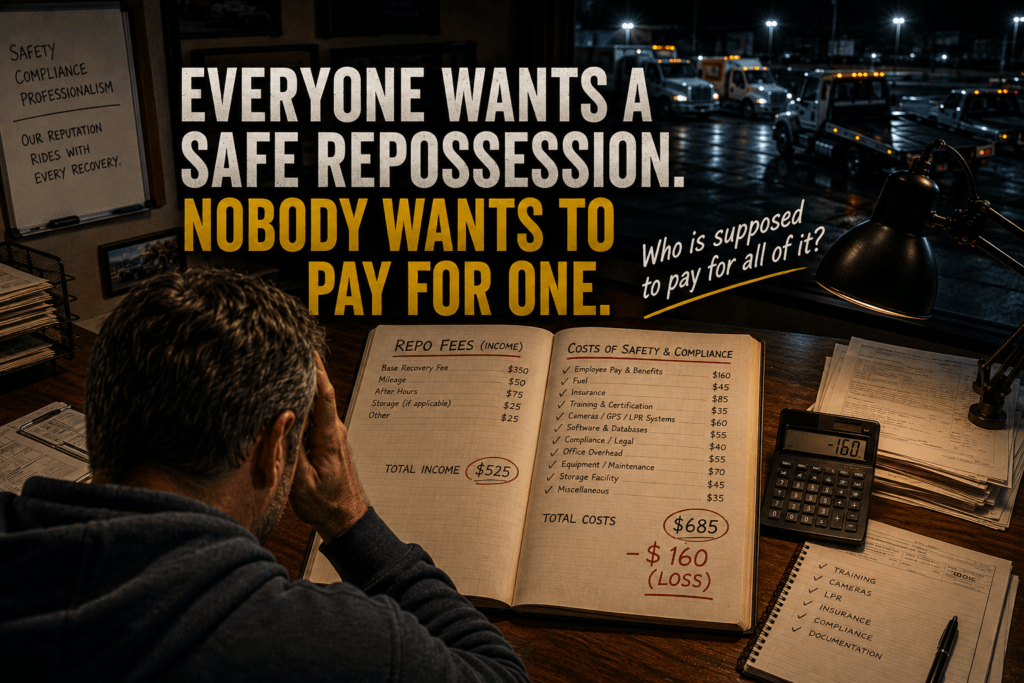
The repossession industry has spent years talking about compliance, consumer protection and safety. There is one uncomfortable question we still haven’t answered: Who is supposed to pay for all of it?
Everyone Wants a Safe Repossession. Nobody Wants to Pay for One
GUEST EDITORIAL
There may be no other industry where a company can be expected to send an employee into an unknown environment, locate and secure someone else’s collateral, avoid confrontation, protect personal property, comply with state law, document nearly every step, report the recovery to law enforcement, maintain expensive insurance and technology, and still potentially earn nothing if the collateral isn’t recovered.
That’s the contingency repossession model.
And somehow, we’ve convinced ourselves this is normal.
It may be time for lenders, forwarders, recovery agencies and regulators to have a much more uncomfortable conversation.
Everyone Wants a Safe Repossession. Nobody Wants to Pay for One
We Want Safer Recoveries, Great!
Everyone should agree on that. No vehicle is worth someone getting hurt.
Recovery agents should disengage when circumstances create an unacceptable risk of confrontation or breach of the peace. Agencies should invest in training, cameras, GPS, LPR technology, secure facilities, proper equipment, insurance, compliance programs and documentation.

But safety isn’t created by writing another policy. Safety requires resources.
A modern recovery operation isn’t a guy with a tow truck and a clipboard anymore.
There are trucks, wheel lifts, dollies, specialty equipment, cameras, GPS systems, LPR systems, cellular connections, databases, skip-tracing tools, software subscriptions, secure storage facilities, administrative employees, compliance personnel and insurance.
Then there is the person actually going into the field. At 2:00 in the morning. To take someone’s vehicle.
Maybe we should stop pretending that part is ordinary.
The Industry Has Created a Strange Incentive
Consider the basic economics.
A lender needs collateral recovered. A recovery agency accepts the assignment.
The agency spends money attempting to locate it.
Employees drive.
Fuel gets burned.
LPR databases get searched.
Addresses get checked.
Investigators work leads.
Software gets used.
Insurance remains in force.
Compliance work gets performed.
And if the vehicle isn’t recovered?
Depending upon the contract:
The agency may receive little or nothing.
Think about that business model for a moment. We’ve effectively told the party performing one of the riskiest parts of the transaction: “You finance the search for our collateral, and we’ll pay you if you’re successful.”
Then we’ve layered additional requirements on top of it.
And we wonder why recovery agencies disappear.
Then Something Even Stranger Happens
Suppose the vehicle is located, but recovering it requires additional equipment.
Maybe dollies are necessary.
Maybe additional labor is required.
Maybe the configuration of the vehicle or where it is parked makes the recovery substantially more difficult.
The recovery company has a decision to make.
Use the necessary equipment and perform the recovery correctly?
Attempt the recovery without it?
Walk away?
Or stop and request authorization while hoping the collateral is still sitting there when someone eventually answers?
This is where policy written in an office collides with reality in the field.
If specialized equipment is reasonably necessary to perform a recovery safely and without damaging the collateral, why should using that equipment become a billing fight afterward?
And here’s an even more uncomfortable question:
What happens when a charge is approved and then challenged after the work has already been performed?
An approval should mean something. Otherwise, it isn’t approval. It’s a suggestion.
Businesses cannot deploy employees and equipment based upon an authorization that can effectively disappear after the expense has already been incurred.
That isn’t merely a billing issue. It changes behavior in the field.
And that makes it a safety issue.
Are We Accidentally Creating More Dangerous Recoveries?
Nobody intends to create unsafe incentives, but incentives don’t care about intentions. Imagine telling a recovery agent:
Use extra equipment when necessary.
Don’t damage the collateral.
Don’t create a breach of the peace.
Don’t enter the vehicle unnecessarily.
Don’t trigger alarms unnecessarily.
Don’t remain on scene too long.
Follow every client procedure.
Document everything.
But we’re not sure we’ll pay for the additional equipment.
What behavior does that encourage?
If an employee knows the company may have to absorb the cost, there is enormous pressure, explicit or otherwise, to accomplish more with less.
That’s exactly the opposite of what a safety-focused industry should want.
We shouldn’t be asking:
“Could you have recovered it without the equipment?”
We should be asking:
“Was the equipment reasonably necessary to make the recovery safer and protect the collateral?”
Those are very different standards.
And Then There Is Personal Property
Here’s another unresolved contradiction. Recovery agencies are repeatedly reminded that personal property inside repossessed collateral creates serious responsibilities and potential liability.
Fair enough.
But agencies can simultaneously be subjected to increasingly restrictive rules governing who can retrieve that property and under what circumstances.
That creates another fundamental question:
Who actually owns the risk?
If the recovery agency is legally responsible for safeguarding property, but another entity controls whether and how that property can be released, responsibility and authority have been separated.
That’s dangerous.
Whenever one party has the responsibility and another party has the authority, disputes are inevitable.
Contracts should answer these questions clearly before the repossession occurs, not after somebody complains.
Law Enforcement Is Another Example
Recovery agencies are required in many jurisdictions to promptly notify law enforcement after a repossession. That makes sense.
A consumer wakes up, sees a missing vehicle and calls police.
Law enforcement needs to know whether the vehicle was stolen or repossessed.
But in many places, this remains a remarkably manual process.
An employee makes a telephone call.
Waits.
Provides information.
Gets transferred.
Provides the information again.
Obtains a badge number.
Documents the call.
Meanwhile, we live in a world where banks can transmit millions of dollars electronically in seconds. Why are we still relying so heavily on telephone calls to communicate time-sensitive repossession information? Why isn’t there a standardized electronic reporting system connecting licensed recovery agencies and law enforcement?
That isn’t science fiction.
It’s an API.
The technology already exists. The institutional coordination apparently doesn’t.
Technology Is Coming Whether the Industry Likes It or Not
LPR has already transformed collateral recovery. The next transformation will be automation and artificial intelligence.
Systems can increasingly monitor assignments, evaluate updates, identify actionable information, flag exceptions, detect billing opportunities, prioritize addresses and eliminate repetitive administrative work.
That creates legitimate concerns.
Who is responsible when automation makes a mistake?
How is consumer information protected?
What decisions should require a human?
What information can be shared?
Those questions deserve serious answers. But banning or resisting automation isn’t the answer.
Auditable automation may ultimately be more compliant than humans clicking through hundreds of repetitive updates every day.
A properly designed system doesn’t get tired. It doesn’t forget because the office got busy.
It can preserve an audit trail. It can escalate uncertainty to a human.
The goal shouldn’t be replacing judgment.
The goal should be reserving human judgment for situations that actually require it.
The Bigger Problem Is Fragmentation
Lenders have systems. Forwarders have systems. Recovery agencies have systems. LPR providers have systems.
Law enforcement has systems. Compliance vendors have systems.
And everyone keeps building another portal.
Every new portal is supposedly designed to improve efficiency. At some point we should ask why adding another login has become our industry’s definition of efficiency.
Recovery agents shouldn’t need ten screens to recover one car.
There should be secure standards allowing authorized systems to communicate.
Assignments.
Status updates.
LPR intelligence.
Fee approvals.
Repossession reports.
Compliance credentials.
Invoices.
Audit records.
All of it should be capable of moving securely between systems without someone retyping the same information five times.
Forwarders Need to Be Part of This Conversation Too
Forwarders provide real value when they reduce friction between lenders and thousands of recovery assignments.
But the industry’s structure deserves scrutiny whenever the intermediary creates more administrative burden than it removes.
The question shouldn’t be: “Do we need forwarders?”
That’s too simplistic. The better question is:
“What measurable value should a forwarder provide in 2026?”
Compliance oversight?
Absolutely.
Assignment management?
Potentially.
Nationwide vendor management?
Certainly.
But technology should eliminate duplicated work rather than institutionalize it.
An intermediary should reduce friction. If it creates friction, its role needs to evolve.
Everyone Talks About “Partnership”
That’s probably the most overused word in the industry.
Lenders call recovery agencies partners. Forwarders call recovery agencies partners. Vendors call recovery agencies partners.
Fine.
Then let’s define partnership. A partnership cannot mean:
We establish the rules.
You absorb the expense.
Your employee assumes the physical risk.
Your company carries the liability.
And we’ll decide afterward whether we’re paying the invoice.
That’s not partnership. That’s risk transfer.
Real partnership means each participant accepts responsibility for the risks it creates and the decisions it controls.
Consumers Have a Stake in This Too
This isn’t an argument for aggressive repossession. It’s the opposite. Consumers benefit when recovery agencies have enough time, equipment and resources to perform recoveries professionally.
They benefit when agents aren’t financially pressured to rush. They benefit when personal property procedures are clear.
They benefit when law enforcement knows immediately that a vehicle has been repossessed rather than stolen.
They benefit when every action has a digital audit trail.
And they benefit when the person approaching their vehicle has been properly trained, insured and equipped.
Cheap repossessions aren’t necessarily good for consumers. Professional repossessions are.
So, Let’s Ask the Questions Nobody Seems to Want to Answer
Who should pay for the cost of locating collateral that belongs to a lender?
When specialized equipment is reasonably necessary for a safe recovery, should its use require a billing negotiation?
Should an electronically approved charge ever be retroactively denied after the service was performed?
If an agency carries liability for personal property, how much authority should another party have over its release?
Why isn’t law-enforcement repossession reporting standardized and electronic?
Why are recovery agencies entering identical information into multiple disconnected systems?
What decisions should AI be allowed to automate?
What measurable value should forwarders provide?
And perhaps most importantly:
How much risk can we continue pushing toward the person standing next to the collateral before the system finally breaks?
The repossession industry doesn’t need another committee telling recovery agents to be safer. It needs lenders, forwarders, recovery agencies, technology companies, insurers and regulators sitting at the same table and redesigning the economics and infrastructure that determine what actually happens in the field.
Because eventually we have to choose.
We can demand safer, more compliant and more professional collateral recovery.
Or we can demand that somebody do it as cheaply as humanly possible.
We probably can’t keep demanding both.
Everyone Wants a Safe Repossession. Nobody Wants to Pay for One – Everyone Wants a Safe Repossession. Nobody Wants to Pay for One – Everyone Wants a Safe Repossession. Nobody Wants to Pay for One
Anonymous
Everyone Wants a Safe Repossession. Nobody Wants to Pay for One – Repossess – Repossession – Repossession Agency – Repossessor – Repossession – Repossession News – Training – Compliance






More Stories
Why Fight LPR? Join It — But What Happens When the Car Repossesses Itself?
In The Future Will There Be Anyone Left to Recover Vehicles?
The Broken Bond Between Lenders and Agents – Positive Resolution
The Repos That May Never Come
A Repossession Is a Repossession
When “Partner” Is Just Another Word for Vendor