


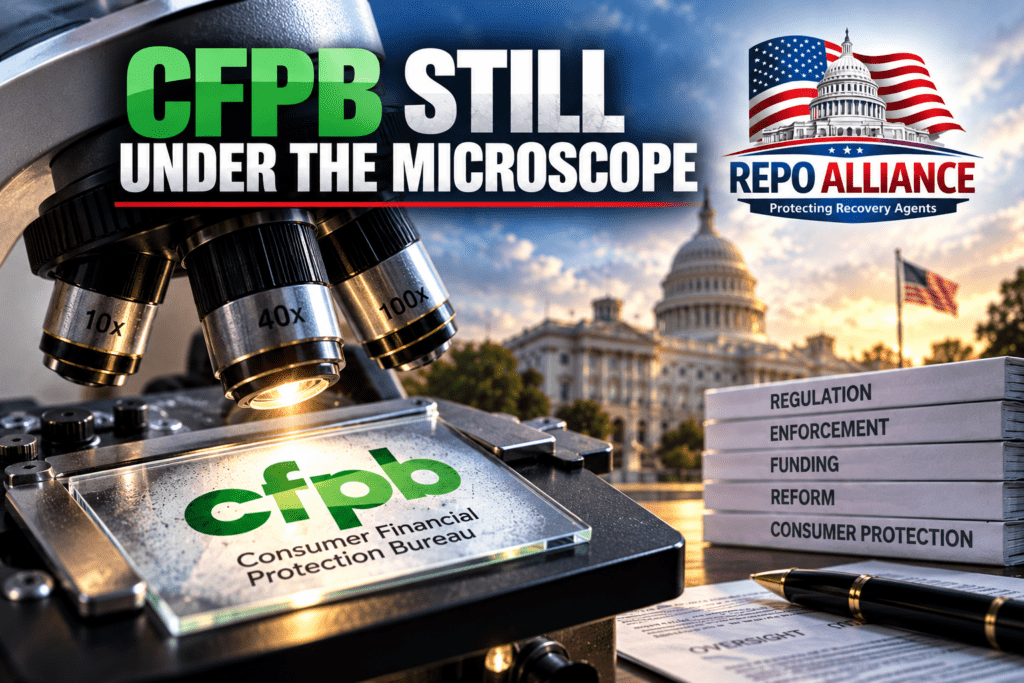
Congress Pushes for CFPB Reform as Questions Remain Over Who Should Watch the Watchdog
As I read through this article a Few thoughts ran through my mind. These are just my thoughts based on 35 years in the collateral recovery industry. Compliance and regulation are two-edged swords certainly compliance helps industries to set standard operating procedures, something this industry is in desperate need of. By the way, banks suffer from the same issues, they need clear definitions and clear expectations.
Congress wants control. To me regulated regulators could make them ineffective. What we see going on is a move towards lender friendly (big donation /vote getters) in congress, this is just normal Washington DC. There needs to be changes to the organization of the CFPB but, if you give congress total control over funding they will control consumer protection through budgeting maneuvers.
Consumer debt sits at an all-time high,18.8 trillion dollars with auto loans holding 1.71 trillion dollars and the average individual debt is about 63,500.00 People are living on credit, people are getting desperate. Delinquency might be leveling off but it is leveling off at historic highs. Consumers need a watch dog and although this watch dog has some issues it still serves the needs of the consumer.
I have said it at least 50 times if you think the Feds are bad if everything falls to the states watch out.
House Republicans and financial-services industry leaders are advancing a broad proposal to reshape the Consumer Financial Protection Bureau, arguing that clearer statutory limits, more transparent rulemaking and less reliance on enforcement actions would produce a more durable consumer-protection framework.
The Consumer Financial Protection Accountability and Reform Act of 2026, H.R. 10184, was unveiled Sept. 1 by House Financial Services Committee Chairman French Hill, R-Ark., Financial Institutions Subcommittee Chairman Andy Barr, R-Ky., and nearly all committee Republicans. The measure would make fundamental changes to the CFPB’s funding, governance, supervision and enforcement authorities, with supporters emphasizing regulatory certainty for both consumers and regulated firms.
The package arrives after years in which banks, fintech companies, credit unions, lenders and debt-collection businesses have faced changing priorities and legal interpretations at the CFPB. At a Capitol Hill roundtable held alongside the bill’s release, lawmakers and industry participants focused on the need for standards that are defined through legislation and rulemaking rather than through supervisory pressure, guidance documents or individual enforcement cases.
Hill said the legislation is meant to respond to “shifting priorities, unclear legal standards, duplicative supervision, and haphazard and overreaching enforcement” that he said have created uncertainty for both consumers and businesses.
“This package establishes durable guardrails to make the CFPB more accountable and transparent while keeping its focus where it belongs: protecting consumers and promoting competition, innovation, and access to affordable financial products and services,” Hill said in the committee’s announcement.
The committee’s framework places particular emphasis on reducing what supporters characterize as “regulation by enforcement.” The proposal would clarify certain CFPB authorities, add procedural protections in enforcement matters, establish more predictable supervisory and enforcement standards, and make explicit that agency guidance does not carry the force of law.
For accounts receivable management firms and creditors, that distinction could be significant. Compliance teams frequently must interpret a mix of statutory language, CFPB rules, examination findings, consent orders, advisory opinions and guidance. A legislative directive separating nonbinding guidance from enforceable requirements could make it easier to distinguish recommended practices from mandatory duties—though firms would still need to comply with applicable federal and state laws, including the Fair Debt Collection Practices Act and Regulation F.
UDAAP standards in focus
A central part of the proposal concerns the CFPB’s authority over unfair, deceptive or abusive acts or practices, commonly called UDAAP. The committee said the bill would require rulemaking to address the meaning of “abusive,” an authority that has generated substantial debate because the statutory definition has been viewed by many industry participants as broad and open to changing interpretation.
The measure’s supporters contend that a clearer definition and additional notice would help institutions assess compliance obligations before the CFPB brings an action. In practical terms, the issue is whether firms can make product, operational and collection-strategy decisions based on readily identifiable standards rather than attempting to infer expectations from settlements or enforcement complaints after the fact.
Roundtable participants also discussed the importance of allowing institutions to identify, correct and remediate consumer harm without automatically creating greater enforcement exposure. The committee said the proposal would reward firms that self-report and remediate problems, while also promoting penalties it describes as proportionate.
That approach could affect how creditors, servicers and collection agencies handle internal audit findings. A framework that provides meaningful credit for voluntary remediation may encourage earlier correction of disclosure, call-processing, complaint-handling or payment-posting issues. The eventual legislative text—and any implementing rules—would determine how much certainty firms receive and what conditions would apply.
Funding, oversight and supervision
The legislation would bring the CFPB into the regular congressional appropriations process, replacing its current funding mechanism through the Federal Reserve. It also would establish a dedicated CFPB inspector general, add rulemaking and retrospective-review requirements, and seek greater transparency around the bureau’s regulatory process.
Barr said the funding change is intended to strengthen congressional oversight of the agency. The committee’s announcement also says the proposal would require periodic reviews of major CFPB rules to evaluate whether their benefits justify their costs.
The bill’s structure covers five broad areas:
- CFPB governance and funding
- Legal clarity and procedural fairness, including UDAAP
- Innovation in consumer financial markets
- Supervision of banks and nonbanks
- Limits on regulation by enforcement
The supervision provisions are likely to draw close attention from both traditional financial institutions and nonbank market participants. The committee said the proposal would reduce duplicative examination and supervisory activity, coordinate oversight more effectively and establish a more risk-based approach. supervisory activity, coordinate oversight more effectively and establish a more risk-based approach.
For collection agencies and debt buyers, the potential relevance extends beyond direct CFPB examination authority. Changes to complaint processes, civil-penalty treatment, supervisory expectations and the boundaries of enforcement authority could influence creditor-vendor oversight, litigation risk assessments, consumer-dispute workflows and the compliance documentation that clients expect from their service providers.
Industry sees opening
The Sept. 1 roundtable featured Hill, Barr, Consumer Bankers Association President and CEO Lindsey Johnson, Financial Technology Association President and CEO Penny Lee, and former CFPB Director Kathy Kraninger. Discussion covered changing regulatory interpretations between administrations, federal-state regulatory coordination, cost-benefit analysis, retrospective review and the proper line between guidance and enforceable obligations.
The participation of bank and fintech trade-group leaders underscores the proposal’s broader industry appeal among organizations seeking a more stable regulatory environment. Supporters argue that predictability can improve consumer outcomes by enabling firms to invest in products, technology and compliance controls with a clearer understanding of the applicable rules.
Critics of major CFPB restructuring, however, are likely to argue that additional procedural barriers, narrower enforcement standards or appropriations-based funding could reduce the bureau’s ability to respond quickly to emerging consumer harms. The core policy question for Congress will be whether the proposal appropriately balances accountability and due process with the CFPB’s consumer-protection mandate.
What comes next:
The bill builds on a CFPB reform discussion draft circulated by the House Financial Services Committee earlier this year. Its final form remains uncertain, as individual provisions will face additional scrutiny during the legislative process and would need to clear both chambers of Congress.
For collection agencies, creditors and other consumer-finance providers, the near-term takeaway is not a change in existing obligations. Regulation F, the FDCPA, FCRA, state collection laws and other applicable requirements remain in force. But the proposal is a consequential signal of how House Republican leaders and key industry groups want future CFPB oversight to operate: with more explicit statutory boundaries, greater procedural safeguards, enhanced congressional accountability and a reduced role for policymaking through enforcement.
If enacted, the reform package could reshape not only the CFPB’s institutional structure but also the compliance calculus for firms across the consumer-credit and collections ecosystem.
WHO IS REPO ALLIANCE?
Repo Alliance Washington Update: The Week That Shaped Auto Finance – Repo Alliance Washington Update: The Week That Shaped Auto Finance – Repo Alliance Washington Update: The Week That Shaped Auto Finance
How and when was the group formed?
The initiative started several weeks ago with an invitation from ARA to all National and State Associations and other major industry leaders.
Is the Repo Alliance another association?
NO! The Repo Alliance is a collaborative effort of the groups which decided to answer the call and develop a fundraising program to further the interests of OUR industry and provide a voice at both National and State levels.
Which organizations came together?
American Recovery Association (ARA), the California Association of Licensed Repossessors (CALR), Texas Accredited Repossession Professionals (Texas ARP), and Harding Brooks Insurance.
How do you contribute?
- A Square account has been established.
- Click here to donate through Square.
- Champion, Promote and Spread the word about this industry initiative!
Can I use any other method to contribute?
YES, you can mail a check, payable to Repo Alliance at 1400 Corporate Dr., Suite 175, Irving, TX, 75038.
Will funding reports and expenditures be available for review?
- YES, this initiative will be completely transparent on monies raised with information available on the website.
- One hundred percent of all monies raised will be used to pay for lobbying efforts. Everyone involved other than the lobbyist is a volunteer.
Why hire a dedicated lobbyist instead of just working with other lobbying groups?
We are working with other industry lobbyist groups but have realized without OUR OWN VOICE, we would be trusting the future of the Recovery Industry to the priorities of others. Riding the coattails of these other groups, puts our agenda as simply an afterthought.
What are the GOALS?
- Change the negative, reputational image of the Recovery Industry.
- Educate legislatures of the vital role we play.
- Fight against language in bills or guidance from agencies that would decimate the recovery industry.
Contact Us
833-737-6255
833-REPOALL
CFPB Still Under the Microscope – CFPB Still Under the Microscope – CFPB Still Under the Microscope
Related:
Washington Takes Aim at the CFPB: What Auto Finance Needs to Know
Federal Shutdown Threat Puts Repossession Moratorium Back on the Radar
Federal Government Shutdown Triggers Repossession Moratorium!
Repo Alliance Washington Update: The Week That Shaped Auto Finance
Washington Shifts the Playing Field for Auto Finance
Washington Gridlock Meets Financial Data Reform
The Policy Changes That Could Shape Tomorrow’s Repossession Market
When the Watchdog Leaves: What a Smaller CFPB Could Mean for Repossession
Repo Alliance – Washington Shifts Could Reshape Repo Volume and Compliance Risk
Washington in Motion: What New Federal Actions Mean for Auto Finance and Repossession
Repo Alliance – This Week in Washington – March 2026
The Repo Alliance: Giving a Voice to a ‘Ghost’ Industry in Washington
Repo Alliance Progress & Updates from May DC Meeting
Repo Alliance – Let’s Not Lose our Minds
How Does the “One Big Beautiful Bill Act” Affect the Repo Industry?
CFPB Still Under the Microscope – Compliance – Repossess – Repossession – Repossession Agency – Repossessor – Repossession – Repossession News – CFPB – Consumer Financial Protection Bureau – CFPB






More Stories
New On Hook Episode: A Conversation with Bahador Rahimi
Meet Otto: Your New AI Assistant in Clarity
NARS 2027 Industry Award Nominations Are Open
Beyond the Camera: A New Standard for Agent Safety and Field Protection
A Million-Dollar Milestone No One Wishes Was Necessary
Policy is great – Culture is better