

Does the federal broker registration framework apply to repossession forwarding companies, and if so, what should the industry do about it?
The Registration Gap: A Compliance Brief for Repossession Industry Stakeholders
Introduction: The Compliance Gap
A federal registration requirement for brokers of motor carrier transportation has been part of federal law for decades. The requirement is functional in design: by its plain text, it appears to reach any entity that arranges transportation by motor carrier for compensation, regardless of what that entity calls itself or what industry it operates in.
One question has received little attention within the repossession industry: whether repossession forwarding intermediaries — entities that receive vehicle recovery assignments from secured creditors and arrange for field recovery agencies to perform the physical work — would meet the federal broker definition under 49 U.S.C. § 13102(2) and, if so, whether they are required to register with the Federal Motor Carrier Safety Administration under 49 U.S.C. § 14916(a) — the operative registration requirement — through the process established at 49 U.S.C. § 13904.
This paper does not answer that question for any particular entity. The determination of whether a specific intermediary meets the broker definition, and what that means for its obligations, belongs to qualified transportation counsel and, ultimately, to regulators and courts.
What this paper does is apply the statutory framework to the forwarding function as it is commonly practiced, identify the compliance question that application raises, and note the path the statute provides for addressing it.
The analysis proceeds in four parts: the federal broker framework and what it requires (Part I); the functional test applied to forwarding intermediaries (Part II); a brief note on the compliance exposure that follows from the question (Part III); and the path forward (Part IV).
Part I — The Federal Broker Framework
Three statutory provisions form the foundation of this analysis. Each is drawn from Title 49 of the United States Code, which governs federal transportation law.
The Broker Definition — 49 U.S.C. § 13102(2)

Federal law defines “broker” as:
“a person, other than a motor carrier or an employee or agent of a motor carrier, that as a principal or agent sells, offers for sale, negotiates for, or holds itself out by solicitation, advertisement, or otherwise as selling, providing, or arranging for, transportation by motor carrier for compensation.”
Several features of this definition warrant attention. First, the definition is functional in structure — by its plain text, it appears to turn on what an entity does, not what the industry calls it. An entity that performs the described function raises the registration question regardless of how it characterizes itself in vendor agreements or marketing materials.
Second, the definition excludes entities that are themselves motor carriers or the employees or agents of a motor carrier in the legal sense.
Third, the definition requires that the arranging function occur “for compensation,” but the statute does not appear to specify any minimum amount, frequency, or form.
Whether a forwarding fee, per-account payment, or margin retained on the transaction constitutes “compensation” under this language is a question the statute’s plain text appears to reach broadly.
The Registration Requirement — 49 U.S.C. § 14916(a)
49 U.S.C. § 14916(a) provides that a person may provide interstate brokerage services as a broker only if that person is registered under § 13904 and has satisfied the financial security requirements under § 13906.
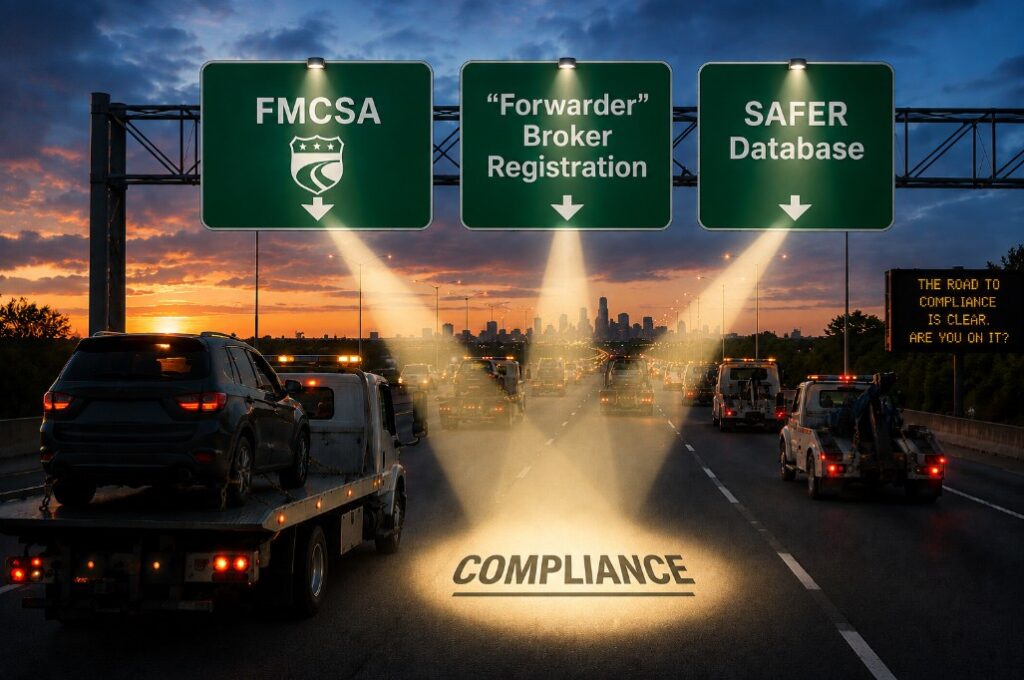
The text of § 14916(a) does not appear to contain a volume threshold, minimum transaction count, or phase-in provision. The registration question turns on whether an entity meets the broker definition — if it does, the statute would appear to require registration before that function is performed. Registration is obtained through FMCSA’s Unified Registration System (URS), which assigns a broker authority designation that appears in the publicly searchable SAFER database.
The Bond Requirement — 49 U.S.C. § 13906
Section 13906 requires each registered broker to maintain a surety bond or trust fund instrument as a condition of registration. The Moving Ahead for Progress in the 21st Century Act (MAP-21), Pub. L. 112-141 (2012), increased the required bond amount from $10,000 to $75,000 — a 650 percent increase.
What Registration Looks Like in Practice
FMCSA broker registration is an administrative process conducted through the Unified Registration System. An applicant designates the authority type sought — in this context, broker authority — and files the required surety bond through an approved provider.
Registered brokers appear in FMCSA’s SAFER database with an active authority designation, which any party can verify. The process does not require litigation or regulatory proceedings. For entities that conclude, after consulting qualified counsel, that registration is appropriate, the path is accessible.
Part II — The Functional Test Applied
Applying the broker definition to repossession forwarding intermediaries begins with a functional description of what those intermediaries do. The statutory analysis follows the function.
Function, Not Label
The broker definition at § 13102(2) focuses on function rather than label — what the entity does, not what it is called. An entity that performs the function described in the definition — arranging for transportation by motor carrier for compensation — raises the registration question regardless of whether it uses the word “forwarder,” “assignment desk,” or “dispatch platform.” The question this paper raises is whether the repossession forwarding function, as it is commonly practiced, maps to that statutory description.
The Three-Phase Transaction — An Overview
A typical forwarding transaction involves three functional layers. In the first phase, a secured creditor — usually a lender or financial institution — assigns a delinquent account to a forwarding intermediary. The assignment includes vehicle and debtor information and an instruction to recover the collateral.
In the second phase, the forwarding intermediary selects a field recovery agency and routes the assignment to it. In the third phase, the field recovery agency locates the vehicle, effects the repossession, and arranges transportation of the collateral — typically to a storage facility or auction site.
The forwarding intermediary’s operational role sits between the first and second phases: it receives assignments from creditors and dispatches field agencies to fulfill them. That dispatch function — selecting and routing a motor carrier to perform transportation for compensation — is the activity the broker definition appears to reach.
The Element-by-Element Question
The broker definition contains several functional elements. Each raises a question when applied to forwarding intermediaries.
Element 1 — Arranging for Transportation by Motor Carrier
The core question this element raises is whether the forwarding intermediary’s dispatch function constitutes “selling, offering for sale, negotiating for, or . . . arranging for . . . transportation by motor carrier.” The statute’s disjunctive structure is broad: any one of those functions, if performed for compensation, raises the registration question.
As to whether field recovery agencies constitute “motor carriers” within the meaning of the statute: several analytical touchpoints support that characterization. The repossession industry’s use of the FLSA motor carrier overtime exemption in employment litigation (29 U.S.C. § 213(b)(1)) is consistent with a characterization of vehicle recovery operations as falling within the federal motor carrier framework for purposes of that analysis.
And as a practical matter, repossession companies operating under active FMCSA motor carrier authority comply with Unified Carrier Registration (UCR) requirements, transit highway weigh stations, and receive DOT roadside inspections — the same regulatory touchpoints as any motor carrier operating in interstate commerce.
From the author’s direct operational experience in Georgia’s repossession sector, these requirements have applied without question or exception.
If the motor carrier characterization applies to field recovery agencies — as the indicators above suggest — the question becomes whether the forwarding intermediary’s assignment and routing of those agencies constitutes “arranging” within the meaning of § 13102(2). The statute’s plain language appears broad enough to reach that function. Notably, the definition does not appear to condition the analysis on volume. The text asks whether the intermediary arranges transportation by motor carrier — not whether it does so exclusively, predominantly, or across the majority of its assignments. A forwarding intermediary whose vendor network includes even a single field agency operating as a motor carrier would appear to raise the question.
It would be unusual for any forwarding intermediary operating at scale to have a portfolio that does not include voluntary surrenders, laydowns, and confirmed-location impounds — creditor clients routinely direct all assignment types through their forwarding relationships. On those assignments, there is no contested recovery element: the vehicle is located, the collateral is accessible, and the field agency’s function is to collect and transport. With the recovery question removed, the field agency’s role appears to be transportation — and the intermediary’s role appears to be arranging it. The characterization question is at its most direct on those assignments.
Element 2 — For Compensation
Forwarding intermediaries receive compensation for their role in the transaction — typically a fee from the creditor client, a per-unit payment, or a margin retained on the recovery rate. Whether that compensation constitutes payment for “arranging for transportation by motor carrier” is a question whose answer would appear to follow from how the first element is resolved. If the arrangement function is reached by the statute, the compensation element appears likely to be present as well.
Element 3 — By a Person Other than the Intermediary
In the forwarding model, it is the field recovery agency — not the forwarding intermediary — that provides the transportation. The intermediary arranges; the agency performs. This structural separation appears to map to the “by another person” element of the broker definition.
Element 4 — Not Providing Transportation Itself
The forwarding intermediary, in the typical model, does not operate its own recovery fleet. It does not dispatch its own personnel. It arranges for field agencies to do so. The distinction between arranging and providing transportation is the line the broker definition appears to draw.
Counter-Arguments — A Brief Note
Arguments against the application of the broker definition to forwarding intermediaries exist and deserve acknowledgment. The principal arguments are two.
First, the characterization of forwarding intermediaries as agents of the creditor rather than independent arrangers of transportation — an argument the author views as less persuasive in the modern forwarding model, where intermediaries operate independently (most SLA’s state this outright), contract with multiple field agencies across multiple creditor relationships, and retain their own fee structures.
Second, the contention that vehicle repossession does not constitute “transportation” within the meaning of the statute because the vehicle owner has not consented to the movement — an argument the author considers stronger in the contested involuntary recovery context and weaker in the voluntary surrender and lot-to-auction transport context, where consent questions do not arise in the same way.
Practitioners assessing the question for their own operations should weigh both with qualified transportation counsel.
Part III — A Note on Compliance Exposure
This paper’s scope is limited to identifying the registration question and the compliance path the statute provides. Three compliance exposure questions are worth raising here, briefly.
The § 14916 Question for Secured Creditors
49 U.S.C. § 14916(a) provides that a person may provide brokerage services as a broker only if registered under § 13904 and in compliance with the § 13906 bond requirement.
A separate provision, § 14916(c), may raise questions of civil penalty exposure for any person who knowingly authorizes, consents to, or permits a violation of the subchapter — a question that may be relevant to creditors who direct assignments to unregistered intermediaries.
If forwarding intermediaries are later found to meet the broker definition and were unregistered, § 14916 raises a question for secured creditors who directed recovery assignments to those intermediaries: what does contracting with an unregistered broker mean for the creditor’s own position under the statute?
This paper does not answer that question — it is a fact-specific inquiry that belongs to qualified counsel. What this paper raises is whether creditors who engage forwarding intermediaries without confirming their FMCSA registration status are operating with full information about that inquiry.
The § 14916 Question for Forwarding Intermediaries
Section 14916 also raises a question in a different direction. If a forwarding intermediary dispatches field recovery agencies that lack proper motor carrier authority, the intermediary may face a separate exposure question as an entity arranging transportation by an unregistered carrier.
This is analytically distinct from the creditor exposure question above — it concerns what the intermediary’s obligations may be with respect to the carriers it uses, not its own registration status. Both questions point toward a basic compliance verification that FMCSA’s SAFER system is designed to enable.
The FLSA Signal
One analytical signal worth noting is the motor carrier overtime exemption under the Fair Labor Standards Act, 29 U.S.C. § 213(b)(1). This exemption has been asserted within the repossession industry on the basis that recovery agents are engaged in transportation by motor carrier and therefore fall outside FLSA’s overtime requirements.
The question this raises is one of internal consistency. If the industry’s own position in the FLSA context is that field recovery agencies are motor carriers engaged in transportation, it is worth asking whether the same analytical framework — applied to the entities that receive assignments from creditors and route those assignments to field agencies — raises the question of whether those arranging entities meet the broker definition.
In the author’s analytical view, an industry position that treats its carriers as motor carriers for FLSA purposes, while treating the entities arranging those carriers’ work as outside the broker definition for FMCSA purposes, raises a question of internal consistency that practitioners would benefit from examining with counsel. This paper does not suggest there is no principled distinction — only that the question appears worth asking.
Part IV — The Path Forward
A Compliance Gap, Not a Character Failure
The federal broker framework was built in the context of freight transportation. Its application to vehicle repossession forwarding intermediaries was not apparent from the face of the statute, and the question does not appear — based on the author’s review of published enforcement actions, agency guidance, and federal case law — to have been addressed in any prior published forum.
The forwarding model developed and expanded over multiple decades during which this regulatory question went largely unexamined.
That history matters for how the compliance question should be approached. Entities that have operated without FMCSA broker registration did so in an environment where the requirement was not widely understood as applicable to their function.
The gap this paper identifies appears to be structural in origin — the product of two regulatory frameworks that developed independently and whose intersection was not closely examined as the forwarding model grew. That framing does not change the statutory analysis. But it does suggest that the appropriate response is a compliance assessment.
Registration as the Answer
The statute provides the path. An entity that concludes, after consulting qualified transportation counsel, that it meets the federal broker definition can register through FMCSA’s Unified Registration System, file the required $75,000 surety bond, and operate with active FMCSA broker authority.
Registration provides the path the statute identifies for addressing the compliance question. It also makes the intermediary’s status transparent to the creditors and field agencies that rely on it — a practical benefit independent of the regulatory obligation.
The Voluntary Compliance Window
An entity that assesses its registration position and acts voluntarily — before any formal regulatory finding or third-party challenge — is in a different posture than one that responds to a proceeding already underway. As a practical matter, acting on one’s own initiative, at a time of one’s own choosing, with counsel of one’s own selection, is a different position than responding to a demand.
The voluntary compliance window is open. The statutory process is accessible. The question this paper raises is one the industry can answer on its own terms.
A Note on Methodology
This paper presents the author’s industry analysis of the federal broker registration framework and its potential application to repossession forwarding intermediaries. The analysis is grounded in the author’s direct operational experience inside the vehicle recovery sector — including nearly two decades as the principal of a licensed motor carrier in Georgia’s repossession industry, holding active FMCSA motor carrier authority and complying with the federal motor carrier regulatory obligations described in this paper.
The statutory framework discussed is drawn from the current text of Title 49 of the United States Code and publicly available FMCSA regulatory guidance. The author’s review of published FMCSA enforcement actions, agency guidance documents, and federal court decisions did not identify any prior published treatment of the broker registration question as applied to repossession forwarding intermediaries.
This paper does not constitute legal advice. Readers seeking to assess their own regulatory obligations should consult qualified transportation counsel.
About the Author
Carl W. Carico is an industry analyst and the principal of a licensed motor carrier in Georgia’s vehicle recovery sector. He has held active FMCSA motor carrier authority for nearly two decades, complying with federal motor carrier registration, financial security, and operational requirements throughout his career — including Unified Carrier Registration, highway weigh station compliance, and DOT roadside inspection obligations. The analysis in this paper reflects that direct operational experience inside the forwarding ecosystem applied to the federal statutory framework.
He publishes industry analysis through Professional Recovery Press at ccarico.com. He is the creator of the Peace Point System™, a UCC § 9-609 breach-of-peace prevention framework, and has consults in operational and vehicle recovery and repossession matters.
Author’s Note
This paper presents the author’s industry analysis of the federal broker registration framework and its potential application to repossession forwarding intermediaries. It is published for informational purposes only and does not constitute legal advice. The author is not an attorney. No attorney-client relationship is created by this publication.
The statutory citations in this paper refer to provisions of Title 49 of the United States Code as the author understands them based on the current text of the statute and publicly available regulatory guidance. Readers seeking to assess their own registration obligations, or those of entities with which they do business, should consult qualified transportation counsel. The conclusions expressed herein represent the author’s analytical interpretation of the applicable statutory framework and are not offered as settled law or as the legal opinion of an attorney.
© 2026 Carl “Wes” Carico | Professional Recovery Press | ccarico.com. All rights reserved. This industry analysis is published for informational purposes only. It does not constitute legal advice and should not be relied upon as such. Reproduction permitted with attribution.
Carl W. Carico, Industry Analyst │ Professional Recovery Press │ ccarico.com
Published June 20, 2026 Version 2026-06-01
The Registration Gap: A Compliance Brief for Repossession Industry Stakeholders
Related Articles and More from Wes:
The Blind Spot Closes – Forwarding Intermediary Liability After Montgomery v. Caribe Transport II
Now Available: Peace Under Pressure
Now Available: Professional Standards in Repossession Volume II – Standards Lifecycle
Professional Standards in Repossession Volume I – A Book Review
Why I Took the Recovery Masters Course – and Why You Should Too
Use of Force in Repossession – The Line That Keeps You Safe
Can I Defend Myself or Others?
Get the increase, cut the contract, or close the doors
Ancillary Fees – The Associated Issues with Safety and Quality
Undervaluing Services – No Simple Fix, But the Responsibility Is Obvious
Framing the Conversation – Increases Are All About the Numbers, Not The Virus
Repossession Obsession – Questions Consumers, Legislators and Lawyers May Want to Start Asking
The Registration Gap: A Compliance Brief for Repossession Industry Stakeholders – The Registration Gap: A Compliance Brief for Repossession Industry Stakeholders – The Registration Gap: A Compliance Brief for Repossession Industry Stakeholders – The Registration Gap: A Compliance Brief for Repossession Industry Stakeholders
The Registration Gap: A Compliance Brief for Repossession Industry Stakeholders – Repossess – Repossession – Repossession Agency – Repossessor – Repossession – Forwarder – Contract – Auto Loan – Repossession Violence – Repossession History – Training – Compliance





More Stories
WHEN IS ENOUGH, ENOUGH? A Question Worth Asking Across the Repossession Industry
Three Million Repossessions: A New Measure of America’s Recovery Industry
Why Fight LPR? Join It — But What Happens When the Car Repossesses Itself?
In The Future Will There Be Anyone Left to Recover Vehicles?
The Broken Bond Between Lenders and Agents – Positive Resolution
The Repos That May Never Come