
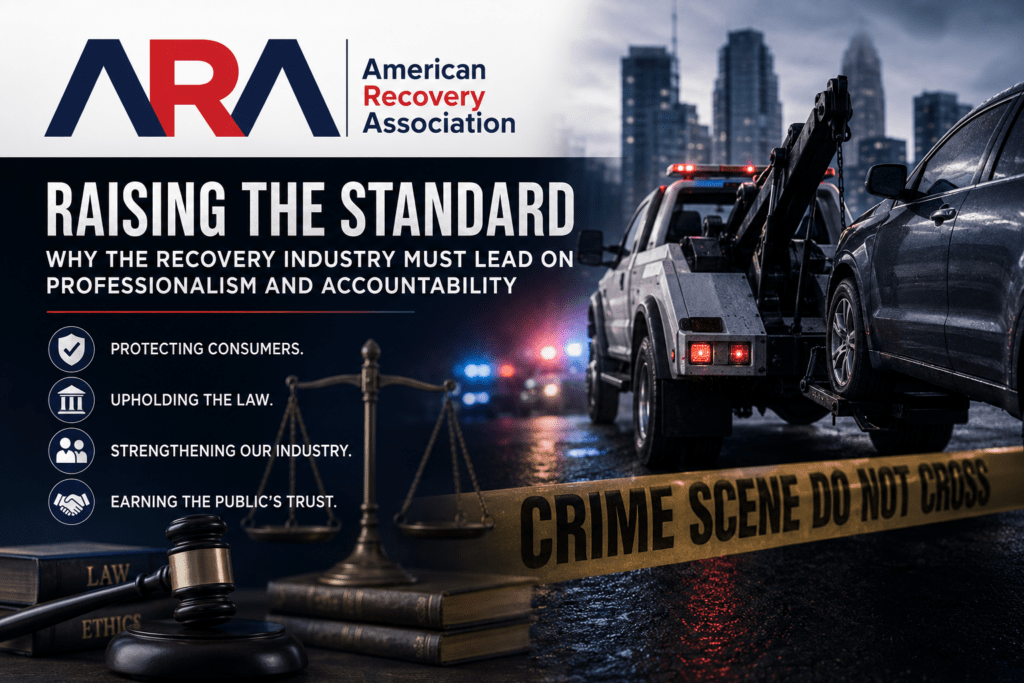
Raising the Standard: Why the Recovery Industry Must Lead on Professionalism and Accountability – Raising the Standard: Why the Recovery Industry Must Lead on Professionalism and Accountability
When incidents like the one recently reported in Charlotte occur, our industry has a responsibility to do more than simply condemn the actions of one individual. We must ask the harder question: How did someone with an apparent history of questionable conduct continue operating in this profession?
According to public reporting, the individual now faces multiple criminal charges after allegedly repossessing a vehicle while two occupants remained inside, deploying pepper spray, damaging a consumer’s phone, and engaging in conduct that ultimately resulted in felony charges. Media reports also indicate this was not an isolated incident, with previous investigations dating back to 2019 alleging a pattern of concerning behavior, including operating without a valid driver’s license and other questionable practices.
Whether every allegation is ultimately proven in court is for the legal system to decide. But if the reported pattern is accurate, it highlights a much larger issue our industry can no longer afford to ignore.
Many of the nation’s largest financial institutions and forwarding companies require recovery agencies to maintain insurance, complete background screenings, meet compliance standards, and continually demonstrate their qualifications before receiving assignments.
Yet that same level of oversight often disappears when recoveries are performed directly for smaller lenders, buy-here-pay-here dealerships, or independent creditors. In many cases, there is no consistent national standard to ensure the individual performing the recovery has received proper education, understands the law, demonstrates professional competency, or remains accountable after entering the profession.
That gap in oversight creates unnecessary risk for consumers, creditors, recovery companies, and the public alike.
It also highlights another important responsibility. Creditors, particularly smaller lenders and buy-here-pay-here dealerships, must understand what qualifications they should expect from the recovery companies they hire. Too often, vendor selection is driven primarily by price or convenience rather than by training, compliance, insurance, ethics, and professional accountability.
Hiring qualified professionals protects consumers, reduces liability, safeguards the creditor, and strengthens the reputation of our entire industry.
This issue goes far beyond whether someone possesses a CCRS or CARS certification. Those programs provide valuable education and represent an important foundation, but education alone does not define a profession.
Professionalism requires ongoing ethics, continuing education, compliance monitoring, accountability, and the ability to intervene when someone demonstrates they should no longer represent the profession.
There have been numerous publicly reported incidents over the years involving breaches of the peace, unlawful conduct, consumer complaints, and repeated failures to follow accepted professional practices. Whether every allegation is ultimately proven is a matter for the legal system, but collectively these incidents reveal a common problem: inconsistent professional standards and a lack of meaningful oversight.
These patterns should become part of the conversation with legislators because they reinforce the need for a profession governed by meaningful standards rather than allowing individuals to perform collateral recoveries without first demonstrating they meet minimum professional expectations.
Who better understands this profession than those who have dedicated their careers to it? Other professions, including medicine, law, engineering, and accounting, protect the public through recognized professional standards, continuing education, ethical oversight, and disciplinary processes. The recovery industry should strive to do the same.
The profession should move toward a model in which those performing recoveries are members of recognized national professional associations that establish and enforce minimum standards for education, ethics, compliance, consumer interaction, and continuing professional development.
Organizations such as the American Recovery Association and Allied Finance Adjusters have spent decades developing best practices, education programs, and professional expectations. They are uniquely positioned to help establish nationally recognized standards that benefit consumers, creditors, and recovery professionals alike.
More importantly, they provide something licensing alone cannot.
A state license answers one question: Is an individual legally permitted to perform repossessions within that state’s laws?
Professional oversight answers another, equally important question: Should that individual continue representing the profession?
Licensing grants legal authority to operate. Professional associations establish expectations for ethics, competency, continuing education, consumer interaction, and accountability. One provides permission to enter the profession; the other helps ensure the privilege is earned and maintained.
When someone repeatedly violates those standards, there should be consequences beyond simply losing a client. There should be a fair and transparent process for review, remediation, discipline, suspension, or removal from professional standing that protects consumers, creditors, legitimate recovery companies, and the reputation of an industry that is overwhelmingly composed of hardworking professionals who perform this difficult work safely, ethically, and lawfully every day.
Achieving that requires more than educating recovery professionals. It also requires educating the creditors who hire them.
States that have already enacted licensing requirements should evaluate whether their laws truly provide meaningful consumer protection. Licensing should extend beyond background checks and initial qualifications to include continuing education, ethical obligations, compliance requirements, and mechanisms for discipline when those standards are violated.
Likewise, states considering new licensing legislation should build these principles into law from the beginning rather than creating licensing systems that function primarily as registration programs.
A license should represent more than permission to operate. It should reflect a commitment to professionalism.
When one company fails, the public rarely distinguishes between that company and the rest of the profession. The damage extends far beyond a single incident. It affects every reputable recovery agency that has invested in training, compliance, professionalism, and doing the job the right way.
The question before us is not whether change is coming. It is whether our profession will lead that change or wait for others to impose it.
If we fail to establish meaningful professional standards and hold ourselves accountable, someone else eventually will. The choice is ours.
That is why the recovery industry should move toward nationally recognized professional standards supported by associations with established governance, ethics, education, compliance oversight, and fair disciplinary processes. Professionalism should not depend on who hired the recovery company or where the recovery takes place; it should be the expectation across our profession.
The American Recovery Association and Allied Finance Adjusters should lead this effort by bringing together lenders, forwarding companies, recovery agencies, state associations, legislators, and other industry stakeholders to establish nationally recognized professional standards, advocate for model legislation, and create a framework of education, ethics, compliance, and accountability that defines what it truly means to be a recovery professional.
Together, we have an opportunity to strengthen public trust, reinforce creditor confidence, and shape a profession that is defined by excellence rather than remembered for its exceptions.
A profession is not defined solely by the authority to perform the work; it is defined by the standards to which it holds itself.
The time to lead is now.

Raising the Standard: Why the Recovery Industry Must Lead on Professionalism and Accountability – Raising the Standard: Why the Recovery Industry Must Lead on Professionalism and Accountability – Raising the Standard: Why the Recovery Industry Must Lead on Professionalism and Accountability
 Regards,
Todd Case | President
American Recovery Association
www.repo.org
Raising the Standard: Why the Recovery Industry Must Lead on Professionalism and Accountability – Repossession Violence – Repossession History – Repossession – Repossess – Repossession – Repossession Agency – Repossessor – American Recovery Association – ARA





More Stories
New On Hook Episode: A Conversation with Bahador Rahimi
NY Repo Agent Allegedly Beaten and Put in Chokehold
Beyond the Camera: A New Standard for Agent Safety and Field Protection
Bail Collateral Repo Turns Into 100-MPH Fugitive Chase
“Repo Man” Arrested After Alleged Wrongful Repossession
ARA Calls Industry Leaders to the Table Amid Historic Fuel and Operating Cost Pressures