



The New Yorker Found a Repo Man. It Missed the Industry
The New Yorker Article – The Story She Didn’t Write
EDITORIAL
You just can’t hate the press enough. The New Yorker recently published a lengthy feature on the repossession industry. Or at least that is what many readers probably believe they read. In reality, they read the story of one repossessor.
A colorful one.
A complicated one.
A perhaps fascinating if not tragic one.
And that distinction matters.
Read the Article Here!
The New Yorker Article – The Story She Didn’t Write
The article follows repossessor Matthew Pitman through addiction, prison, family tragedy, YouTube fame, personal redemption, and his return to the recovery industry. It is compelling journalism and an engaging character study.
But if the goal was to understand the modern professional repossession industry, readers may have come away knowing far more about one man than the true industry itself.

That is unfortunate because hidden throughout the article is a very different story. A much more important story. A story that never quite becomes the focus.
A Character Study Disguised as an Industry Profile
Consider the disparity in coverage. Thousands of words are devoted to RepoNut.
His videos, his confrontations, his criminal history, his addiction, his prison sentence, his personal struggles, his badge, his social media presence and his life.
Meanwhile, many of the industry’s most respected voices appear only briefly before the narrative rushes back to its chosen protagonist.
Former ARA President Vaughn Clemmons reportedly spent nearly thirty minutes speaking with the reporter. His decades of experience, industry perspective, and observations about professionalism were ultimately distilled down to a few brief quotes.
Danny and Sophia Pabon, operators of one of the industry’s most respected professional recovery companies, received similar treatment.
Meanwhile, thousands of words were devoted to the exploits of RepoNut.
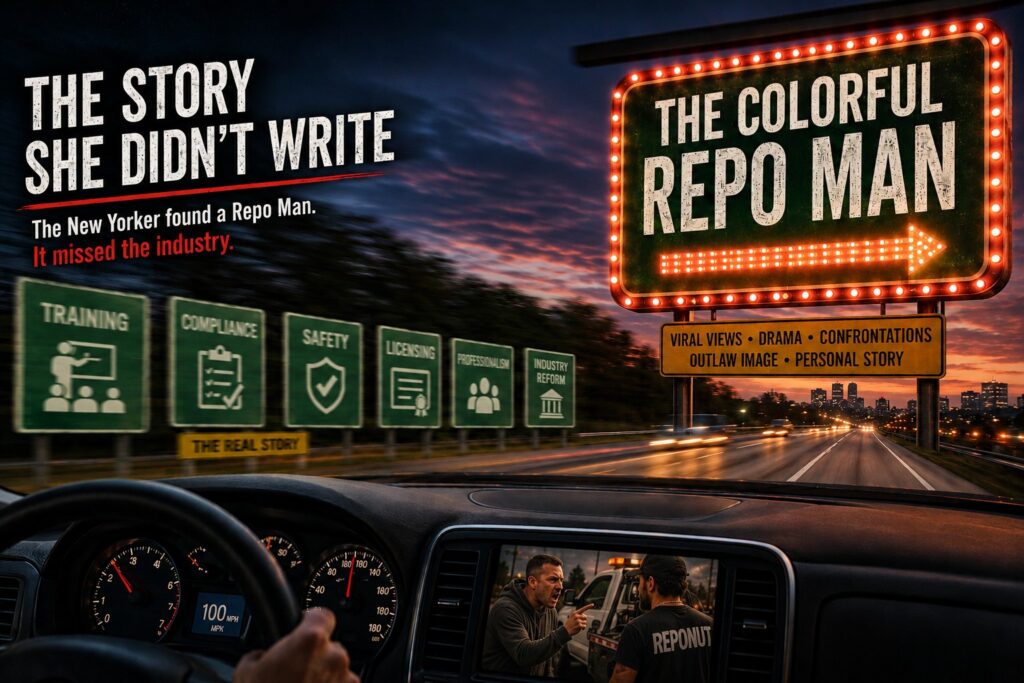
Discussions about compliance, training, licensing, technology, insurance requirements, safety programs, and industry reform appear throughout the article like the blur of road signs being passed by a speeding vehicle.
The reader sees them.
But never stops.
The Professional Industry Was Right There
What makes the article particularly frustrating is that the professional side of the industry was not hidden from the reporter. In fact, it appears repeatedly throughout the story.
Readers are introduced to wounded recovery agents being honored at NARS. They hear discussions about safety, training, professionalism, licensing, de-escalation, compliance, and industry standards. They are introduced to operators and business owners who have spent years trying to move the profession away from its outlaw image and toward a more professional future.
The article repeatedly opens the door to that story.
It simply never walks through it.
Instead, just as the conversation begins to shift toward where the industry is today, the narrative returns to RepoNut, his personal history, his YouTube channel, his addiction, his prison sentence, or another colorful chapter from his life.
The irony is impossible to miss.
The article successfully found both repossession industries.
The one that existed yesterday.
And the one that exists today.
It simply chose to spend most of its time with the former.
The result is a story that acknowledges the industry’s ongoing professional transformation while simultaneously focusing its spotlight elsewhere.
The Most Important Quote in the Entire Article
The irony becomes impossible to ignore near the end of the story. After spending thousands of words chronicling the rise of a social media repo celebrity, the article quotes Danny Pabon discussing one of the industry’s ongoing reputation challenges.
When asked what he tells his employees about posting online, his answer was simple:
“They shouldn’t post anything online.”
There it is. Perhaps the most revealing sentence in the entire article.
The industry’s most successful operators are moving away from exactly the behavior that made the article’s central character famous.
One story is about where the industry came from. The other is about where the industry is trying to go.
Guess which one received most of the attention?
The Industry Behind the Stereotype
This is not a criticism of Matthew Pitman. By his own admission, he has lived an extraordinary life. Nor is it a criticism of the reporter.
Journalists have always been drawn to compelling personalities. The problem is that compelling personalities often make poor representatives. Today’s recovery industry bears little resemblance to the profession that existed decades ago.
Modern recovery agencies operate under lender audits, compliance reviews, insurance requirements, data security protocols, camera systems, GPS monitoring, licensing requirements in many states, and increasing legal scrutiny.
Entire conferences are now dedicated to safety, training, professionalism, and risk management.
The industry’s leaders are not trying to become internet celebrities. They are trying to become less interesting.
Less dramatic, less confrontational, less controversial and more professional.
That story may not generate millions of YouTube views. But it is the story that is increasingly defining the profession and industry.
The Story Journalists Keep Retelling
Perhaps the most fascinating aspect of the article is how familiar it feels. For more than a century, reporters have approached repossession the same way.
They find an interesting repo man, they climb into the truck, they watch the recovery and they tell the story.
As far back as 1925, newspapers were doing exactly that. Here we are a century later, little has changed other than the technology.
The trucks are newer, the technology is different, the cameras are digital and the license plate readers are computerized.
But the narrative remains remarkably familiar.
The colorful repo man becomes the story while the industry itself fades into the background.
The New Yorker Article – The Story She Didn’t Write
The Story She Didn’t Write
Buried within the article was a far different story. A story about an industry struggling to professionalize itself. A story about operators advocating training, standards, licensing, accountability, and safety.
A story about leaders trying to move the profession away from the very image that continues to attract media attention.
It is THE story that appeared repeatedly throughout the article yet it never became the article.
Perhaps that is because professionalism is harder to write about than personality. Perhaps it is because compliance officers do not make compelling protagonists.
Or perhaps it is because every generation of journalists rediscovers repossession through the same familiar lens. Whatever the reason, the result remains the same.
After a century of ride-alongs, reporters continue to seek and find the same colorful Repo Man character.
The question is whether they are still finding the same industry. The other question is, will they ever?
I have done probably more than twenty interviews over the years and it always turns out like this. A one-hour interview with two quotes inserted in a ride-along story. Why does anyone bother anymore?
It often feels as though the media is less interested in the industry that exists today than the industry it wishes still existed.
The colorful outlaw.
The social media celebrity.
The confrontation.
The spectacle.
Those stories are easy to write.
The harder story is the one about thousands of recovery professionals quietly trying to do the job correctly every day.
Unfortunately, that is the story that never gets written.
Read the Article Here!
The New Yorker Article – The Story She Didn’t Write – The New Yorker Article – The Story She Didn’t Write – The New Yorker Article – The Story She Didn’t Write
Kevin Armstrong
Publisher
The New Yorker Article – The Story She Didn’t Write – Repossess – Repossession – Repossession Agency – Repossessor – Repossession – Compliance – Repossession Violence – Repossession History – NARS – North American Repossessors Summit






More Stories
The Cost of Collecting LPR Data Has Gone Up. Why Hasn’t the Pay?
WHEN IS ENOUGH, ENOUGH? A Question Worth Asking Across the Repossession Industry
Three Million Repossessions: A New Measure of America’s Recovery Industry
Why Fight LPR? Join It — But What Happens When the Car Repossesses Itself?
In The Future Will There Be Anyone Left to Recover Vehicles?
The Broken Bond Between Lenders and Agents – Positive Resolution