


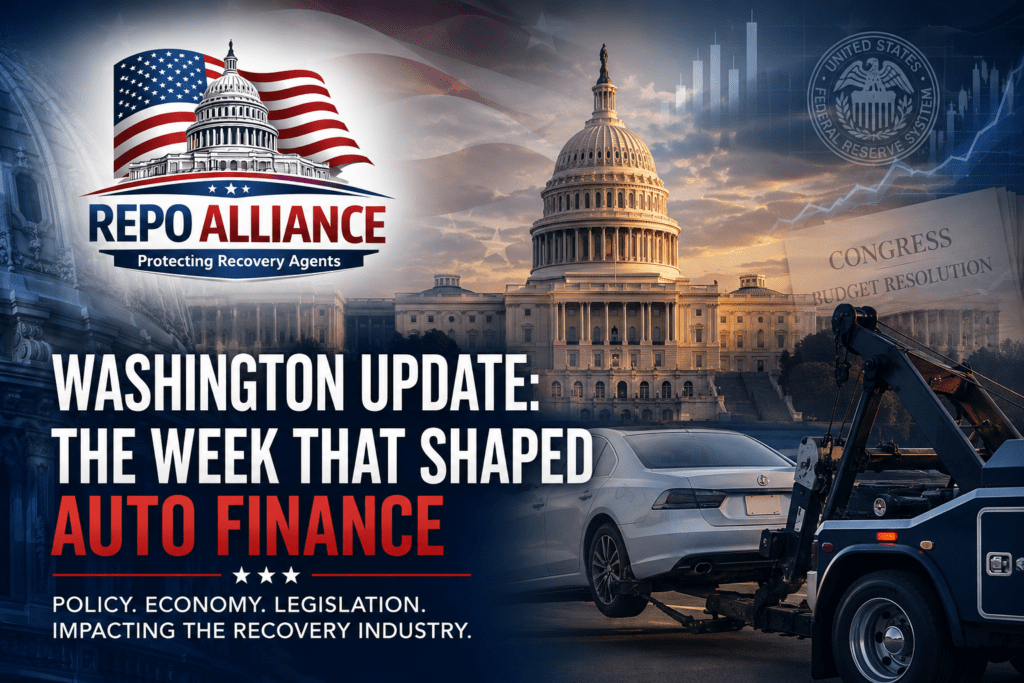
Trump promotes domestic manufacturing, the Fed holds rates steady, Congress races to avert a shutdown, and key policy decisions continue to influence the lending and recovery industries.
Repo Alliance Washington Update: The Week That Shaped Auto Finance – Repo Alliance Washington Update: The Week That Shaped Auto Finance
Federal policy decisions rarely affect the recovery industry overnight, but they often shape the business environment for months and years to come. This week’s developments from Washington include President Trump’s latest push to strengthen domestic auto manufacturing, the Federal Reserve’s decision to leave interest rates unchanged, congressional negotiations to avoid a government shutdown, and uncertainty surrounding the nation’s top law enforcement post. Together, these actions could influence vehicle sales, auto lending, collections, regulatory enforcement and the overall operating climate for repossession professionals.
Here’s what Repo Alliance is watching, and why it matters to the recovery industry.
7.31.26: Auto Finance Update
President Trump Talks to Auto Industry
This week, President Trump visited a General Motors plant in Milford, Michigan. During the visit he spoke to workers and discussed the automotive industry. In particular, the president boasted new capital investments automakers have made in the United States. Key excerpts from the speech include:
- He commended Congress for making interest on auto loans tax deductible.
- “Today, I’m proud to say that the auto industry is back and America is back, and it’s pulling Detroit and Michigan along with it.”
- “But now all of that is changing, because I placed historic tariffs on foreign producers and manufacturers, including a 25 percent tariff on foreign automobiles, something that no other president had the courage to ever do.”
Repo Alliance Washington Update: The Week That Shaped Auto Finance
Fed Holds Interest Rates Level
In one of the first meetings under new Federal Reserve Chairman Kevin Warsh, the Federal Open Market Committee announced they are keeping interest rates unchanged. In its announcement, the Fed said: “The Committee decided to maintain the target range for the federal funds rate at 3-1/2 to 3-3/4 percent, in support of the Federal Reserve’s dual mandate.
The Committee is continuing its policy of maintaining ample reserves in the banking system. Economic activity is expanding at a solid pace despite elevated uncertainty that owes, in part, to the conflict in the Middle East. Productivity growth and capital investment are strong. Job gains have kept pace with the workforce, and the unemployment rate has changed little.
Inflation remains elevated relative to the Committee’s 2 percent goal, in part reflecting supply shocks that have driven price increases in certain sectors, including energy. The Committee will deliver price stability.”
Prior to the meeting, Treasury Secretary Scott Bessent said he hoped Warsh would act independently and “follow the data” in making his decision with the committee. FOMC was torn between President Trump’s recent calls to reduce rates to stimulate investment and economic realities that inflation continues to grow beyond target levels.
The unchanged interest rate is mixed news for the automotive industry. Though the rates are unchanged, economists are not showing a strong consensus that the FOMC will indeed raise interest rates at some point in 2026.
Repo Alliance Washington Update: The Week That Shaped Auto Finance
Senate Close to CR to Avoid Shutdown, Reconciliation 3.0 Remains Open Question
With just over three months left before the midterm elections, time is running out for Republicans in Congress to pass key bills that may help their electoral prospects. A series of high-priority bills seem to be converging into one larger political fight that is testing the Senate and pitting President Trump against Senate Majority Leader John Thune (R-SD).
Last week, the House of Representatives passed a continuing resolution funding the government through December 4th. As a reminder, a continuing resolution essentially extends current appropriations spending levels and provisions for a temporary period while Congress works on a full spending deal for FY27. The Senate agrees with an early December expiration date, but it plans to add a series of anomalies, which are designations providing extra funding for emergency items, to the House-passed bill. Leader Thune filed cloture on a vehicle for the Senate CR on Thursday, and it is possible he will release the Senate’s version of the CR today, with the expectation that the upper chamber vote on the measure next week.
However, there are some loose ends to tie up. Some Democrats are demanding the CR include a legislative provision blocking the Office of Management and Budget from advancing its “Regulation on Federal Financial Assistance.” Some Republicans are demanding the CR include the SAVE Act, which reforms federal law regarding voter registration and elections. Despite their frustrations, signs suggest the CR will be relatively clean and is likely to pass next week.
What is less clear is what the Senate will do in regard to Reconciliation 3.0. Last week, by a vote of 216-214, the House of Representatives passed the concurrent budget resolution for FY27. That budget resolution authorizes Congress to begin a $95 billion budget reconciliation process (Reconciliation 3.0, as it is commonly known).
This would allow Republicans to pass a major bill through the Senate with 51 votes instead of the traditional 60 votes needed to end a filibuster. The House version directs four committees to participate in the budget reconciliation process: the House Armed Services Committee is to spend $60 billion on military hardware.
The House Intelligence Committee is to spend $13 billion on intelligence programs, the House Agriculture Committee is to spend $12 billion to provide support to farmers, and the House Administration Committee is to spend $10 billion, effectively incentive payments to states to adopt voter registration and election reforms consistent with President Trump’s SAVE Act. The current thinking is that Reconciliation 3.0 will not include any offsets to the $95 billion bill.
But the House’s version of Reconciliation 3.0 is not popular in the Senate. Defense hawks are asking for significantly more money for the Pentagon, growing the cost of the bill. Budget hawks warn they want to see offsets to the new spending. And President Trump surprised the Senate by urging them to add an increase to the debt limit, something which will not make the bill more popular among Senate Republicans.
At this point, Leader Thune says the Senate doesn’t have the votes to pass the budget resolution. This has President Trump considering whether Thune is the right leader in the Senate. Thune responded that if another Republican can lead the Senate, it would be “a big relief.” Senate Republicans continue to talk about the Reconciliation 3.0 package to see if there is a variation of it that can keep 51 senators on board. If they can reach an agreement on that, they would reverse engineer the budget resolution to reflect the committee instructions.
Though the CR’s outlook is positive, and would avoid a shutdown during the elections, little else is certain as the Senate continues to evaluate its priorities.
Repo Alliance Washington Update: The Week That Shaped Auto Finance
Attorney General Nomination in Doubt
Todd Blanche, the acting Attorney General and nominee to be permanent Attorney General, faces a setback this week. The Senate Judiciary Committee had planned to vote on his nomination, but it has been delayed indefinitely. Republican senators have expressed concerns about Blanche for his close ties to President Trump and whether he can act independently of the president. In particular, Senator John Cornyn (R-TX) says he won’t vote for Blanche until the Department of Justice rescinds its agreement to never prosecute Donald Trump, his family, or his businesses, for any potential tax violations.
The situation deteriorated further when President Trump hinted he may withdraw Blanche’s nomination, allowing him to remain acting Attorney General indefinitely. The Attorney General oversees federal investigation into antitrust matters of significance to the auto finance industry.
WHO IS REPO ALLIANCE?
Repo Alliance Washington Update: The Week That Shaped Auto Finance – Repo Alliance Washington Update: The Week That Shaped Auto Finance – Repo Alliance Washington Update: The Week That Shaped Auto Finance
How and when was the group formed?
The initiative started several weeks ago with an invitation from ARA to all National and State Associations and other major industry leaders.
Is the Repo Alliance another association?
NO! The Repo Alliance is a collaborative effort of the groups which decided to answer the call and develop a fundraising program to further the interests of OUR industry and provide a voice at both National and State levels.
Which organizations came together?
American Recovery Association (ARA), the California Association of Licensed Repossessors (CALR), Texas Accredited Repossession Professionals (Texas ARP), and Harding Brooks Insurance.
How do you contribute?
- A Square account has been established.
- Click here to donate through Square.
- Champion, Promote and Spread the word about this industry initiative!
Can I use any other method to contribute?
YES, you can mail a check, payable to Repo Alliance at 1400 Corporate Dr., Suite 175, Irving, TX, 75038.
Will funding reports and expenditures be available for review?
- YES, this initiative will be completely transparent on monies raised with information available on the website.
- One hundred percent of all monies raised will be used to pay for lobbying efforts. Everyone involved other than the lobbyist is a volunteer.
Why hire a dedicated lobbyist instead of just working with other lobbying groups?
We are working with other industry lobbyist groups but have realized without OUR OWN VOICE, we would be trusting the future of the Recovery Industry to the priorities of others. Riding the coattails of these other groups, puts our agenda as simply an afterthought.
What are the GOALS?
- Change the negative, reputational image of the Recovery Industry.
- Educate legislatures of the vital role we play.
- Fight against language in bills or guidance from agencies that would decimate the recovery industry.
Contact Us
833-737-6255
833-REPOALL
Related:
Washington Shifts the Playing Field for Auto Finance
Washington Gridlock Meets Financial Data Reform
The Policy Changes That Could Shape Tomorrow’s Repossession Market
When the Watchdog Leaves: What a Smaller CFPB Could Mean for Repossession
Repo Alliance – Washington Shifts Could Reshape Repo Volume and Compliance Risk
Washington in Motion: What New Federal Actions Mean for Auto Finance and Repossession
Repo Alliance – This Week in Washington – March 2026
The Repo Alliance: Giving a Voice to a ‘Ghost’ Industry in Washington
Repo Alliance Progress & Updates from May DC Meeting
Repo Alliance – Let’s Not Lose our Minds
How Does the “One Big Beautiful Bill Act” Affect the Repo Industry?
Repo Alliance Washington Update: The Week That Shaped Auto Finance – Repossess – Repossession – Repossession Agency – Repossessor – Repossession – Compliance – Consumer Financial Protection Bureau – CFPB – Lending – Auto Loan






More Stories
New On Hook Episode: A Conversation with Bahador Rahimi
Meet Otto: Your New AI Assistant in Clarity
NARS 2027 Industry Award Nominations Are Open
Beyond the Camera: A New Standard for Agent Safety and Field Protection
A Million-Dollar Milestone No One Wishes Was Necessary
Policy is great – Culture is better