


A Call for Industry-Wide Discussion on Frivolous Litigation and the Future of Risk in the Recovery Industry
GUEST EDITORIAL
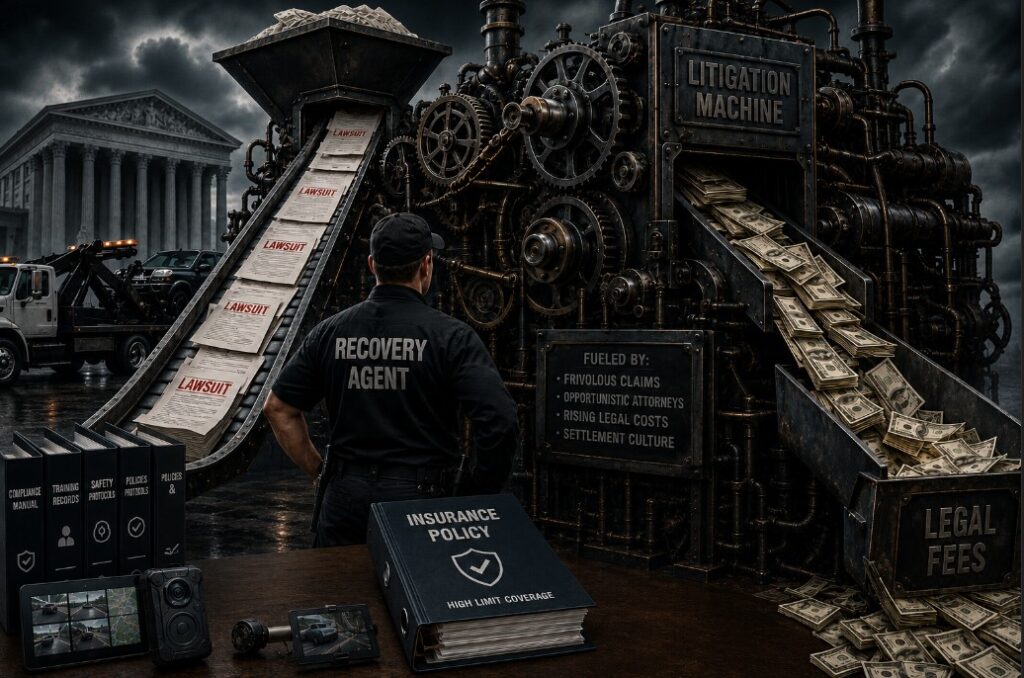
The repossession and recovery industry has evolved dramatically over the last decade. Today’s professional recovery agencies operate under some of the most rigorous compliance expectations and risk management standards ever seen in the industry. Agencies invest heavily in driver training, de-escalation protocols, compliance systems, GPS tracking, body and vehicle camera systems, documentation procedures, and high-limit insurance coverage, all with the shared goal of protecting consumers, reducing incidents, and operating professionally and transparently.
Yet despite these efforts, many agencies continue to face an escalating cycle of litigation that raises an important question for our industry:
Are we unintentionally incentivizing frivolous claims rather than discouraging them?
Across the country, recovery agencies are documenting every interaction in extraordinary detail. In many cases, video evidence, procedural records, and compliance documentation clearly demonstrate that allegations made against agencies are unsupported or exaggerated. However, even when evidence strongly favors the agency, claims are frequently settled before ever reaching a courtroom.
The reason is simple: litigation costs.
Insurance carriers are often forced to make business decisions based on the expense of prolonged legal defense rather than the actual merits of a claim. While understandable from a cost-management perspective, the long-term effect creates a troubling pattern: attorneys recognize that filing suit alone may result in settlement, regardless of whether substantial wrongdoing occurred.
This cycle impacts everyone.
It affects insurance loss histories. It increases premiums across the industry. It places enormous financial pressure on compliant operators. Most concerning, it sends the wrong message to agencies that are making substantial investments in professionalism, safety, and accountability.
The recovery industry should not reach a point where comprehensive compliance efforts feel irrelevant because litigation exposure exists regardless of performance.
This is not a call to avoid accountability.
Legitimate claims deserve legitimate scrutiny, and agencies that fail to meet professional standards should absolutely be held responsible. Accountability strengthens our industry.
But there must also be meaningful discussion around how the current environment may be rewarding opportunistic litigation while penalizing agencies that are doing things the right way.
As an industry, we should begin asking:
- How do we better support carriers and defense counsel in aggressively defending meritless claims?
- How do we create stronger distinctions between legitimate misconduct and opportunistic litigation?
- How do we ensure that agencies investing heavily in compliance and training are recognized rather than continuously penalized?
- What reforms or collective initiatives could reduce the long-term financial burden being placed on compliant operators?
We have long advocated for professionalism, compliance, and industry advancement. This issue deserves the same level of attention and collective engagement.
If meaningful change is going to occur, it will require honest discussion, industry unity, and a willingness to confront the unintended consequences of the current litigation landscape.
With insurance costs rising yearly and frivolous litigation on the rise, we need to create a table for industry representatives and insurance companies to sit at together and come up with some viable solutions.
We cannot afford to keep going in this direction and being the source of supplemented income for consumer rights attorneys who file the same paperwork over and over again, knowing that something will stick and the carrier(s) will eventually settle.
The future stability of the recovery industry may depend on our efforts.
Corey J. Cox
President
Asset Resolutions
———————————————

Houston
Dallas-Ft. Worth
Austin
San Antonio
“Driven By Results, Defined By Integrity. Asset Resolutions-Big State, Bigger Results.”
The Cost of Doing Everything Right – The Cost of Doing Everything Right – The Cost of Doing Everything Right
The Cost of Doing Everything Right – Repossess – Repossession – Repossession Agency – Repossessor – Repossession – Training – Compliance – Lawsuit – Lawsuit





More Stories
Why Fight LPR? Join It — But What Happens When the Car Repossesses Itself?
In The Future Will There Be Anyone Left to Recover Vehicles?
The Broken Bond Between Lenders and Agents – Positive Resolution
The Repos That May Never Come
A Repossession Is a Repossession
When “Partner” Is Just Another Word for Vendor