


This is not about avoiding responsibility, it’s about assigning it correctly.
Repossession vs. Remarketing: A Breakdown in Accountability
In today’s repossession environment, the pressure isn’t just coming from the field, it’s coming after the fact. Vehicles are being recovered, documented, and delivered exactly as required… yet weeks later, the same repossessors are being asked to explain vehicle condition issues they never had control over.
The problem isn’t performance; it’s a breakdown in where responsibility begins and ends. And until that line is clearly re-established, both sides will continue to operate on assumptions instead of facts.
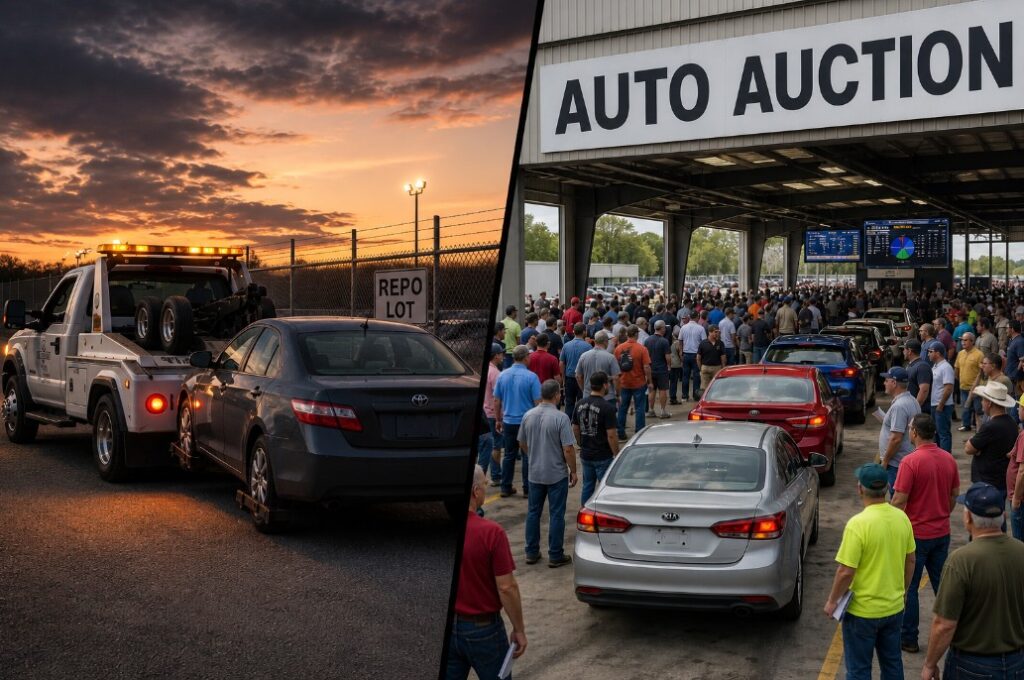
In the lifecycle of a defaulted vehicle, there are two distinct operational sides:
- Repossession (Recovery)
- Remarketing (Auction & Resale)
These functions are sequential, not overlapping. One secures the asset. The other prepares it for sale. Yet across the industry, those lines are being blurred—and as a result, repossessors are increasingly being held accountable for outcomes they do not control.
Two Sides, Operating Independently
Repossession is a field operation.
It involves:
- Locating and recovering the vehicle
- Navigating unpredictable environments
- Securing and transporting the unit
- Documenting visible condition at the time of recovery
Remarketing is a controlled, facility-based process.
It includes:
- Intake inspections
- Condition reporting
- Cleaning and reconditioning (“make-ready”)
- Preparing the vehicle for resale
These two sides often function in separate silos; different vendors, different departments, different objectives. But when something goes wrong, that separation disappears. And the repossessor becomes the default point of accountability.
What a Repossessor Does—and Does Not Do
A repossessor’s responsibility is clear: recover, document, and deliver.
They do not:
- Perform mechanical diagnostics
- Jump-start vehicles to check mileage
- Scan for warning lights
- Evaluate internal mechanical condition
With or without a key, the repossessor does not conduct a mechanical assessment of the vehicle. If a key is present and operates the unit, that fact is documented—typically with a required dash photo. That is the extent of operational acknowledgment.
Anything beyond that belongs to a different phase of the process.
The Documentation Already Exists
Every professional repossession is supported by detailed reporting, most commonly through platforms like RDN (Recovery Database Network).
This includes:
- Time-stamped condition reports
- Photo documentation
- Key status
- Observational notes at the time of recovery
In short: the facts are already recorded.
Yet too often, allegations are raised without first reviewing this documentation—placing the repossessor in a position of repeatedly defending actions that are already verified.
The Real Breakdown: Redemption After Auction Handling
One of the clearest examples of this misalignment occurs during consumer redemption.
The Timeline
- Day 1: Vehicle is repossessed
- Days 1–15: Vehicle sits on the repossessor’s lot (standard hold period)
- Day 16: Vehicle is transported to auction
- Days 16–30+: Vehicle remains within the legal redemption window (varies by state, commonly 30 days in places like Texas)
Logically, the vehicle should remain in its as-recovered condition until that redemption period expires. But that’s not what’s happening.
Premature Make-Ready at Auction
In many cases, the moment the vehicle arrives at auction, it is immediately processed:
- Stickers removed
- License plates taken off
- Personal property cleared
- Vehicle handled, moved, and staged
- “Make-ready” steps initiated
The unit is effectively prepped for sale before the redemption window closes.
At that point, the vehicle is no longer preserved in its original repossessed condition.
Then the Consumer Redeems
The consumer returns—sometimes on day 29, sometimes much later—and redeems the vehicle.
Now there are issues:
- Dead battery
- Low or flat tires
- Unit not running properly
- Vehicle out of gas
- Cigarette burns or interior damage
- Disconnected battery cables
- Missing components or tampering concerns
- New or worsened exterior damage
The vehicle they receive is not the same vehicle that was repossessed.
And the Repossessor Gets the Call
Despite the chain of custody, the questions come back to the repossessor:
- “Why isn’t the vehicle running properly?”
- “Why is the battery dead?”
- “Why is it out of gas?”
- “Where did this damage come from?”
These questions ignore a fundamental reality:
The repossessor has not had possession of the vehicle for weeks—sometimes months.
During that time, the vehicle has:
- Been transported
- Sat at auction
- Been handled by multiple parties
- Undergone partial make-ready processes
Yet the repossessor is expected to explain the outcome.
The Core Issue: Accountability Without Control
What’s happening is not increased oversight—it’s misplaced accountability.
- Auction findings are treated as retroactive evidence
- Make-ready processes are ignored in condition changes
- Documentation is overlooked
- The repossessor becomes the default explanation
This creates a system where:
- The party with the least control carries the most blame
- The actual point of change is never properly examined
A Simple Standard That’s Being Ignored
Before any allegation is directed at a repossessor, there should be a basic process:
- Review the RDN file in full
- Confirm documented condition at recovery
- Evaluate chain of custody
- Identify when and where the condition changed
Only then should responsibility be assigned.
The Industry Needs a Reset
This is not about avoiding responsibility—it’s about assigning it correctly.
- Repossession = Recovery, documentation, delivery
- Remarketing = Inspection, handling, reconditioning, resale
Mechanical condition, drivability, and post-recovery changes belong to the remarketing phase, not the repossession phase.
Final Word
You cannot:
- Handle a vehicle
- Strip identifying materials
- Move it repeatedly
- Begin preparing it for sale
…and then expect it to remain in its original repossessed condition weeks later during redemption. And you cannot expect the repossessor to answer for what happened after they no longer had possession, control, or access. There are two sides to this industry. Both are essential.
But until accountability follows control, one side will continue to absorb the blame for both.
And that is neither accurate—nor sustainable.
Anonymous venting agency owner
Repossession vs. Remarketing: A Breakdown in Accountability – Repossession vs. Remarketing: A Breakdown in Accountability – Repossession vs. Remarketing: A Breakdown in Accountability
Repossession vs. Remarketing: A Breakdown in Accountability – Repossess – Repossession – Repossession Agency – Repossessor – Repossession – Auction – Auction – Auto Loan – Remarketing






More Stories
The Cost of Collecting LPR Data Has Gone Up. Why Hasn’t the Pay?
WHEN IS ENOUGH, ENOUGH? A Question Worth Asking Across the Repossession Industry
Three Million Repossessions: A New Measure of America’s Recovery Industry
Why Fight LPR? Join It — But What Happens When the Car Repossesses Itself?
In The Future Will There Be Anyone Left to Recover Vehicles?
The Broken Bond Between Lenders and Agents – Positive Resolution