


The modern repossession business is no longer simply about finding vehicles. It is increasingly about surviving the system surrounding them.
EDITORIAL
For much of the past several years, the repossession industry prepared for what many believed would become a historic recovery boom. Delinquencies climbed. Vehicle affordability worsened. Negative equity spread across the market. Used vehicle values fluctuated violently after the pandemic-era surge. On paper, all of the conditions pointed toward sustained high-volume repossession activity.
Yet for many recovery agencies in 2026, reality has looked very different.
Instead of overwhelming assignment growth, many companies have experienced unstable placement volume, shrinking margins, delayed recovery timelines, increasing compliance pressure, and rising operational costs. In many cases, agencies are being asked to do more work, under more scrutiny, for less predictable revenue.
The result is a growing industry squeeze that is beginning to reshape the economics of repossession itself.
The Delinquency-Repossession Disconnect
Historically, rising delinquencies translated relatively quickly into increased repossession assignments. That relationship has become far less direct.
Across the lending landscape, many creditors appear increasingly reluctant to move accounts into immediate repossession status. Rather than triggering recovery activity at traditional 60-day delinquency windows, some lenders have extended accounts further into 90-, 120-, or even longer-day default cycles before placement.

Several factors appear to be driving the shift.
Lenders remain highly sensitive to reputational risk surrounding repossession activity. Regulatory scrutiny continues to increase. Vehicle prices remain elevated compared to historical norms, making deficiencies larger and recoveries more politically sensitive.
At the same time, many lenders are attempting to preserve portfolio performance through extensions, modifications, payment deferrals, and internal collections before initiating recovery action.
The result has been an unusual market dynamic:
high delinquency pressure without proportional repossession flow.
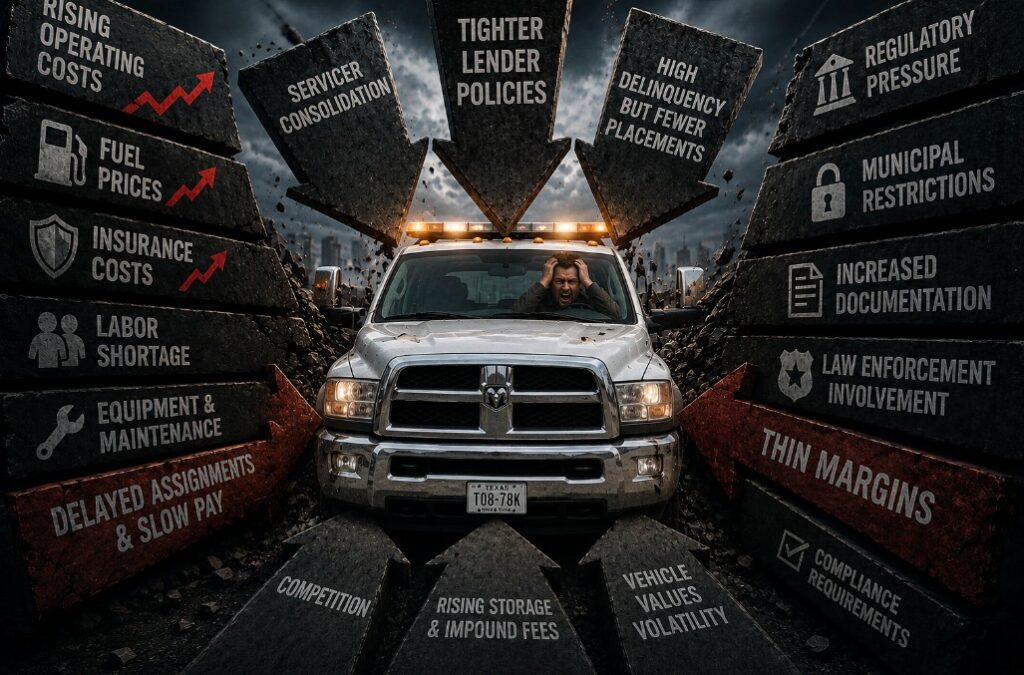
For repossession agencies, that creates a serious forecasting problem. Recovery businesses are operationally heavy. Trucks, insurance, labor, compliance systems, storage facilities, fuel, and dispatch infrastructure all require fixed overhead whether assignments are flowing steadily or not.
When placement volume becomes inconsistent, agencies often absorb the instability directly.
Rising Costs Are Colliding with Delayed Revenue
Even when assignments arrive, the economics of recovery have changed dramatically compared to just a few years ago.
Fuel costs remain substantially higher than historical averages. Insurance costs continue climbing aggressively across towing and recovery operations. Labor shortages remain persistent in many regions. Compliance staffing and technology requirements have expanded significantly.
Meanwhile, recovery fees in many markets have not increased proportionally with operating expenses.
Many agencies now describe operating in an environment where:
- assignment cycles are slower,
- recovery rates are harder,
- skip volume is more complex,
- and every completed repossession requires more time and more documentation than before.
The traditional “high-volume offset” that once helped absorb thin margins becomes difficult when placements become less predictable.
For smaller independent agencies especially, this creates growing financial vulnerability.
Municipal and Regulatory Oversight Is Expanding
At the same time operational costs are increasing, many agencies are facing expanding oversight from local governments and regulators.
Across the country, municipalities continue introducing:
- stricter notice requirements,
- oxcart fees,
- enhanced reporting procedures,
- impound documentation mandates,
- storage restrictions,
- and heightened law-enforcement interaction requirements.
In some jurisdictions, repossession activity is increasingly treated less like a secured-creditor recovery process and more like a quasi-regulated enforcement activity.
For agencies, that means additional administrative burden on every assignment.
The trend is especially important because local procedural changes often spread. A single city or police department policy can quickly influence neighboring jurisdictions, insurance carrier expectations, lender compliance standards, or forwarding company procedures.
What begins as a local operational change can rapidly become an industry norm.
The Compliance Burden Keeps Growing
Compliance itself has become one of the largest hidden costs in modern repossession operations.
Lenders and forwarding companies continue expanding:
- audit requirements,
- body camera expectations,
- lot security standards,
- digital documentation mandates,
- consumer interaction protocols,
- vendor scoring systems,
- cybersecurity requirements,
- and insurance minimums.
At the same time, data privacy concerns surrounding GPS tracking, license plate recognition technology, and consumer information handling are attracting growing political and regulatory attention.
California in particular appears positioned to aggressively expand consumer-finance enforcement initiatives that may eventually affect:
- repossession vendors,
- forwarding companies,
- skip-tracing activity,
- and data aggregation practices nationwide.
Even agencies operating far outside California often find themselves forced to comply with standards created there because national lenders rarely maintain separate vendor compliance models by state.
Consolidation Is Quietly Accelerating
The pressure is also accelerating consolidation across both lending and servicing.
As portfolios migrate toward larger servicing platforms and centralized forwarding structures, independent recovery agencies may face:
- fewer direct lender relationships,
- greater dependency on national forwarding systems,
- tighter fee structures,
- and reduced negotiating leverage.
Larger operators may benefit from scale advantages, compliance infrastructure, and broader geographic reach. Smaller agencies often face difficult choices:
invest heavily in compliance and technology upgrades, merge, specialize, or exit the industry entirely.
This is not necessarily producing fewer repossessions overall. Instead, it may be reshaping who controls the flow of assignments and who can economically survive handling them.
The Industry’s Biggest Risk May Be Uncertainty
Perhaps the greatest challenge facing repossession companies right now is not simply lower volume or higher costs.
It is unpredictability.
Recovery companies can adapt to difficult markets when conditions are stable and measurable. What becomes dangerous is when agencies cannot reliably forecast:
- assignment timing,
- staffing needs,
- fuel exposure,
- equipment investment,
- or lender behavior.
Many companies spent the last several years preparing for one version of the market — sustained high-volume recovery activity — only to encounter a far more volatile and uneven operating environment.
And yet, the underlying credit stress in the auto finance market has not disappeared.
Delinquencies remain elevated. Affordability remains strained. Negative equity remains widespread. Subprime pressure remains significant. Loan modifications and extensions may delay repossessions, but they do not necessarily eliminate eventual losses.
That means the industry may still be facing substantial future recovery demand — just arriving later, more unevenly, and under far heavier compliance expectations than in prior cycles.
A Different Kind of Recovery Era
The repossession industry may be entering a very different kind of recovery cycle than many expected.
Not one defined purely by overwhelming volume, but by operational complexity.
In previous eras, success often depended primarily on speed, coverage area, and recovery efficiency. Today, survival increasingly depends on compliance management, documentation discipline, technology investment, municipal navigation, cybersecurity readiness, and financial resilience.
The modern repossession business is no longer simply about finding vehicles. It is increasingly about surviving the system surrounding them.
Kevin Armstrong
Publisher
The Repo Squeeze: Why Recovery Companies Are Being Pressured from Every Direction – The Repo Squeeze: Why Recovery Companies Are Being Pressured from Every Direction – The Repo Squeeze: Why Recovery Companies Are Being Pressured from Every Direction
The Repo Squeeze: Why Recovery Companies Are Being Pressured from Every Direction – Compliance – Forwarder – Fuel Costs – Gas Prices – Repossess – Repossession – Repossession Agency – Repossessor – Repossession






More Stories
Why Fight LPR? Join It — But What Happens When the Car Repossesses Itself?
In The Future Will There Be Anyone Left to Recover Vehicles?
The Broken Bond Between Lenders and Agents – Positive Resolution
The Repos That May Never Come
A Repossession Is a Repossession
When “Partner” Is Just Another Word for Vendor