



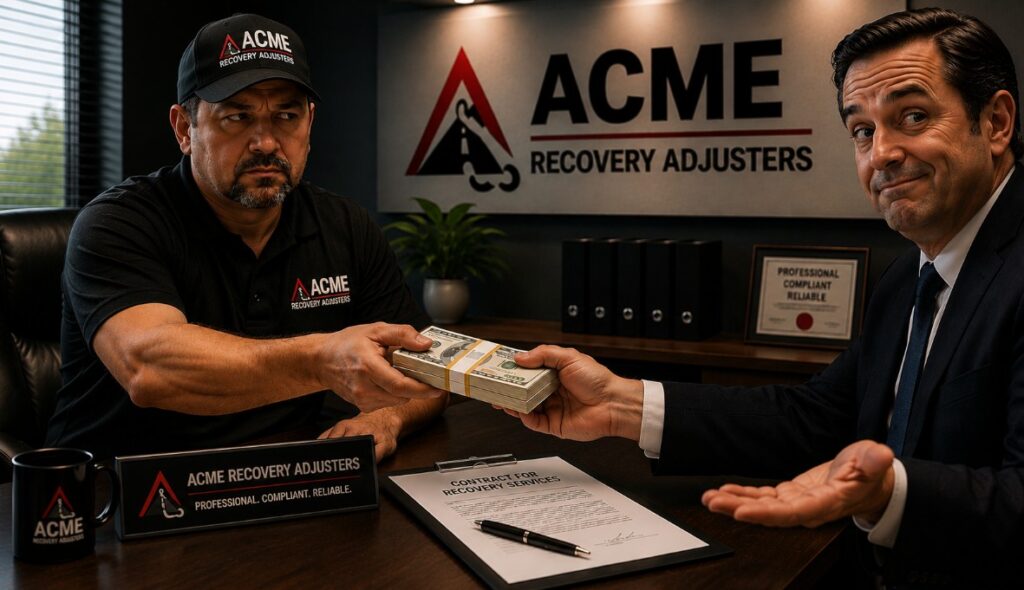
Why extending unsecured credit to clients requires the same discipline lenders apply to managing risk
EDITORIAL
There has always seemed to be a line separating repossession companies from the lenders and forwarders they serve. But every day a recovery agency accepts a contingent assignment, it is extending a loan.
Think about that for a minute.
Despite the obvious differences in their roles, every recovery agency is also a lender.
The only difference is that most agencies don’t think of themselves that way. They call it accounts receivable. Banks call it a loan portfolio.
For decades, the repossession industry has become increasingly sophisticated in how it manages risk.
Today’s recovery agencies invest heavily in compliance programs, employee training, insurance, cybersecurity, body-worn cameras, documentation, GPS technology, and breach-of-peace prevention. Safety protocols have improved. Legal awareness has increased. Operational procedures have become more disciplined.

Those investments have made the industry stronger, more professional, and better prepared for the challenges of modern collateral recovery.
Most agency owners would probably agree there are six categories of risk they think about almost every day:
- Operational Risk
- Legal Risk
- Compliance Risk
- Safety Risk
- Cybersecurity Risk
- Reputational Risk
Each deserves constant attention.
But there may be a seventh risk that receives far less discussion than it should.
Lender/Forwarder Financial Risk.
The Business Every Agency Doesn’t Realize It’s In
This may sound like an unusual statement, but consider it carefully: Every recovery agency is also a lender.
Not because it originates auto loans. Because every time an agency accepts a contingent assignment, it extends unsecured credit to the company that hired it.
The agency immediately begins investing its own resources.
- Employees are paid.
- Fuel is consumed.
- Insurance costs continue.
- Equipment depreciates.
Technology, licensing, office overhead, and compliance expenses all continue regardless of when payment arrives.
The lender or forwarder pays later.
- Sometimes thirty days later.
- Sometimes sixty.
- Sometimes ninety.
- Occasionally, not at all.
From a business perspective, the agency has extended unsecured credit. The difference is that most agencies don’t think of it that way. They call it “accounts receivable.”
Your Accounts Receivable Is More Than an Accounting Report
Banks manage loan portfolios. Credit unions monitor loan concentrations.
Finance companies establish credit limits, review delinquency trends, and create policies that determine when additional credit should, or should not, be extended.
Recovery agencies also maintain a portfolio of outstanding balances.
The difference is that very few view those balances through the same risk management lens.
An accounts receivable aging report isn’t simply an accounting document. It represents every dollar your business has already invested while waiting to be repaid.
The question isn’t whether you trust your customers. The question is how much unsecured credit your business is willing to extend to any one customer at any given time.
That’s a management decision, not a relationship decision.
Understanding Upstream Financial Risk
Most recovery agencies know exactly who sends them assignments. Fewer stop to consider who ultimately funds those assignments.
Cash flows through the recovery industry much like assignments do. A finance company may rely on warehouse financing, capital markets, private investors, or institutional funding.
A forwarder depends on timely payment from its lender clients. Recovery agencies depend on payment from lenders or forwarders.
When financial stress develops upstream, its effects often move downstream.
By the time cash-flow problems reach the recovery agency, the work has already been completed and the expenses have already been incurred. Understanding that chain doesn’t require becoming a financial analyst. It simply means recognizing that every customer has financial risk, and every agency has financial exposure.
Lessons Worth Remembering
The repossession industry has experienced several reminders that upstream financial risk is real.
Several subprime auto lenders are showing signs of major financial stress and that should be a big red flag. The bankruptcy of Tricolor demonstrated how quickly financial distress at a lender can leave vendors holding substantial unpaid balances.
The 2022 payment disputes involving Primeritus illustrated a different version of the same challenge. Financial pressure upstream affected payment downstream, placing recovery agencies in the difficult position of financing completed work while waiting for the situation to be resolved.
Different circumstances.
Different companies.
The same underlying lesson.
When cash flow is interrupted upstream, the financial consequences rarely stop with the company at the center of the problem, they move through the entire recovery ecosystem.
Every Lender Needs a Credit Policy
Financial institutions don’t extend unlimited unsecured credit and neither should recovery agencies.
That doesn’t mean distrusting customers or damaging long-standing business relationships. It means establishing objective policies before difficult situations arise.
Questions every agency owner should periodically ask include:
- How much unsecured exposure are we willing to carry with any single lender or forwarder?
- At what point should outstanding balances receive management review?
- Should every customer have an internal credit limit?
- When do aging receivables justify modifying payment terms, requesting retainers, or temporarily limiting additional exposure?
- How dependent is our business on one customer, or one forwarding company?
- If our largest client stopped paying tomorrow, how would it affect payroll, insurance, and operations?
These aren’t collections questions. They’re risk management questions.
A New Way to Think About an Old Problem
Recovery agencies have spent decades learning how to protect themselves from operational risk. They’ve built safer companies, stronger compliance programs, and more professional organizations than ever before.
The next evolution may not involve another software platform, another camera system, or another piece of recovery equipment. It may be learning to manage lender and forwarder financial risk with the same discipline the industry already applies to operational and legal risk.
Every assignment accepted before payment is received represents an extension of unsecured credit.
Recognizing that simple reality changes the conversation.
Because once a recovery agency begins thinking like a lender, it naturally begins asking the same questions every prudent lender asks:
How much risk are we carrying?
Who are we extending credit to?
When does that risk become excessive?
And what policies do we have in place before the answer becomes painfully obvious?
The repossession industry has always helped lenders manage credit risk.
Perhaps it’s time for recovery agencies to recognize that they have credit risk of their own.
Every Recovery Agency Is Also a Lender – Every Recovery Agency Is Also a Lender – Every Recovery Agency Is Also a Lender
Kevin Armstrong
Publisher
Every Recovery Agency Is Also a Lender – Forwarder – Repossess – Repossession – Repossession Agency – Repossessor – Repossession – Lending – Auto Loan – Subprime Auto Loans – Subprime Auto Loans






More Stories
Three Million Repossessions: A New Measure of America’s Recovery Industry
Why Fight LPR? Join It — But What Happens When the Car Repossesses Itself?
In The Future Will There Be Anyone Left to Recover Vehicles?
The Broken Bond Between Lenders and Agents – Positive Resolution
The Repos That May Never Come
A Repossession Is a Repossession