

A fourth placement is not the same product as a first placement. Pretending otherwise doesn’t change the economics.
EDITORIAL
One of the more interesting conversations I’ve had recently wasn’t with a recovery agency owner. It was with a forwarder. I raised a question that many recovery agencies have quietly asked for years: Why does a fourth-placement repossession assignment generally pay the same fee as a first placement?
The answer kind of surprised me, but it probably shouldn’t have.
According to the forwarder, many lenders have found that rotating difficult accounts to a new recovery company can improve overall recovery rates. A fresh set of eyes, different operating hours, different investigative techniques or simply a new geographic footprint can sometimes produce results where previous attempts failed.
From the lender’s perspective, the strategy makes sense. From the recovery agency’s perspective, however, the economics often do not.
Those are two entirely different measurements.
The lender is asking, “Does another placement improve our portfolio recovery rate?”

The recovery agency is asking, “Can I make money on this assignment?”
Both questions can have valid answers. The problem is that they rarely meet in the middle.
The Assignment Nobody Talks About
Consider two assignments.
The first is a fresh repossession.
The borrower recently defaulted. The addresses are current. Employment is recent. The vehicle has not yet disappeared. Family members have not been contacted repeatedly. The debtor may not even realize repossession is imminent.
Recovery probability is reasonable.
Now consider another assignment.
It has already been worked by three different agencies. Every listed address has been run multiple times. Neighbors have already seen the tow trucks passing by at all hours.
The debtor has likely changed routines, moved the vehicle, or hidden it entirely. The easy leads are gone. The obvious locations have been exhausted.
Recovery probability is poor.
Yet both assignments are typically offered at the same recovery fee.
In virtually every other service industry, those would be considered entirely different jobs.
The Information Gap
The issue isn’t simply compensation. It’s information.
Many repossession assignments never identify whether they are first, second, third or fourth placement. An agency receives a new assignment accepts what appears to be an ordinary assignment.
Only after beginning work do they recognize the VIN, the borrower, the address or the history.
“We’ve already worked this account.” By then, valuable time has already been spent.
The agency now faces an uncomfortable decision.
Continue investing resources into an account that may have already consumed dozens of field visits by themselves or other competitors?
Or decline the assignment, frustrating the forwarder while protecting its own business? Neither outcome benefits anyone.
Driving in Circles
Modern recovery operations have changed. Through extreme risk aversion, most lenders discourage or prohibit direct borrower contact. This removes the simple strategy of account resolution that the entire repo industry was based on for almost a century.
Instead, agencies are expected to locate the collateral through observation and quick and lawful recovery.
That often means driving.
Again.
And again.
And again.
Running the same addresses another company already exhausted.
Fuel, payroll, insurance, truck maintenance and opportunity cost agencies time and money.
Every unnecessary mile carries a cost.
When an agency unknowingly receives a third or fourth placement, it may simply be repeating work that someone else already performed weeks or months earlier.
The lender may see another placement.
The recovery company sees another fuel bill.
Collections Solved This Long Ago
The collections industry recognized this reality decades ago.
As accounts become more difficult to collect, contingency commissions generally increase with each placement. According to the Consumer Financial Protection Bureau’s 2023 Consumer Credit Card Market Report, large credit card issuers reported average contingency commissions of approximately 21% for primary placements, 27% for secondary placements, 30% for tertiary placements and 36% for fourth placements.
Why?
Because later placements are harder.
That isn’t controversial. It’s accepted business economics.
Repossession, however, often treats every assignment as though difficulty never changes.
A Different Conversation
This editorial is not intended to suggest that lenders are acting improperly.
If portfolio data shows that additional placements improve overall recoveries, lenders should absolutely consider strategies that reduce losses.
Nor is this an attack on forwarders.
They are frequently caught in the middle, balancing lender expectations with increasingly difficult conversations with recovery agencies that recognize recycled assignments.
Instead, perhaps the industry should ask a different question. Why not simply disclose the placement history?
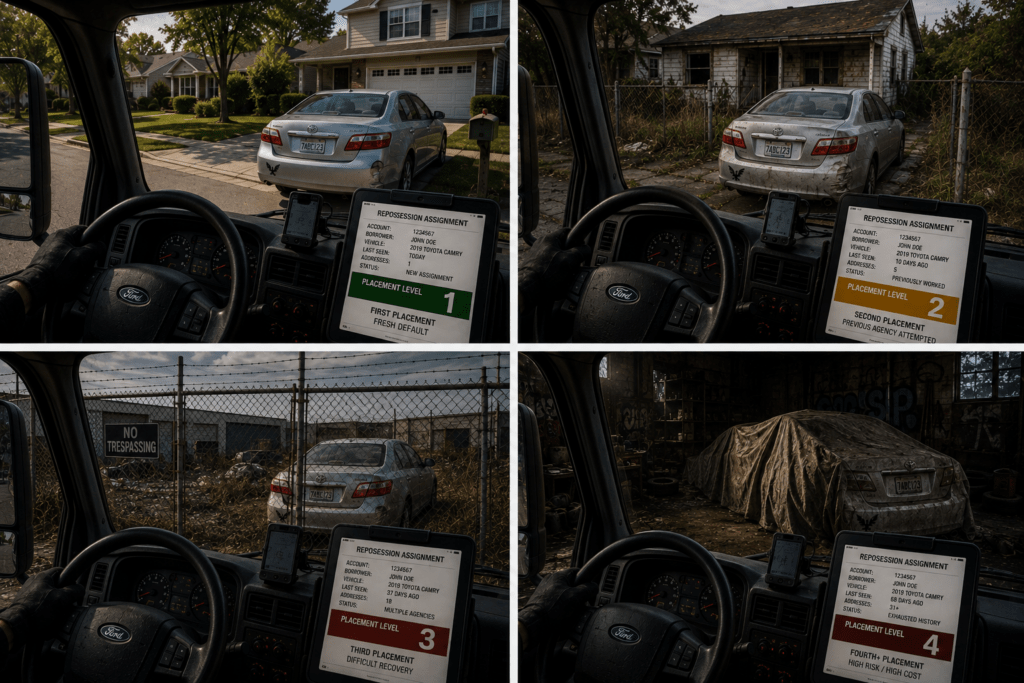
Imagine every assignment clearly identifying:
- Placement Number: Third
- Previous Agencies: Two
- Days Since Default: 184
- Prior Field Activity: Available
Now the recovery agency can make an informed business decision. Some agencies would gladly accept the challenge.
Others might negotiate additional investigative work. Some might decline.
All of those outcomes are healthier than discovering the truth only after the assignment has already been accepted.
Transparency Benefits Everyone
Recovery agencies are not asking for guaranteed higher fees. Many are simply asking for honest information.
A fourth placement is not the same product as a first placement. Pretending otherwise doesn’t change the economics.
It merely shifts the cost onto the companies expected to absorb it.
If lenders believe multiple placements improve recovery rates, the data may very well support that conclusion. But improved portfolio performance should not depend on withholding information from the professionals tasked with producing those recoveries.
Transparency builds better decisions. Better decisions produce better recoveries and a more efficient and sustainable repossession industry.
And perhaps most importantly, transparency builds stronger partnerships between lenders, forwarders and the recovery agencies that keep the entire process moving. The repossession industry has become increasingly sophisticated in technology, compliance and analytics over the past decade.
Perhaps it’s time the assignment model caught up as well.
If the collections industry has recognized for decades that every placement changes the economics of recovery, perhaps it’s time the repossession industry asks why the fourth placement is still being treated like the first.
When the First Placement is the Fourth: Why the Repossession Industry Needs More Transparency – When the First Placement is the Fourth: Why the Repossession Industry Needs More Transparency – When the First Placement is the Fourth: Why he Repossession Industry Needs More Transparency
Kevin Armstrong
Publisher
When the First Placement is the Fourth: Why the Repossession Industry Needs More Transparency – Forwarder – Repossess – Repossession – Repossession Agency – Repossessor – Repossession – Repossession News – Auto Loan – Lending – Delinquency






More Stories
The Broken Bond Between Lenders and Agents – Positive Resolution
The Repos That May Never Come
A Repossession Is a Repossession
When “Partner” Is Just Another Word for Vendor
Welcome to the Repossession Casino — But Who Is Really Paying the Losing Bets?
The Cost of Doing Business: Why We Cannot Afford to Work for Free