


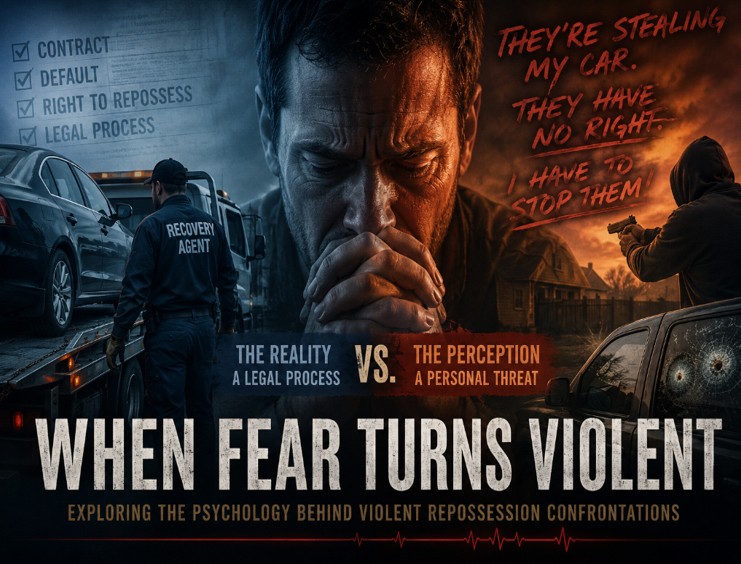
Looking beyond the crime to understand the emotions that sometimes drive violence during vehicle recoveries
EDITORIAL
The amber lights reflect across the driveway as the tow truck comes to a stop. Inside the house, the borrower looks out the window and immediately knows why it is there. For weeks, perhaps months, the phone calls have gone unanswered. Payment promises have been broken. Financial problems have been postponed. Now there is no avoiding them.
Within moments, a stranger is standing beside the one possession that still gets them to work, takes the children to school, or represents the last visible sign that life is still under control.
Most repossessions end peacefully.
Some do not.
When a repossession turns violent, the public narrative is usually straightforward. A borrower lost a vehicle. A confrontation occurred. Someone was assaulted, injured, or killed.
The criminal justice system understandably focuses on guilt, punishment, and accountability.
But beneath many of these tragedies lies a question that receives far less attention:
What was happening inside the borrower’s mind in the moments before the violence?
Understanding those emotions does not excuse criminal behavior. It does not lessen the suffering of victims or their families, nor does it diminish the responsibility of those who choose violence.
It may, however, help explain why otherwise ordinary people sometimes make catastrophic decisions.
And understanding why violence occurs may be one of the industry’s most effective tools for preventing it.
The Vehicle Is Rarely Just a Vehicle
To a lender, the vehicle is collateral. To a recovery agent, it is an assignment.
To many borrowers, it represents something far more personal.
Transportation.
Employment.
Independence.
Identity.
Status.
Control.
A repossession often represents far more than the loss of a car. It may symbolize months of financial hardship, broken plans, mounting debt, embarrassment, and uncertainty about what comes next.
For some borrowers, the recovery is the moment those realities become impossible to ignore.
The Conflict Between Reality and Perception
One of the greatest psychological gaps in a repossession is the difference between what is happening and what the borrower believes is happening.
Reality: A contracted recovery agent has arrived to recover collateral following a loan default.
Borrower’s Perception: A stranger is taking my property.
That gap matters.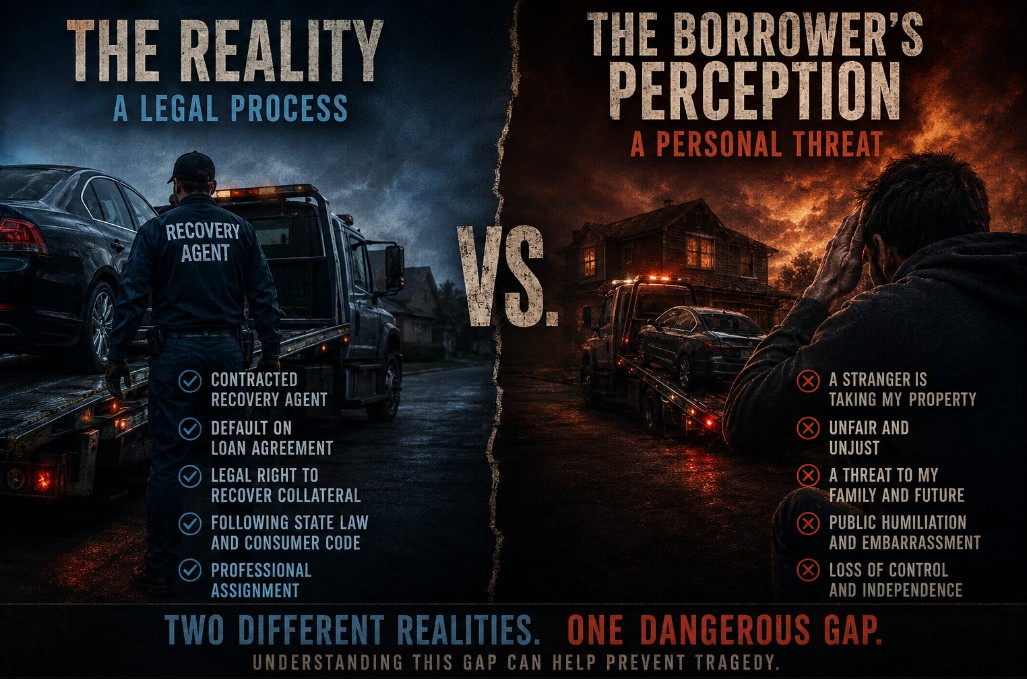
Because people rarely react to reality itself, they react to their perception of reality.
When borrowers describe violent encounters later, they often use the language of theft rather than contract enforcement.
“They were taking my car.”
“They stole my vehicle.”
“They came onto my property.”
The legal distinctions become secondary to the emotional experience.
To the borrower, the loss feels immediate, personal, and deeply unfair, even when the repossession is entirely lawful.
That emotional gap is where many violent confrontations begin.
The Common Language of Violent Borrowers
Review enough police interviews, courtroom testimony, and sentencing hearings, and familiar themes begin to emerge.
Many offenders do not initially describe themselves as angry. Instead, they describe feeling:
- Trapped.
- Cornered.
- Desperate.
- Humiliated.
- Out of options.
Different words. The same underlying emotion.
A profound loss of control.
Violence is rarely the goal.
For many offenders, violence becomes a desperate attempt to regain control over a situation that suddenly feels uncontrollable.
When Fear Hijacks the Brain
Readers familiar with our earlier discussions about fraud psychology may recognize a similar neurological process at work.
Under extreme stress, the brain’s amygdala, the region responsible for detecting danger, can temporarily override the prefrontal cortex, the area responsible for judgment, impulse control, and long-term reasoning.
Psychologists often refer to this as an “amygdala hijack.”
In fraud, that fear may convince someone to wire money to a scammer.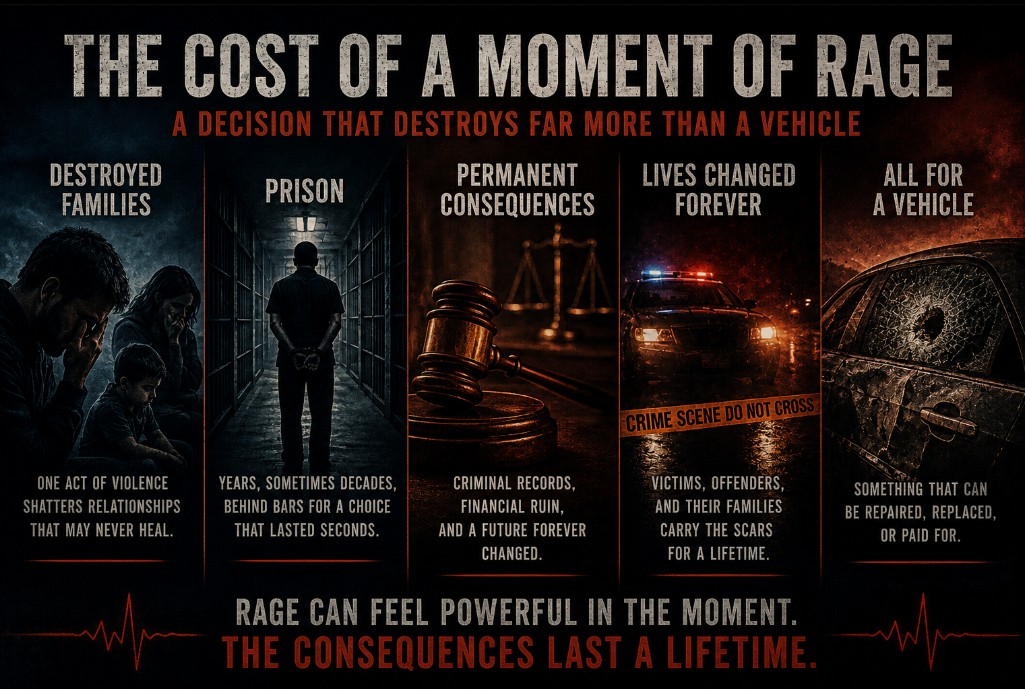
During a repossession, the same biological process can narrow a person’s thinking until only one objective remains:
“Stop this from happening.”
Heart rate rises.
Adrenaline surges.
Vision narrows.
Attention becomes fixed on the immediate threat while long-term consequences begin to fade into the background.
Prison.
A criminal record.
The destruction of families.
The permanent consequences of violence.
All become secondary to the overwhelming desire to stop the immediate loss.
The violence remains a choice.
But it is a choice being made under the influence of extraordinarily powerful emotional forces.
Why Losing Hurts More Than Winning
Behavioral economists have long observed that people experience loss far more intensely than they experience equivalent gains.
Psychologists call this loss aversion. Losing a $20 bill feels considerably worse than finding one feels good.
The same principle applies to repossession.
The borrower is not merely losing transportation.
They may feel they are losing independence.
Employment.
Status.
Routine.
Identity.
Hope.
Understanding that emotional imbalance helps explain why seemingly irrational decisions can feel completely rational in the moment.
The Role of Shame
Fear alone does not explain many violent repossessions. Shame often plays an equally important role.
Neighbors are watching.
Family members are watching.
Children may be watching.
The recovery truck can feel like a public announcement that something has gone terribly wrong.
Psychologists have long recognized shame as one of the most powerful human emotions. For some individuals, public humiliation is experienced almost as a threat to survival itself.
When fear and shame combine, rational thinking can deteriorate rapidly.
Lessons From the Courtroom
The murder trial surrounding Alabama recovery agent Jayson Click offered jurors more than a reconstruction of a homicide. It revealed the emotional escalation that preceded it.
Fear.
Frustration.
Perceived injustice.
A growing belief that control was slipping away.
The testimony illustrated something recovery professionals have understood for decades.
Borrowers often stop seeing the recovery agent as an independent contractor performing a lawful assignment. Instead, the agent becomes the visible symbol of every financial setback, every missed payment, every difficult conversation, and every fear about the future.
That psychological shift can be extraordinarily dangerous.
Yet it also helps explain why violence that appears irrational to outsiders may feel justified to the person committing it.
Not Every Violent Borrower Is the Same
The industry often encounters frightened people making terrible decisions. It also encounters individuals with long histories of violence, criminal behavior, or profound entitlement.
These are not the same psychological profiles.
Some offenders appear devastated by what they have done. Others seem detached from it.
One particularly disturbing case involved an offender whose demeanor after the killing appeared almost indifferent. He joked with officers at the scene and later displayed a similarly casual attitude during court proceedings.
Fear explains some violence, but it does not explain all violence.
Understanding psychology should never become an excuse for ignoring accountability.
Lessons for the Recovery Industry
The repossession industry has spent decades improving compliance standards, training, and safety procedures.
Yet one reality has never changed, recovery agents routinely arrive at one of the most emotionally charged moments in another person’s financial life.
Most assignments conclude without incident.
Some borrowers cooperate.
Others quietly accept the outcome.
But every assignment involves human beings carrying burdens that may not be immediately visible.
Recognizing those emotional conditions cannot eliminate violence. It may, however, help agents recognize situations where the risk of violence is increasing.
Understanding behavior is not the same as excusing it.
It is preparing for it.
Final Thoughts
The public often asks why someone would shoot, assault, or kill another person over a vehicle.
The answer is that, in the offender’s mind, it was rarely just about the vehicle. It was about fear.
Fear of failure.
Fear of humiliation.
Fear of losing control.
Fear of what comes next.
The repossession industry cannot eliminate those fears. It cannot erase financial hardship or shame. But it can become better at recognizing the emotional conditions under which violence becomes more likely.
Every recovery agent understands they are locating and repossessing vehicles.
The best agents also understand they are often arriving on the worst day of someone else’s financial life.
Recognizing that reality does not make violence acceptable. It makes violence more predictable.
And if it becomes more predictable, perhaps someday it becomes more preventable. Because once fear turns violent, everyone loses.
When Fear Turns Violent: Understanding the Psychology Behind Repossession Confrontations – When Fear Turns Violent: Understanding the Psychology Behind Repossession Confrontations – When Fear Turns Violent: Understanding the Psychology Behind Repossession Confrontations
Kevin Armstrong
Publisher
When Fear Turns Violent: Understanding the Psychology Behind Repossession Confrontations – Repossession Violence – Repossession History – Repossession – Repossess – Repossession – Repossession Agency – Repossessor – Police – Police – Arrest – Arrest





More Stories
Why Fight LPR? Join It — But What Happens When the Car Repossesses Itself?
In The Future Will There Be Anyone Left to Recover Vehicles?
The Broken Bond Between Lenders and Agents – Positive Resolution
The Repos That May Never Come
A Repossession Is a Repossession
When “Partner” Is Just Another Word for Vendor