



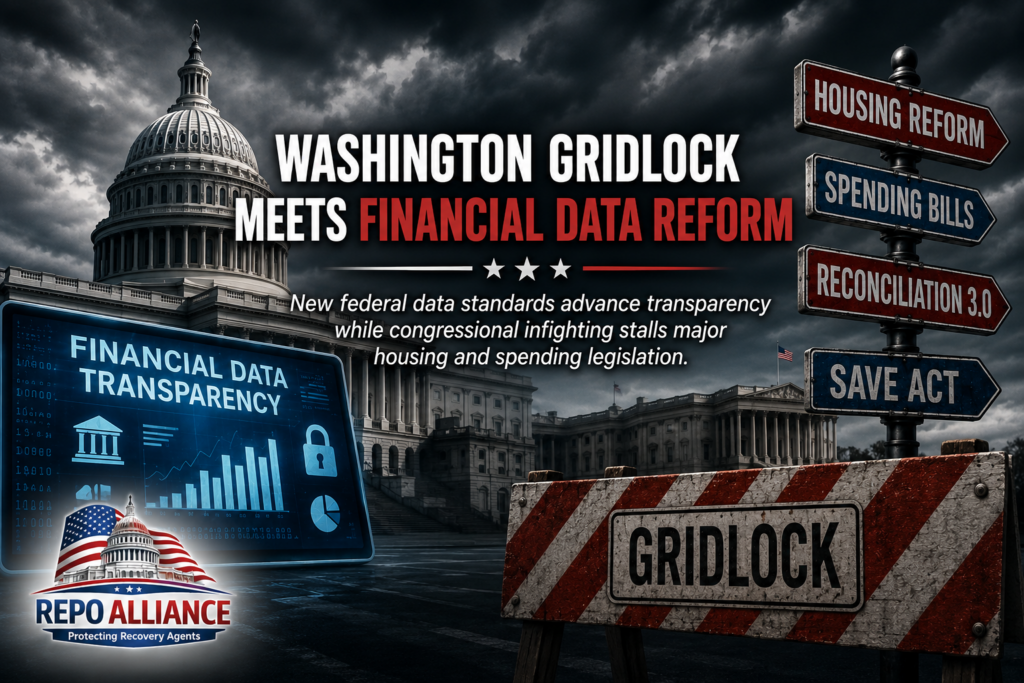
New federal data standards advance transparency while congressional infighting stalls major housing and spending legislation.
Washington Gridlock Meets Financial Data Reform – Washington Gridlock Meets Financial Data Reform
Federal regulators are moving forward with sweeping financial data modernization, but Congress appears increasingly unable to agree on its legislative priorities. This week’s developments could influence future regulatory oversight, housing policy, and the broader lending environment that ultimately shapes the repossession industry.
6.26.26: Auto Finance Update
Financial Transparency Rule Joint Data Standards
This week, the Consumer Financial Protection Bureau, along with a variety of other federal financial agencies, issued a joint rule titled “Financial Data Transparency Act Joint Data Standards”
According to CFPB, “Consumer Financial Protection Bureau (CFPB) finalized rulemaking that establishes technical standards for data submitted to certain financial regulatory agencies. “This joint final rule is required under the Financial Data Transparency Act of 2022 to promote interoperability of financial regulatory data across the Securities and Exchange Commission, the Board of Governors of the Federal Reserve System, the Office of the Comptroller of the Currency, the Federal Deposit Insurance Corporation, the National Credit Union Administration, the Federal Housing Finance Agency, the Commodity Futures Trading Commission, the Department of the Treasury, and the CFPB.
The new standards being adopted establish common identifiers for entities, geographic locations, dates, and certain products and currencies. The standards include a principles-based joint standard with respect to data transmission and schema and taxonomy formats, which would allow financial institutions to submit high-quality, machine-readable data to the agencies.”
This rule is intended to provide for a more effective regulatory environment by having financial institutions submit interoperable data to regulators. Theoretically, it should help regulators track information that would have some impact on the repossession industry. However, “repossession” is not mentioned in the rule.
Housing Reform Bill Caught in Political Priorities
This week, the Senate and House recessed early as both chambers are having a hard time identifying their legislative priorities in the final months ahead of the midterm elections. The result of this disunity is delayed FY27 appropriations bills, possible inclusion of health policy in a “Reconciliation 3.0” bill, and the possibility of a government shutdown.
The tumult began early in the week when President Trump abruptly cancelled a bill-signing ceremony regarding a major housing reform bill which had just passed both chambers of Congress with overwhelming bipartisan support. The 21st Century Road To Housing Act, among other things, makes major reforms to how communities plan and develop housing supply, how families can access federally-insured mortgages, and bans institutional investors from buying single-family homes. Notably, the bill does grant lenders the right to repossess a home (Section 1001(a)(2)(F)).

President Trump claimed that he will not sign the housing bill until Congress passes his proposed reforms to federal voter registration and elections policies called the “SAVE Act.” House Speaker Mike Johnson (R-LA) said the House would proceed with a third reconciliation bill and the SAVE Act would be central element of it. However, Senate Majority Leader John Thune (R-SD) says the SAVE Act does not have enough support to pass the Senate, whether the bill requires 50 or 60 votes. President Trump went to lunch Wednesday with the Senate Republicans at the Capitol trying to flip votes, though nothing indicates minds were changed.
By very publicly announcing the necessity of a Reconciliation 3.0 bill (regardless if that bill includes the SAVE Act), President Trump and House Republicans are piecing together what major provisions of that bill would be. Previously, Republican leaders had made many commitments to rank and file lawmakers that a third reconciliation bill would include a variety of matters that were close to passing in last year’s One Big Beautiful Bill Act or the recent Secure America Act (Reconciliation 1 and 2, respectively). The major elements being considered are $350 billion in defense funding, tax cuts, and reforms to welfare, health, energy, public lands, and a host of other items. The health items that have been considered include site neutral payments for many services under Medicare, prescription drug reforms, and anything that conceivably drives down health care costs. Many Republicans want the Reconciliation 3.0 bill to be budget neutral, meaning the $350 billion in defense funding and, say, $650 billion in new tax cuts, would necessitate $1 trillion in reduced spending in other areas. Though Reconciliation 3.0 is gaining attention, Senate Republicans (as well as many skeptical House Republicans) do not think a third reconciliation bill is likely. Thune says a narrow “defense-only” reconciliation package should only be a “last resort.” Washington Gridlock Meets Financial Data Reform
Regardless, the confluence of housing, Reconciliation 3.0, the SAVE Act, and the annual appropriations process culminated in a mini-rebellion this week when Rep. Anna Paulina Luna (R-FL) led a group of House Republicans to block any bill until the Senate takes up the SAVE Act. This meant the appropriations bills set for consideration in the House this week were suspended. This will delay the consideration of other appropriations bills, including the Labor/HHS/Education bill that funds most federal health activities. Though Luna said her strategy was inspired by President Trump, the president himself on social media called upon Luna and her dissidents to resume normal work.
Meanwhile, the Senate Appropriations Committee had planned to consider four of their 12 appropriations bills this week, but delayed the markup due to the recent hospitalization of Sen. Mitch McConnell (R-KY). Given the lack of an agreement on topline spending levels making Democratic support for FY27 bills unlikely, without McConnell in attendance the committee lacks the votes to advance bills since Republicans only have a one vote advantage and a tie vote does not allow bills to move forward.
As Congress approaches important dates ahead of the August recess, the end of the fiscal year, and the November midterm elections, it is becoming evident President Trump, the Senate, and the House are not on the same page regarding legislative priorities, and it is unclear how must-pass legislation, like the annual appropriations bills, pass on time.
WHO IS REPO ALLIANCE?
How and when was the group formed?
The initiative started several weeks ago with an invitation from ARA to all National and State Associations and other major industry leaders.
Is the Repo Alliance another association?
NO! The Repo Alliance is a collaborative effort of the groups which decided to answer the call and develop a fundraising program to further the interests of OUR industry and provide a voice at both National and State levels.
Which organizations came together?
American Recovery Association (ARA), the California Association of Licensed Repossessors (CALR), Texas Accredited Repossession Professionals (Texas ARP), and Harding Brooks Insurance.
How do you contribute?
- A Square account has been established.
- Click here to donate through Square.
- Champion, Promote and Spread the word about this industry initiative!
Can I use any other method to contribute?
YES, you can mail a check, payable to Repo Alliance at 1400 Corporate Dr., Suite 175, Irving, TX, 75038.
Will funding reports and expenditures be available for review?
- YES, this initiative will be completely transparent on monies raised with information available on the website.
- One hundred percent of all monies raised will be used to pay for lobbying efforts. Everyone involved other than the lobbyist is a volunteer.
Why hire a dedicated lobbyist instead of just working with other lobbying groups?
We are working with other industry lobbyist groups but have realized without OUR OWN VOICE, we would be trusting the future of the Recovery Industry to the priorities of others. Riding the coattails of these other groups, puts our agenda as simply an afterthought.
What are the GOALS?
- Change the negative, reputational image of the Recovery Industry.
- Educate legislatures of the vital role we play.
- Fight against language in bills or guidance from agencies that would decimate the recovery industry.
Contact Us
833-737-6255
833-REPOALL
Repo Alliance – WashinWashington Gridlock Meets Financial Data Reform – Washington Gridlock Meets Financial Data Reform – Washington Gridlock Meets Financial Data Reformgton Shifts Could Reshape Repo Volume and Compliance Risk – Repo Alliance – Washington Shifts Could Reshape Repo Volume and Compliance Risk – Repo Alliance – Washington Shifts Could Reshape Repo Volume and Compliance Risk
Related:
The Policy Changes That Could Shape Tomorrow’s Repossession Market
When the Watchdog Leaves: What a Smaller CFPB Could Mean for Repossession
Repo Alliance – Washington Shifts Could Reshape Repo Volume and Compliance Risk
Washington in Motion: What New Federal Actions Mean for Auto Finance and Repossession
Repo Alliance – This Week in Washington – March 2026
The Repo Alliance: Giving a Voice to a ‘Ghost’ Industry in Washington
Repo Alliance Progress & Updates from May DC Meeting
Repo Alliance – Let’s Not Lose our Minds
How Does the “One Big Beautiful Bill Act” Affect the Repo Industry?
Washington Gridlock Meets Financial Data Reform – Repossess – Repossession – Repossession Agency – Repossessor – Repossession – Compliance – Consumer Financial Protection Bureau – CFPB –






More Stories
Beyond the Camera: A New Standard for Agent Safety and Field Protection
A Million-Dollar Milestone No One Wishes Was Necessary
Policy is great – Culture is better
ARA Calls Industry Leaders to the Table Amid Historic Fuel and Operating Cost Pressures
The Fuel Emergency
Talk Is Cheap, Repossession Isn’t. Get Off Your Knees: The Eagles Draw a Line on Repo Fees