




Lenders keep postponing repossessions, but recovery agencies are expected to deliver the same results at the same price.
EDITORIAL
Some lenders have recently been complaining about low recovery ratios. At least one is threatening to stop direct assignments unless they improve. But what if the repossession industry’s declining recovery rates aren’t a recovery agency problem at all? What if lenders themselves are creating the problem by waiting too long to assign vehicles for repossession?
New auto loan data suggests that may be exactly what’s happening.
Call it “Repo Aversion.” An increasingly apparent reluctance among auto lenders to pull the repossession trigger, even as troubled loans continue deteriorating. Rather than assigning vehicles for recovery, lenders extend payments, modify loan terms, and pursue additional collection efforts, sometimes for months, before finally admitting that repossession is unavoidable.
And by then, the damage is already be done.
A new analysis of approximately 31 million individual auto loans by industry analyst Bill Ploog reveals just how dramatically repossession timing has changed.
In 2018, 89% of completed auto repossessions occurred before the loan was charged off. By 2026, that figure had plunged to just 62%.

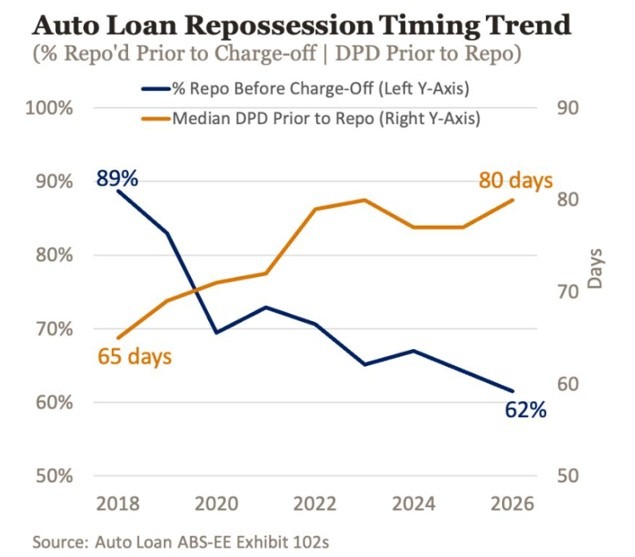
That means 38% of completed repossessions now occur after charge-off, compared with just 11% eight years ago. The share has more than tripled.
Meanwhile, median reported delinquency prior to repossession has increased from 65 days to 80 days.
These figures come from loan-level data extracted from corporate officer-attested Form ABS-EE filings submitted to the Securities and Exchange Commission. Ploog’s analysis includes major lenders such as Ally, Bridgecrest, CarMax, Carvana, Exeter, Ford, GM, Honda, Hyundai, Nissan, Santander, Toyota, Volkswagen, and World Omni, among others.
The data was normalized using January through September observations for each year to allow comparison with 2026 year-to-date results. The delinquency measurement reflects month-end status before the month of repossession.
The findings point to a fundamental change in lender behavior. Repossession is increasingly becoming the last resort, rather than an earlier response to a loan that has little realistic chance of recovery through continued collections.
And the repossession industry may be paying the price.
Recovery Rates Were Already Collapsing
The significance of Ploog’s findings becomes clearer when compared with a January 2025 report from the Consumer Financial Protection Bureau.
In its report, Repossession in Auto Finance, the CFPB examined repossession activity among nine major auto lenders from 2018 through 2022.
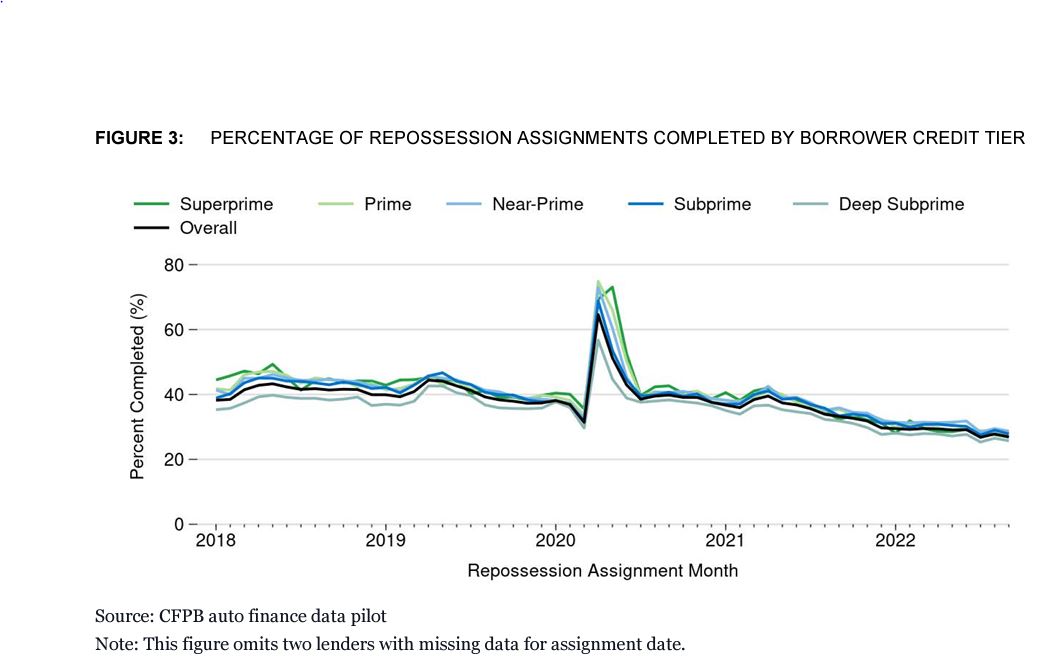
The agency documented a troubling decline in repossession assignment completion rates.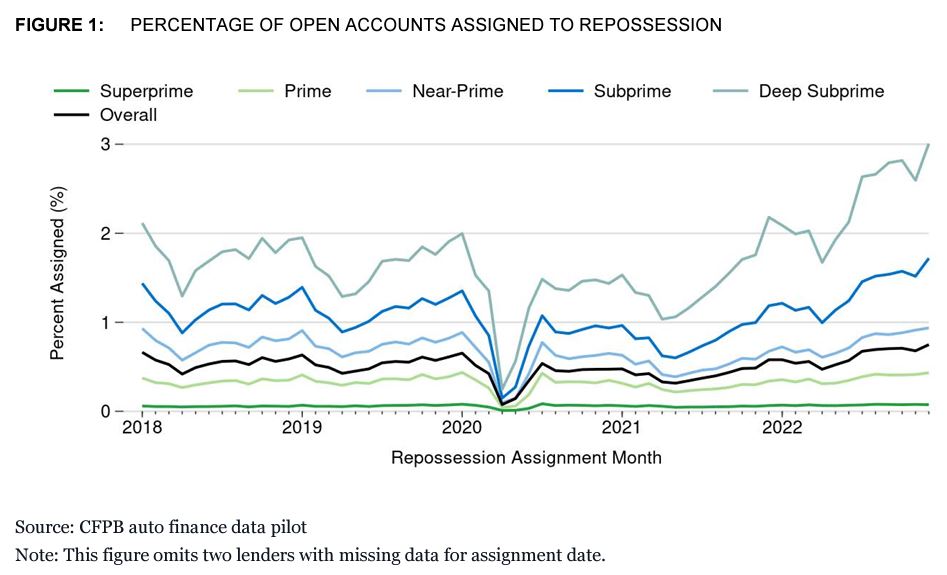
In September 2019, approximately 38% of repossession assignments resulted in completed recoveries. By September 2022, that figure had fallen to just 27%.
That’s an 11-percentage-point decline, representing a nearly 29% relative reduction in assignment completion.
These are not the same measurements as Ploog’s findings. The CFPB measured completed recoveries as a percentage of assignments, while Ploog examined the timing of completed repossessions relative to charge-off. The studies also cover different lender populations and periods.
But viewed together, they raise a question that deserves considerably more attention.
How much of the repossession industry’s declining recovery performance is the direct result of lenders waiting too long to assign their collateral?
A vehicle assigned at 60 days delinquent is not necessarily the same recovery opportunity as one assigned after months of extensions, unsuccessful collection attempts, and deteriorating borrower circumstances.
The borrower may have moved. The vehicle may have changed locations repeatedly. The customer may have become increasingly evasive or stopped communicating altogether.
Yet the recovery agency receiving that assignment may still be expected to locate the vehicle for the same fee and meet the same performance standards as an account assigned much earlier.
Lenders control the assignment timing. Recovery agencies do not.
And that brings us to what may be the driving force behind this growing repo aversion.
Loan Extensions: Extend and Pretend
Loan extensions and modifications have become increasingly important tools for lenders attempting to manage delinquent auto loans. When successful, these programs can help struggling borrowers retain their vehicles while allowing lenders to avoid repossession expenses and potential losses.
But when they fail, the lender has often accomplished little more than delaying the repossession while the collateral continued depreciating.
Additional ABS data analyzed by Ploog illustrates just how widespread extensions have become in certain below-prime lending portfolios.
As of May 2026, the percentage of outstanding below-prime loans that had received at least one extension included:
- GM Financial: 49%
- Exeter Finance: 35%
- Bridgecrest: 28%
- Santander: 27%
- CarMax Auto Finance: 27%
Nearly half of GM Financial’s below-prime outstanding loans in the analyzed population had received an extension. More than one-third of Exeter’s had as well.
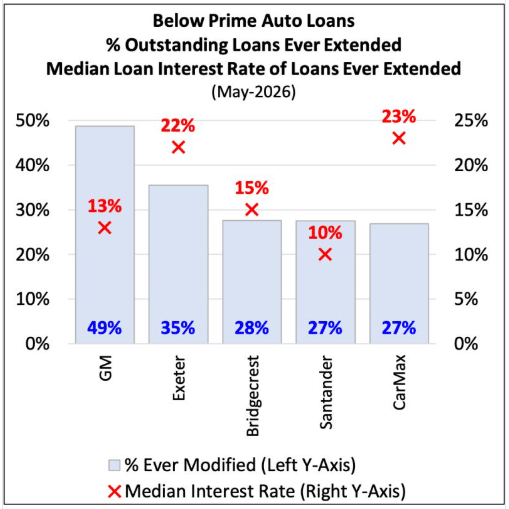
These figures represent loans that had ever received an extension, not necessarily accounts currently delinquent or extensions that ultimately failed.
Nevertheless, they demonstrate how extensively some lenders are relying on payment relief.
And they raise another uncomfortable question.
At what point does an effort to help a borrower become an exercise in postponing an inevitable loss?
Every successful extension represents a repossession avoided. But every unsuccessful extension potentially represents additional time during which the vehicle continues depreciating and the borrower’s financial circumstances may worsen.
When lenders eventually exhaust those alternatives, the account is finally assigned for repossession.
The recovery agency then inherits a problem that may have been developing for months.
Repo Aversion: Worsening the Negative Equity Problem
There is another consequence of delaying repossession that receives considerably less attention: the impact on loan-to-value ratios and eventual deficiency balances.
Vehicles depreciate whether borrowers make their payments or not.
When lenders extend payments without meaningfully reducing principal, the outstanding loan balance may decline more slowly than the vehicle’s value.
Consider a borrower owing $25,000 on a vehicle worth $20,000. The loan already carries a 125% loan-to-value ratio and $5,000 in negative equity.
Now suppose additional extensions and the passage of time leave the borrower owing $24,500 while the vehicle’s value falls to $17,000.
The LTV has increased to approximately 144%, and the negative equity has grown to $7,500.
The lender has postponed repossession, but the underlying collateral position has deteriorated.
If the vehicle is eventually recovered and sold, that growing difference between the outstanding debt and the vehicle’s realizable value can contribute to a larger deficiency balance.
Accrued interest, allowable fees, recovery expenses, and actual sale proceeds can further influence the final deficiency.
Not every extension produces this outcome, and a successful modification can prevent a loss entirely. But repeatedly extending an account that ultimately fails can leave the lender facing a worse collateral position than if repossession had occurred earlier.
The lender may be delaying recognition of an unavoidable recovery problem while allowing the potential loss to grow.
And when the vehicle finally enters the repossession process, the recovery agency is being asked to recover depreciated collateral that may now be more difficult and expensive to locate.
The Charge-Off Data Exposes the Risk
Perhaps the strongest evidence that repeated payment relief does not always resolve the underlying problem comes from Ploog’s analysis of loans following their first extension.
Among below-prime loans receiving their first extension in 2024, the cumulative gross charge-off rate reached approximately 31% within 25 months.
For the 2025 first-extension vintage, the cumulative gross charge-off rate had already reached approximately 21% within 13 months.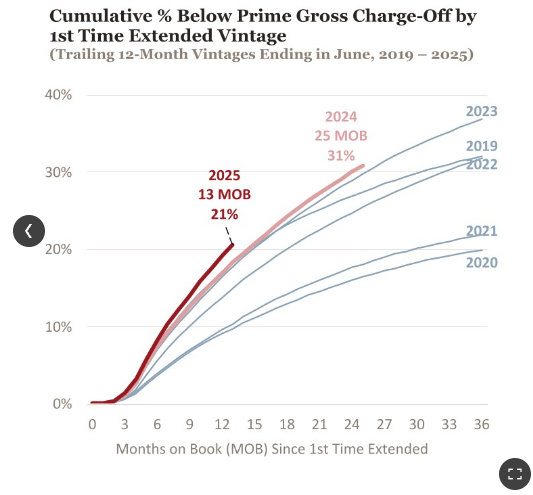
These are different observation periods, and the figures should not be interpreted as proof that extensions caused those charge-offs. Borrowers receiving extensions are often already experiencing financial difficulties.
Nevertheless, the results demonstrate that substantial portions of these extended-loan cohorts ultimately charged off despite receiving payment relief.
That is particularly revealing when considered alongside the repossession timing data.
Lenders are extending significant portions of their below-prime portfolios. Meaningful shares of previously extended loans are subsequently charging off. And an increasing percentage of completed repossessions are occurring after charge-off.
The available data does not establish that these are the same individual loans or prove that extensions are the principal cause of declining assignment completion rates.
But the pattern is difficult to dismiss.
Repo-averse lenders may be spending months attempting to rehabilitate accounts that ultimately require repossession anyway, leaving recovery agencies to deal with the consequences of those delays.
And the longer that process continues, the greater the potential for collateral depreciation, growing deficiencies, and more difficult recoveries.
A Self-Inflicted Problem with the Repo Industry Paying the Price
There is a fundamental contradiction in the way repossession performance is often evaluated.
Lenders establish the original loan terms. They determine how much risk to accept, how much negative equity to finance, when to offer extensions, and how long to pursue collection alternatives.
Most importantly, they determine when an account is finally assigned for repossession.
Recovery agencies control none of those decisions, yet when recovery rates deteriorate, agencies can find themselves facing demands for better performance, faster recoveries, and greater efficiency.
All while operating under compensation structures that may have changed little despite increasingly difficult assignments.
That raises a basic question of fairness and economics.
If lenders are changing the age and quality of the accounts they assign, why should they expect the same recovery rates at the same price?
An account that has spent months cycling through delinquency, extensions, and unsuccessful collection efforts may require considerably more investigative work, additional field visits, and greater expense than an account assigned earlier.
And the recovery agency has no ability to recover the time already lost.
It cannot reverse depreciation, undo unsuccessful extensions, or return the borrower to the circumstances that existed months earlier.
It can only attempt to locate and recover the collateral as it exists when the assignment finally arrives.
This is not an argument against helping borrowers who genuinely have the ability to recover financially. Successful loan modifications benefit everyone involved and prevent unnecessary repossessions.
It is an argument against allowing repossession aversion to become a substitute for recognizing when a loan is no longer realistically recoverable through additional payment relief.
At some point, postponing repossession may stop being a solution and become part of the problem.
Perhaps It’s Time Lenders Examined Their Own Performance
The CFPB documented declining assignment completion rates years ago. Ploog’s more recent ABS analysis reveals that repossessions are occurring later in the delinquency cycle, increasingly after charge-off.
His additional extension and charge-off data provides a plausible explanation for why lenders are waiting longer and why some of those delays may ultimately prove costly.
The missing piece is loan-level evidence directly connecting prior extensions and assignment delays to subsequent repossession completion rates. That would help determine how much of the decline is attributable to lender timing decisions rather than other factors affecting recoveries.
But the findings already justify a serious examination of lender practices.
If lenders are choosing to hold troubled accounts longer, extending loans that ultimately fail, and allowing collateral values to deteriorate before assigning repossession, they should be examining the consequences of those decisions before demanding better results from recovery agencies.
They should also be reconsidering whether their recovery fees and performance expectations reflect the actual difficulty of the accounts they are assigning.
The repossession industry cannot be expected to overcome every consequence of lender decisions made long before an assignment ever reaches an agency.
And perhaps the most troubling possibility is that a meaningful portion of the industry’s declining recovery performance is not the result of recovery agencies doing their jobs poorly, but of lenders making those jobs unnecessarily difficult.
Lenders cannot keep moving the repossession finish line farther away and then blame recovery agencies for taking longer to reach it.
The Self-Inflicted Wound: Repo-Averse Lenders and the Decline in Recovery Rates – The Self-Inflicted Wound: Repo-Averse Lenders and the Decline in Recovery Rates – The Self-Inflicted Wound: Repo-Averse Lenders and the Decline in Recovery Rates
Kevin Armstrong
Publisher
Sources: Bill Ploog’s original analysis of approximately 31 million auto loans using SEC Form ABS-EE loan-level filings, including 2018–2026 repossession timing, May 2026 below-prime loan extensions, and 2024–2025 first-extension charge-off vintages. Consumer Financial Protection Bureau, Repossession in Auto Finance, January 2025.
The Self-Inflicted Wound: Repo-Averse Lenders and the Decline in Recovery Rates – Fuel Costs – Gas Prices – Repossess – Repossession – Repossession Agency – Repossessor – Repossession – Repossession News – Auto Loan






More Stories
Without Change is the Risk worth the Reward?
The Repossession Industry Is Eating Its Own
Twelve Years, Seventy-Five Dollars
The LPR Arms Race: How Many Cameras Are Enough?
The Cost of Collecting LPR Data Has Gone Up. Why Hasn’t the Pay?
WHEN IS ENOUGH, ENOUGH? A Question Worth Asking Across the Repossession Industry