



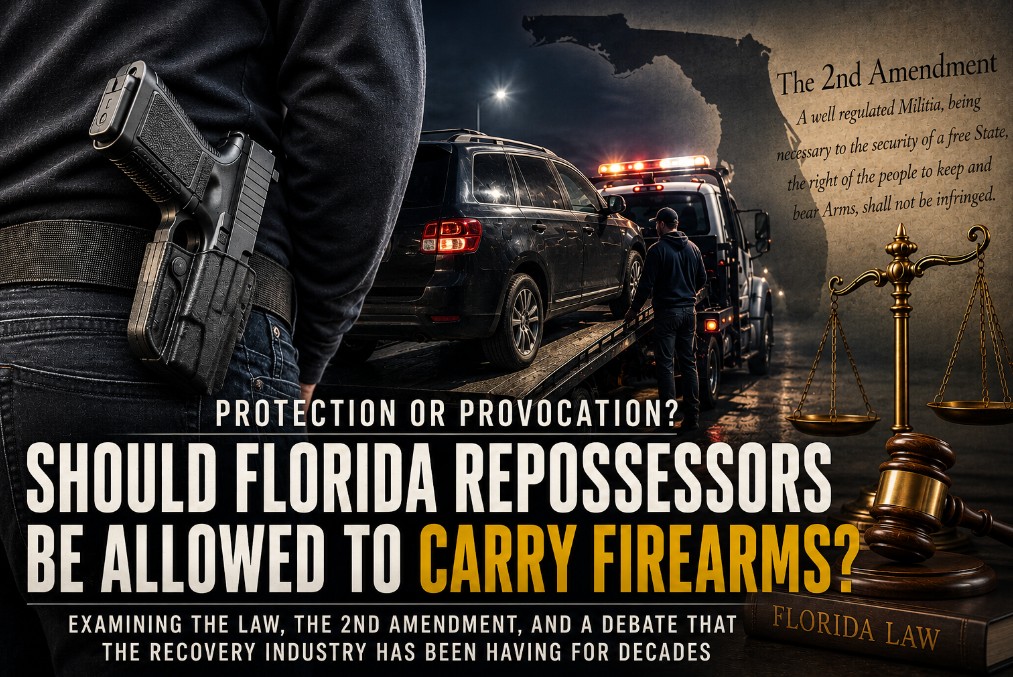
Protection or Provocation? – Take Our Poll!
Should Florida Repossessors Be Allowed to Carry Firearms?
EDITORIAL
The murder of Jacksonville repo agent Oliver Lopez has reignited a debate that has simmered within Florida’s repossession industry for years: Why are licensed repossessors prohibited from carrying firearms while performing repossession duties, and should that prohibition remain in place?
It is a difficult conversation. It’s one the repo industry has been having for decades and not just in Florida. But it is also one that deserves to be approached honestly.
When a repossessor is murdered while attempting to recover collateral, the instinctive response from many industry professionals is simple: If he had been armed, perhaps he would still be alive.
But public policy is rarely that simple.
What Florida Law Actually Says
Florida is generally considered one of the more firearm-friendly states in the nation. Law-abiding adults may carry concealed firearms without a permit, and recent court decisions have expanded open-carry rights as well.
Yet repossessors remain an exception.
Under Chapter 493 of the Florida Statutes, licensed recovery agents are prohibited from carrying firearms on their person while on private property and engaged in repossession activities. The restriction applies even if the repossessor otherwise has legal authority to carry a firearm. Florida regulators and the Attorney General’s Office have recently reaffirmed that the prohibition remains in effect despite broader changes to Florida’s firearm laws.

The reasoning behind the law is straightforward: repossession work places agents into inherently confrontational situations involving emotionally charged property disputes. Lawmakers concluded that introducing firearms into those encounters could increase the likelihood of deadly outcomes.
Whether that reasoning still holds up is where the debate begins.
The Second Amendment Question
Many repossessors argue that Florida’s law creates a constitutional contradiction.
A repossessor may legally carry a firearm while driving to the assignment. He may legally possess firearms at home. He may legally carry concealed while shopping, eating dinner, or walking down the street.
Yet the moment he begins performing the very job that places him at the highest risk of violence, that right disappears.
To many recovery professionals, that seems backwards.
Supporters of reform point to the U.S. Supreme Court’s recent Second Amendment decisions, particularly the emphasis on the right of ordinary citizens to bear arms for self-defense. They argue that repossessors are not government actors, law enforcement officers, or armed security personnel. They are private citizens engaged in lawful business activities and should not lose constitutional protections merely because they are recovering collateral.
Critics of the current law also note that violent repossession incidents are not theoretical. Every year brings reports of agents being assaulted, shot at, stabbed, rammed by vehicles, or killed. Many argue that if any profession has a legitimate claim to self-defense concerns, repossessors rank near the top of the list.
The Argument for Allowing Firearms
Those advocating for change generally focus on three points.
First, repossession agents routinely encounter dangerous situations without warning. Unlike police officers, they often have limited information about the individuals involved, criminal histories, mental health concerns, or the presence of weapons.
Second, criminals already carry guns.
The current law only affects law-abiding recovery agents. A debtor willing to commit murder is unlikely to be deterred by Florida licensing statutes.
Third, many agents believe the prohibition creates a false sense of safety. A firearm carried discreetly for defensive purposes is not necessarily a tool of escalation. In many cases, it may never be drawn. Its value lies in providing an option when every other option has failed.
Supporters often point to Florida’s extensive training requirements for armed security officers and private investigators. If those professions can obtain specialized firearms credentials, they ask why trained recovery agents cannot do the same.
The Argument Against Allowing Firearms
Opponents raise concerns that are equally difficult to dismiss.
Repossession differs from most professions because confrontation is built into the job itself.
A homeowner may not expect a process server. A suspect may not expect a private investigator. But virtually every debtor understands why a repossessor is present.
The encounter begins with conflict.
Critics argue that introducing firearms into those situations could transform arguments, physical struggles, and heated confrontations into fatal shootings. The concern is not merely that debtors might attack agents. It is that both sides could become armed participants in a rapidly escalating encounter.
There are also liability concerns.
If a repossessor shoots a debtor during a disputed recovery, lenders, forwarders, insurers, and agencies could find themselves facing enormous legal exposure. Even a legally justified shooting could trigger years of litigation.
Many lenders already express concern about breach-of-the-peace claims. Firearms add another layer of complexity to an industry already operating under intense scrutiny.
Is There a Middle Ground?
Perhaps the debate should not be framed as a choice between complete prohibition and unrestricted carry.
A middle-ground approach could include:
- Advanced firearms training specific to repossession scenarios.
- Additional licensing requirements beyond standard carry eligibility.
- Psychological screening similar to some armed security positions.
- Mandatory de-escalation training.
- Strict use-of-force policies.
- Enhanced reporting requirements following firearm-related incidents.
Such an approach would recognize both realities: repossession is dangerous, and firearms introduce additional risks.
The Question Florida Must Answer
The death of Oliver Lopez does not automatically prove that Florida’s firearm prohibition is wrong.
Likewise, the existence of the prohibition does not automatically prove it enhances safety.
What Lopez’s murder does demonstrate is that repossession remains one of the most dangerous occupations in the automotive finance ecosystem. Every stakeholder—lenders, regulators, lawmakers, and recovery professionals—must confront that reality.
The question is not whether repossession is dangerous.
The question is whether prohibiting trained recovery agents from carrying firearms while performing their duties makes them safer, makes the public safer, or simply leaves them vulnerable during the moments they face the greatest risk.
Reasonable people can disagree on the answer.
But after another repossessor has lost his life, it is a conversation the industry can no longer avoid. But there is no known evidence of the shooting at present to suggest that had he been armed that he may have been in a position to defend himself.
Should Florida Repossessors Be Allowed to Carry Firearms?
Kevin Armstrong
Publisher
Should Florida Repossessors Be Allowed to Carry Firearms? – Should Florida Repossessors Be Allowed to Carry Firearms? – Should Florida Repossessors Be Allowed to Carry Firearms?
Should Florida Repossessors Be Allowed to Carry Firearms? – Repossession Violence – Repossession History – Repossession – Repossess – Repossession – Repossession Agency – Repossessor – Gun – Compliance – Training





More Stories
The Cost of Collecting LPR Data Has Gone Up. Why Hasn’t the Pay?
WHEN IS ENOUGH, ENOUGH? A Question Worth Asking Across the Repossession Industry
Three Million Repossessions: A New Measure of America’s Recovery Industry
Why Fight LPR? Join It — But What Happens When the Car Repossesses Itself?
In The Future Will There Be Anyone Left to Recover Vehicles?
The Broken Bond Between Lenders and Agents – Positive Resolution