


A Blueprint for Future Legislation Elsewhere?
For most recovery agencies, July 1 is just another day on the calendar. In Indiana, it may mark the beginning of one of the most significant operational changes the repossession industry has faced in years.
House Bill 1184, which creates a new statutory framework for collateral recovery agencies in Indiana, officially takes effect next month. While the law’s stated purpose is straightforward, providing additional consumer protections and ensuring borrowers have a reasonable opportunity to recover personal property and redeem collateral, the practical impact on recovery operations may be far more complex.
As the implementation date approaches, agencies, forwarders, lenders, transport providers, and auctions are all asking the same question:
How will this actually work in the real world?
A Milestone Years in the Making
According to the Indiana Professional Repossessors Association (INPRA), the legislation represents a significant achievement for the state’s recovery industry. The association noted that the bill creates a dedicated section of Indiana law governing collateral recovery operations, something many states still lack.
Industry leaders involved in the process describe the legislation not as a reaction to a crisis, but as an effort to establish greater clarity and consistency for lenders, recovery agencies, consumers, and regulators alike.
That distinction is important.
Unlike many repossession-related laws that originate from consumer complaints or enforcement actions, Indiana’s recovery industry played an active role in shaping the legislation and working with lawmakers throughout the process.
For many operators, simply having a defined statutory framework may prove to be one of the law’s most significant long-term accomplishments.
The Intent Behind the Law
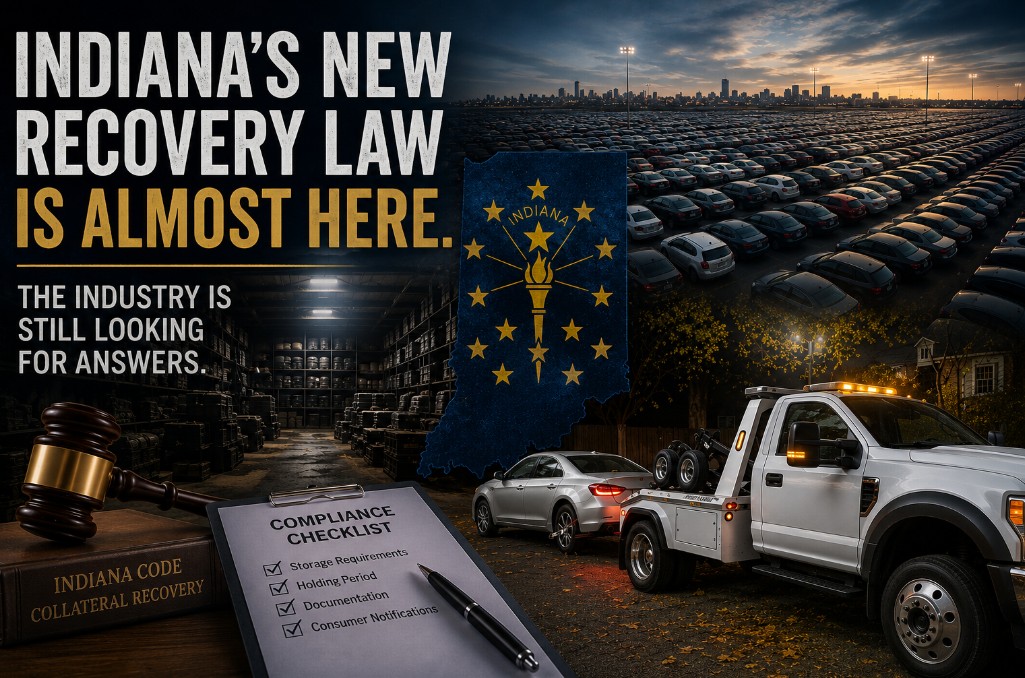
The provision attracting the most attention is the requirement that repossessed collateral remain in Indiana for a specified period before being removed from the state.
Supporters view the measure as a common-sense consumer protection designed to prevent borrowers from discovering their vehicle has already been transported hundreds of miles away before they have had an opportunity to reclaim personal belongings or exercise redemption rights.
Viewed through that lens, the requirement may be less about where vehicles are stored and more about ensuring consumers maintain meaningful access to their personal property.
Few in the industry dispute the goal.
The concern lies in how that goal will be implemented.
Storage Capacity Becomes a New Concern
For decades, much of the repossession and remarketing process has been built around efficiency. Vehicles are recovered, secured, processed, and moved through established channels toward transport companies, auctions, or remarketing facilities.
Indiana’s new requirements could slow that process.
Every additional day a vehicle remains in storage creates costs. Storage space, insurance coverage, lot security, staffing, documentation, and administrative oversight all become more important when collateral remains in place longer than it has historically.
Several operators have privately expressed concerns about capacity. Some storage facilities already operate near their limits, and agencies are evaluating whether existing infrastructure will be sufficient if holding periods routinely extend beyond current practices.
For smaller operators, the challenge may be finding room. For larger agencies, it may involve managing hundreds of additional vehicles occupying valuable lot space.
Forwarders and Lenders Face New Compliance Challenges
The uncertainty extends well beyond recovery agencies.
National forwarding companies are closely watching implementation because compliance responsibility rarely stops with the agency that physically recovers the vehicle. Lenders increasingly expect forwarders to verify that recovery vendors are following all applicable laws and contractual requirements.
As a result, many forwarders are reviewing vendor agreements, compliance procedures, and documentation standards in anticipation of July 1.
For lenders, the challenge may be even greater.
Most major financial institutions operate under nationwide policies designed to create consistency across their portfolios. Indiana’s law requires state-specific procedures, often forcing modifications to recovery instructions, consumer notices, remarketing workflows, and compliance systems.
Many institutions are still finalizing those changes.
Transportation and Auction Questions Remain
Transportation providers and auction partners are also seeking clarification.
Questions continue to circulate throughout the industry regarding when the holding period officially begins, what movements of collateral are permissible within the state, and what documentation lenders will ultimately require to demonstrate compliance.
While the law establishes the framework, many of the practical questions agencies encounter every day remain unanswered.
Industry participants expect lenders to require increasingly detailed records showing where a vehicle was stored, when it arrived, when it became eligible for release, and when it ultimately left the state.
The administrative burden could become just as significant as the operational burden.
The Question Nobody Is Asking
Perhaps the most important question surrounding the new law is surprisingly simple:
Who pays for it?
If vehicles remain in storage longer, costs inevitably increase.
Storage expenses rise. Insurance exposure increases. Administrative requirements grow. Personal-property handling takes more time and resources.
Eventually, someone absorbs those costs.
Will lenders adjust fee structures?
Will forwarders absorb the additional expense?
Or will recovery agencies be expected to comply without additional compensation?
The answer may determine how smoothly the transition unfolds.
Could Indiana Agencies Benefit?
Ironically, the new law may create opportunities for some Indiana-based recovery companies.
Agencies with established storage facilities, strong documentation systems, and sufficient lot capacity may find themselves in an advantageous position. As lenders evaluate compliance risks, local operators capable of demonstrating readiness could become increasingly attractive partners.
The impact may not be felt equally across the industry.
For agencies already maintaining robust Indiana operations, compliance may be relatively straightforward. For organizations relying heavily on interstate transportation and out-of-state storage facilities, the adjustments could be much more significant.
The First Chapter, Not the Last?
Perhaps the most overlooked aspect of House Bill 1184 is what it may signal about the future.
During recent legislative sessions, Indiana lawmakers have considered a variety of proposals affecting the collateral recovery industry, including discussions surrounding licensing, training standards, insurance requirements, operational oversight, and license plate recognition technology.
Not all of those proposals became law. But their introduction demonstrates a growing legislative interest in the industry.
For that reason, July 1 may not represent the end of Indiana’s regulatory evolution. It may simply be the beginning.
If House Bill 1184 is viewed as successful by lawmakers, regulators, lenders, and consumers, it would not be surprising to see additional collateral recovery legislation emerge in future sessions.
Why Agencies Nationwide Are Watching
The reason this matters beyond Indiana is simple. The broader trend within the repossession industry is unmistakable. Legislatures across the country continue to focus on borrower protections, documentation requirements, personal-property handling, data privacy, and increased oversight of recovery operations.
Indiana may be the latest example, but it is unlikely to be the last.
What happens after July 1 could serve as a blueprint for future legislation elsewhere.
Until then, agencies are preparing the same way they prepare for most regulatory changes: reviewing procedures, training staff, updating systems, and documenting everything.
Because when Indiana’s new law takes effect, the industry’s success may depend as much on compliance paperwork as it does on locating and recovering vehicles.
Kevin Armstrong
Publisher
Sources and Further Reading
- Indiana Professional Repossessors Association (INPRA) Announcement
- Indiana House Bill 1184 (2026 Session)
- Indiana General Assembly Bill Tracking System
- Indiana Professional Repossessors Association
Indiana’s New Recovery Law Is Almost Here. The Industry Is Still Looking for Answers. – Indiana’s New Recovery Law Is Almost Here. The Industry Is Still Looking for Answers. – Indiana’s New Recovery Law Is Almost Here. The Industry Is Still Looking for Answers.
Indiana’s New Recovery Law Is Almost Here. The Industry Is Still Looking for Answers. – State Repossession Associations – Repossess – Repossession – Repossession Agency – Repossessor – Repossession – Auction – Auction –






More Stories
CFPB Gives Lenders a Lighter Touch. What About the Repo Agents?
NY Repo Agent Allegedly Beaten and Put in Chokehold
Two New LPR Bills in Congress, One Question for Repossession
Bail Collateral Repo Turns Into 100-MPH Fugitive Chase
REPO AMATEUR HOUR: They Repossessed a Chihuahua
“Repo Man” Arrested After Alleged Wrongful Repossession