

Signals Broader Push Against Data-Driven Repossession Models
Colorado LPR Bill Dies but a Trend is Developing
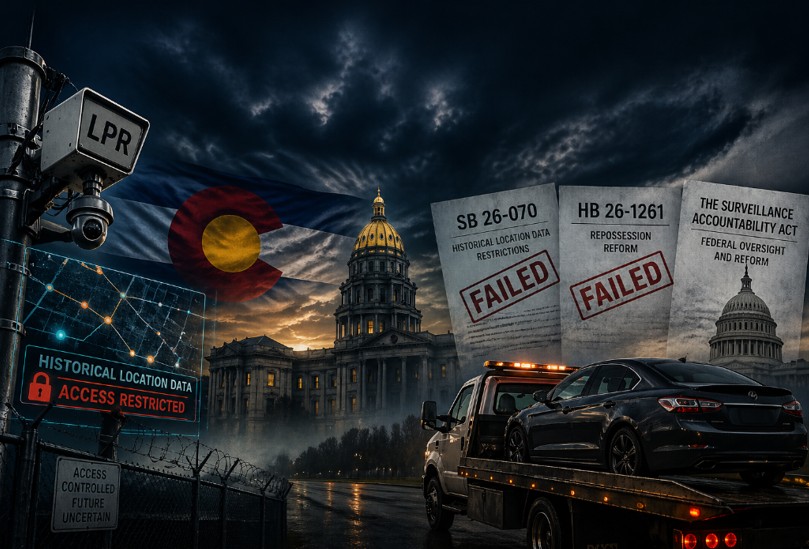
Colorado lawmakers have formally abandoned one of the most aggressive attempts in the country to regulate license plate reader (LPR) data, but the failed effort, paired with a separate repossession reform proposal and emerging federal legislation, signals a broader shift that could reshape the recovery industry.
At the center of the debate was Colorado Senate Bill 26-070, a measure that sought to sharply restrict governmental access to historical vehicle location data. The bill ultimately failed to advance during the 2026 legislative session, but not before triggering significant concern across law enforcement, technology providers, and the repossession sector.
Read the Bill Here!
A Direct Challenge to LPR Data Models
SB 26-070 was designed to limit how government agencies access and use historical location information, including data derived from LPR systems. As introduced, the bill would have:
- Prohibited their access to databases containing historical vehicle location data
- Restricted their sharing of that data across jurisdictions
- Required warrants for certain types of access
- Imposed strict retention and auditing requirements on acquired data
- Rendered improperly obtained data inadmissible in court (Colorado General Assembly)
Even amended versions retained a core principle: treating historical vehicle movement data as sensitive surveillance information subject to constitutional-style protections. For example, lawmakers advanced provisions requiring a warrant for LPR searches beyond a limited time window, reflecting concerns about “reconstruct[ing] weeks or months of a person’s movement.” (Denver 7 Colorado News (KMGH))
For the repossession industry, the implications were immediate. Modern recovery operations rely heavily on aggregated LPR datasets to locate collateral efficiently. By targeting “historical location databases,” the bill effectively challenged the foundation of those systems.
Why the Bill Failed
Despite clearing early hurdles, including committee advancement, SB 26-070 ultimately stalled and was marked as lost.
The failure came after intense opposition from law enforcement and municipal stakeholders, who argued the bill imposed “significant and unworkable restrictions” that would undermine investigations and public safety. (CML)
Concerns centered on:
- The burden of warrant requirements
- Reduced ability to solve time-sensitive crimes
- Limitations on data sharing between agencies
While privacy advocates supported the bill as a necessary guardrail on surveillance technology, lawmakers ultimately declined to move forward with such sweeping restrictions.
HB 26-1261: A Parallel Effort to Reshape Repossession
At the same time Colorado was debating LPR data, it was also considering a separate and equally consequential proposal: Colorado House Bill 26-1261.
Unlike SB 26-070, HB 26-1261 focused directly on repossession practices. The bill proposed:
- Extended pre-repossession notice periods
- Lengthened post-repossession redemption timelines
- Restrictions on certain recovery technologies
- Expanded consumer protection enforcement
That bill also failed, but together with SB 26-070 it paints a clear picture of legislative intent.
Colorado is not targeting a single issue, it is testing multiple pathways to reduce both:
- The ability to locate vehicles through data, and
- The ability to repossess them once found
Viewed together, the two bills represent a coordinated pressure point on the recovery ecosystem:
- SB 26-070 → limits data access and intelligence
- HB 26-1261 → limits execution and timing of repossession
Still on the Big Stage: The Surveillance Accountability Act
Adding to the LPR landscape is the proposed Surveillance Accountability Act, a federal initiative aimed at regulating the broader use of surveillance technologies, including systems that collect location-based data.
While still developing, the federal proposal reflects similar themes seen in Colorado:
- Increased transparency and reporting requirements
- Restrictions on how surveillance data is collected and used
- Greater oversight of data sharing and retention
- Heightened scrutiny of technologies capable of tracking movement over time
The inclusion of LPR and related tracking technologies within this broader surveillance framework suggests that policymakers are beginning to treat vehicle location data as part of a larger privacy and civil liberties issue, not just a law enforcement tool.
A Converging Trend
Taken individually, each of these efforts failed or remains in progress. Taken together, they illustrate a clear and accelerating trend:
Lawmakers are increasingly focused on limiting both the inputs and outputs of repossession.
- Inputs (Data):
Efforts like SB 26-070 seek to restrict access to historical location data, reducing the effectiveness of LPR-based recovery strategies. - Outputs (Recovery):
Bills like HB 26-1261 aim to delay or constrain the repossession process itself through extended timelines and expanded borrower rights. - Overlay (Federal Policy):
The Surveillance Accountability Act introduces the possibility of nationwide standards governing how tracking data is collected, stored, and shared.
Future Industry Implications
For lenders, forwarders, and recovery agencies, the immediate impact in Colorado is limited. Both state-level efforts failed, and no new restrictions are currently in place.
However, the strategic implications are significant.
These proposals, particularly SB 26-070, demonstrate a growing willingness by lawmakers to:
- Challenge the legality and scope of aggregated LPR databases
- Treat historical vehicle data as sensitive personal information
- Regulate private-sector reliance on surveillance-derived intelligence
At the same time, repossession itself is increasingly being reframed as a consumer protection issue rather than a purely contractual remedy.
Bottom Line
Colorado’s 2026 legislative session did not produce new restrictions on LPR data or repossession practices. But it did something arguably more important:
It revealed the direction of future regulation.
The combination of SB 26-070, HB 26-1261, and emerging federal proposals suggests that the repossession industry is entering a period where both data access and recovery execution will face sustained legislative scrutiny.
For an industry built on speed, information, and timing, those pressures, if realized, could fundamentally alter how recoveries are performed in the years ahead.
Related:
New Federal Bill Introduced to Limit LPR Use
Colorado Bill Aims to Severely Impact All Repossession Operations
Colorado LPR Bill Dies but a Trend is Developing – Colorado LPR Bill Dies but a Trend is Developing – Colorado LPR Bill Dies but a Trend is Developing
Colorado LPR Bill Dies but a Trend is Developing – Repossess – Repossession – Repossession Agency – Repossessor – Repossession – License Plate Recognition – LPR –





More Stories
NO REPO SIGNS: Do They Actually Have the Force of Law?
Colorado-Bonded Repossessor Named in $2.5 Million Vehicle Theft and Towing Investigation
Dallas BHPH Dealer Accused of $207K in Illegal Repossessions and Hammer Assault
CFPB Gives Lenders a Lighter Touch. What About the Repo Agents?
NY Repo Agent Allegedly Beaten and Put in Chokehold
Two New LPR Bills in Congress, One Question for Repossession