



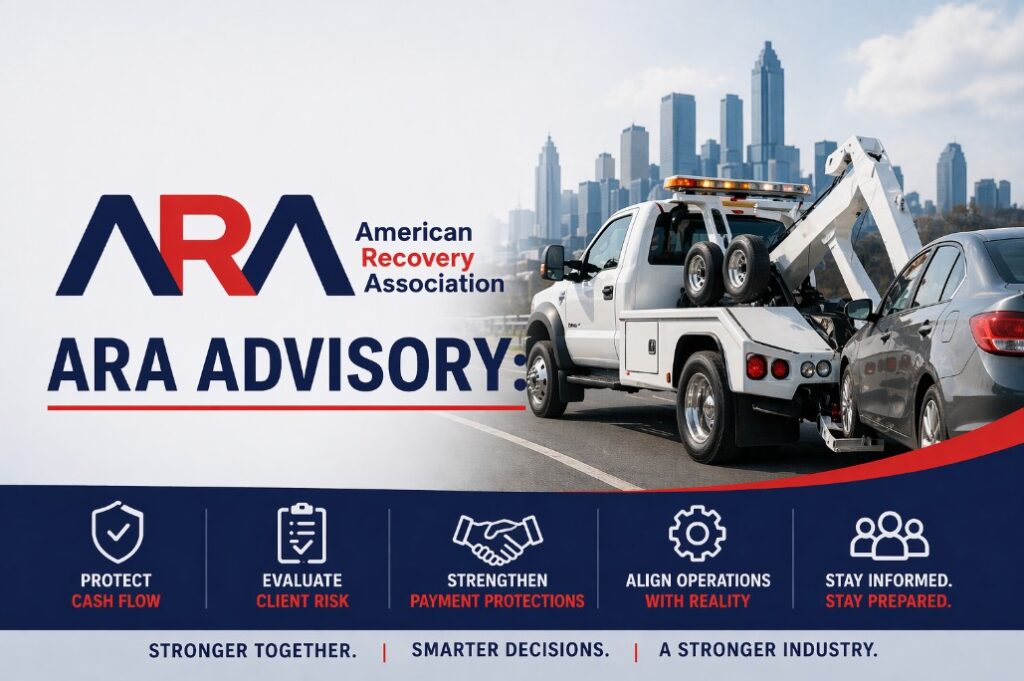
The American Recovery Association (ARA) is issuing this advisory in response to the recent slowdown in assignment volume being experienced across the repossession industry.
Initially, many attributed this decline to seasonal factors, particularly tax season, when consumers used refunds to bring accounts current. However, it is now clear that what we are seeing is not temporary. A broader shift is underway.
Financial institutions are increasingly adjusting their recovery strategies. Accounts that were once placed for repossession at 60 days past due are now often being held at 90 days, 120 days, or longer, as lenders work to keep consumers in their vehicles. While delinquencies may be rising, assignment flow is being delayed, reduced, or, in some cases, eliminated.
At the same time, many agencies are now feeling margin pressure. Fixed expenses tied to trucks, staffing, and debt incurred during the recent high-volume period are not adjusting at the same pace as the decline or delay in assignments. This creates a tightening environment where cash flow and cost control become critical.
A Deeper Shift in the Subprime Market
This slowdown is occurring alongside growing instability within the subprime auto finance sector.
Recent workforce reductions at Credit Acceptance Corporation reflect declining loan originations, tightening credit, and weakening loan performance. At the same time, lender failures continue to impact the industry. The shutdown of Automotive Credit Corporation has left agencies with unpaid balances and no clear path to recovery, with the company stating it is “not currently in a position to make payments on existing balances.”

For many, this mirrors the Tricolor Holdings collapse, as well as other recent lender exits, where agencies were left as unsecured creditors absorbing significant losses.
These events point to a familiar cycle: rising borrower stress, delayed recoveries, reduced lending, and increasing financial pressure across the industry.
Guidance to the Industry
This environment requires disciplined, informed decision-making:
- Be cautious with spending and expansion – Avoid major purchases or growth decisions based on expected volume that may not materialize.
- Protect cash flow – Monitor receivables closely and address aging balances quickly, especially with higher-risk clients.
- Evaluate client risk – Treat your clients the same way they evaluate borrowers. If you do not assess their financial stability before accepting work, you are taking on the risk that they may not pay.
- Strengthen payment protections – Consider retainers or tighter terms where appropriate. Accepting work without safeguards is extending unsecured credit.
- Align operations with reality – Adjust staffing, assets, and expenses to reflect current, not projected, assignment levels.
Moving Forward
The recent slowdown is proving to be more than a seasonal event. It reflects larger structural changes within the lending environment that will continue to influence the repossession industry.
ARA remains committed to supporting its members through this period with continued guidance, advocacy, and market awareness.
We urge all agencies to remain vigilant, protect their businesses, and approach this environment with both caution and discipline.
Todd Case
ARA President
 About the American Recovery Association (ARA):
The American Recovery Association is the world’s largest association dedicated to the advancement and professional development of the recovery and remarketing industry. ARA provides compliance support, education, and advocacy for hundreds of recovery professionals nationwide. ARA is the founder and host of the annual three-day North American Repossessors Summit (NARS) — the largest repossession conference in the industry. For more information, go to repo.org or call (972) 755-4755.
ARA Advisory: Understanding the Recent Slowdown in Repossession Activity – ARA Advisory: Understanding the Recent Slowdown in Repossession Activity – ARA Advisory: Understanding the Recent Slowdown in Repossession Activity
ARA Advisory: Understanding the Recent Slowdown in Repossession Activity – American Recovery Association – ARA – Repossess – Repossession – Repossession Agency – Repossessor – Repossession – Lending – Subprime Auto Loans – Subprime Auto Loans






More Stories
New On Hook Episode: A Conversation with Bahador Rahimi
Meet Otto: Your New AI Assistant in Clarity
NARS 2027 Industry Award Nominations Are Open
Beyond the Camera: A New Standard for Agent Safety and Field Protection
A Million-Dollar Milestone No One Wishes Was Necessary
Policy is great – Culture is better