


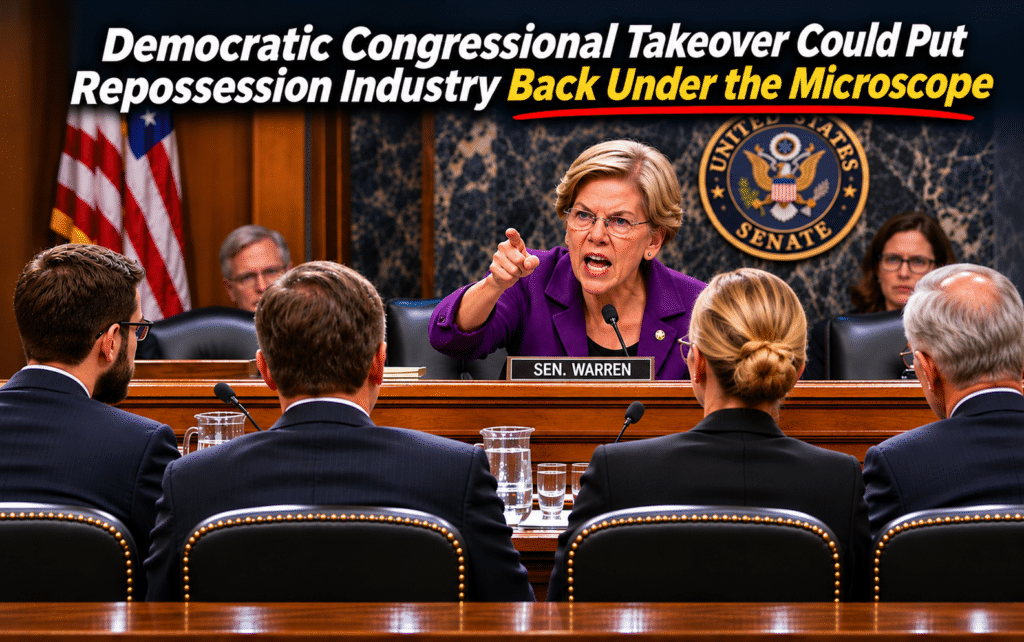
Warren’s unfinished repossession investigation could return with greater congressional authority.
November 5, 2026 – Elections come with consequences. And with the Democrats having seized control of both houses of Congress, the consequences could give legs to a renewed focus on the repossession industry and lenders if U.S. Senator Elizabeth Warren is again selected to chair the Senate Banking Committee.
Nine months ago, U.S. Senator Elizabeth Warren launched an investigation into wrongful vehicle repossessions. Since then, the political circumstances surrounding that inquiry have changed dramatically.
Democrats have won control of both the U.S. House of Representatives and Senate in the November 3 midterm elections, potentially giving Warren the congressional investigative authority she lacked when her inquiry began.
For the repossession industry, the election raises an important question: Will Warren resume her investigation with the power to compel answers from lenders, recovery agencies, and industry associations?
The answer remains uncertain, but the groundwork has already been laid.
As CURepossession reported in March, Warren’s investigation had encountered limited publicly disclosed industry responses, and her position as the ranking Democrat on the Senate Banking Committee restricted her ability to compel cooperation.
That limitation could disappear when the new Congress convenes on January 3, 2027.

Unfinished Business
On February 5th of 2026, Warren announced an investigation into auto lending and repossession practices, sending information requests to major financial institutions, buy-here-pay-here operators, and industry associations.
Recipients included Ally Financial, Capital One, Chase Auto, GM Financial, Toyota Financial Services, America’s Car-Mart, DriveTime, The National Independent Automobile Dealers Association (NIADA), the American Financial Services Association (AFSA) and the American Recovery Association (ARA), among others.
According to the Senate Banking Committee’s announcement, Warren sought information about wrongful repossessions, consumer complaints, repossession errors, and the procedures companies use to prevent improper vehicle recoveries.
Her questions included how companies ensure the correct vehicles are recovered, how disputes are handled, and what happens when consumers challenge the legality of a repossession.
The investigation also questioned whether the Trump administration’s reduction of Consumer Financial Protection Bureau (CFPB) activities had weakened federal oversight of auto lenders and repossession practices.
In March, Warren expanded her examination of auto lending practices to include potentially higher interest rates charged to military service members.
While some industry organizations publicly responded to her initial requests, comprehensive responses from all recipients were not publicly available.
Now, with Democrats preparing to assume Senate control, Warren could have an opportunity to revisit those unanswered questions.
If selected to chair the Senate Banking Committee, she would have greater authority to organize hearings, request documents, and pursue subpoenas under applicable committee procedures.
No renewed investigation or repossession-specific hearing has been announced. But with Senator Warren’s longstanding opposition to the repossession process and the strong likelihood of her assuming the chair of the Senate Banking Committee, the probability is strong and with it, the possibility of a real “dog and pony $hit show.”
Forwarders in the Spotlight?
One potentially significant development for the repossession industry involves accountability throughout the assignment process.
Warren’s February inquiry was not limited to the actions of individual repossession agents. It also sought information about industry practices, error prevention, and the relationships among companies involved in vehicle recoveries.
Those questions could eventually draw attention to repossession forwarders and the increasingly complicated chain of responsibility between lenders and field agents.
Consider a borrower who makes a payment or receives an approved loan modification, but the lender fails to cancel an outstanding repossession assignment.
The assignment remains active with a forwarder, which has already dispatched it to a recovery agency. The vehicle is subsequently repossessed despite the borrower’s updated account status.
Who bears responsibility?
The lender that failed to update its records? The forwarder that transmitted the assignment? Or the recovery agency that acted on the information it received?
These are not merely hypothetical concerns. Servicing errors, inaccurate account information, and failures to cancel assignments have been recurring subjects of federal consumer-protection oversight.
As forwarders assume larger roles in coordinating recoveries, questions about their responsibilities, communications, and compliance procedures could become increasingly relevant.
An important distinction is that a wrongful repossession does not necessarily mean the field agent caused the underlying error. But it would be foolish to assume an ounce of understanding or mercy from a committee led by a Senator with such longstanding animosity toward the entire repo industry and process.
Recovery agencies are responsible for properly identifying vehicles, complying with applicable laws, and avoiding breaches of peace. However, they are completely dependent on lenders and their intermediaries providing accurate information about the borrower’s account and the legal authorization for recovery.
Any congressional examination of wrongful repossessions would need to consider those separate responsibilities to understand where errors originate.
LPR Technology Could Become Another Target
License plate recognition (LPR) technology has been in the hot seat all across the country over the past year and presents another possible area of congressional interest.
Although Warren’s February investigation primarily concerned repossession errors and consumer protections, broader questions about commercial surveillance, data privacy, and information sharing could eventually intersect with the repossession industry.
LPR networks collect enormous amounts of vehicle-location information, raising questions about who controls that data, how long it is retained, and who may access or purchase it.
For repossession agencies increasingly dependent on LPR technology, potential federal privacy legislation or investigations could have operational implications.
Of course it’s still early and no confirmed announcement of a new congressional investigation specifically targeting repossession-related LPR operations has occurred.
But don’t be surprised if does.
Financial Hardship Modifications Create Additional Concerns
Another issue that could attract attention is the growing use of loan modifications and extensions to assist financially troubled borrowers.
Recent NCUA data analysis has shown a substantial increase in credit union financial-hardship modifications, while auto loan delinquencies and charge-offs remain elevated.
These developments create additional opportunities for servicing and communication errors.
When lenders modify loan terms, extend payments, or temporarily suspend collection activity, those changes must be accurately communicated throughout the repossession assignment process.
A failure to update an account or cancel an assignment can result in a vehicle being recovered after a borrower has entered into an approved payment arrangement.
Such errors fall squarely within the concerns Warren identified in February.
As more lenders rely on modifications to manage troubled loans, the accuracy of communication between servicing departments, forwarders, and recovery agencies becomes increasingly important.
What Should the Industry Expect?
It’s only been a few days since the election. The incoming Congress has not yet established its committee leadership or announced a new repossession oversight agenda.
Regardless, Warren’s previous investigation provides a documented foundation for additional inquiries.
The issues already identified include wrongful repossessions, inaccurate assignments, consumer disputes, military borrower protections, and the effectiveness of industry error-prevention procedures.
Additional questions could emerge concerning forwarder accountability, LPR data practices, and the handling of repossession assignments involving modified loans.
None of these potential developments establishes that new legislation, subpoenas, or enforcement actions are imminent.
There is also a distinction between investigating unlawful repossessions and imposing additional requirements on recovery agencies that are already subject to state licensing, consumer-protection laws, contractual compliance standards, and restrictions on breaches of peace.
An effective examination of wrongful repossessions would need to distinguish errors originating with lenders and servicing systems from misconduct or mistakes occurring during the physical recovery.
That distinction matters to both consumers and recovery professionals.
A Question Now Answered
When CURepossession examined Warren’s investigation in March, one of the central questions was whether the November elections might give her greater congressional authority.
That political uncertainty has now been resolved.
Democrats will control both chambers of Congress beginning in January, and Warren could assume a substantially more influential position in overseeing the financial services industry.
Whether she chooses to resume her repossession investigation, expand its scope, or pursue other consumer-lending priorities remains unknown.
But for an industry that has spent much of 2026 confronting rising financial pressures, growing compliance demands, and increasingly complex relationships among lenders, forwarders, and recovery agencies, the possibility of renewed congressional scrutiny deserves attention.
The question is no longer whether Warren’s party will gain control of the Senate. It is what she and the incoming congressional leadership intend to do with that authority and whether their investigation will follow the entire repossession assignment process or concentrate primarily on the agents who recover the vehicles.
Democratic Congressional Takeover Could Put Repossession Industry Back Under the Microscope – Democratic Congressional Takeover Could Put Repossession Industry Back Under the Microscope – Democratic Congressional Takeover Could Put Repossession Industry Back Under the Microscope
Related:
ARA Served Letter of Inquiry by Senator Warren
National Dealer Association Responds to Senate Repossession Probe
AFSA – Setting the Repossession Records Straight
Senator Warren Goes Back Down the Lending and Repossession Rabbit Hole
Democratic Congressional Takeover Could Put Repossession Industry Back Under the Microscope – Repossess – Repossession – Repossession Agency – Repossessor – Repossession – Repossession News – Forwarder – LPR – Compliance – Consumer Financial Protection Bureau – CFPB





More Stories
New On Hook Episode: A Conversation with Jeremy Cross
Subprime Auto Losses Hit Seven-Year High, But Lenders Keep Lending
Philadelphia Expands Electronic Repo Reporting to Eight Police Districts
The Money Conversation Continues: NARS Panel Returns for Round Two
Repo Agent Hospitalized After Being Pinned by Tesla
MAUCK RECOVERY MOVES FORWARD