

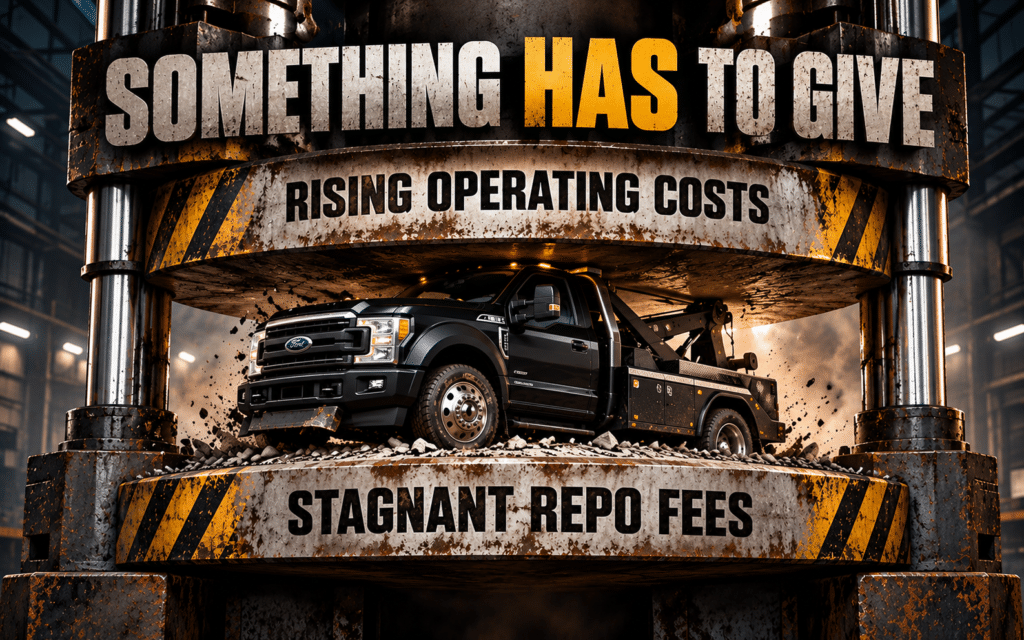
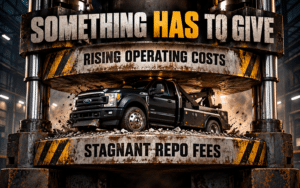
Facility costs have quadrupled, insurance has soared, and equipment prices keep climbing. Yet average repossession fees have increased just $75 in 12 years. Something has to give.
GUEST EDITORIAL
I went back and forth about writing this. Here’s the deal, none of this matters and none of this will change if the cars are still getting picked up at the rates offered. It’s right in our face and it is 100% unsustainable.
Here we are accepting theses rates, accepting the over-the-top compliance standards, keeping our trucks clean, serviceable and presentable for our clients’ customers, keeping our employees trained in conflict resolution, so they don’t act a fool in the field and they treat everyone with respect, keeping our trucks fitted with recording equipment, to keep ourselves and our clients out of the courtroom.
What do we get for all these additional efforts? An average raise of $75 for an involuntary repossession after 12 years?
I’ve been in the repossession industry for a long time, and like many agency owners, I’ve watched the cost of operating a business increase year after year. We continue to invest in equipment, employees, insurance, technology, and facilities, but the fees we’re receiving for our services have not kept pace with those increases.
I recently took some time to compare what we were paying to operate our business in 2014 with what we’re paying today. I knew our expenses had increased significantly, but seeing the numbers side by side really put things into perspective.
I think it’s important that we start having a serious conversation about this, not just among agency owners, but with the lenders and forwarding companies we work with every day.
Here are the number; The following figures come from my own company’s operating expenses. They aren’t industry averages or estimates of what other agencies are paying. They’re examples of what we’ve experienced over the past 12 years.
| Expense | 2014 | 2026 | Increase |
| San Diego facility rent (monthly) | $2,500 | $12,500 | 400% |
| San Fernando Valley facility rent (monthly) | $21,000 | $79,000 | 276% |
| New F-450 with dynamic bed | $65K–$80K | $95K–$115K+ | Approx. 45% |
| Hourly wage benchmark | $9 | $19 | 111% |
| Insurance for four trucks | $6K–$8K | $15K–$30K | Approx. 221% |
| Recovery camera system | $8K–$10K | $15K | Approx. 67% |
| Average involuntary repossession fee | $300 | $375 | 25% |
Percentage increases for cost ranges are approximate and based on their midpoints.
One of the biggest increases we’ve experienced has been in facility expenses.
In 2014, our San Fernando Valley facility cost us $21,000 per month. Today, we’re paying $79,000 per month. That’s an increase of $58,000 every month, or $696,000 annually. Our San Diego facility went from $2,500 per month to $12,500 per month, another $120,000 annually.
Between those two locations alone, we’re spending $816,000 more per year than we were in 2014.
Now compare that with our average involuntary repossession fee, which went from $300 to $375 during that same period. That’s a $75 increase in 12 years.
To put it another way, at $375 per recovery, we would need to complete 2,176 additional paid repossessions every year just to generate enough revenue to cover the increase in rent at those two locations. And that’s before paying the agent, fueling the truck, maintaining the equipment, or covering any of the other expenses involved in completing those recoveries.
Equipment and Insurance Aren’t Getting Any Cheaper, anyone who has purchased a new recovery truck recently knows how expensive they’ve become.
In 2014, we could purchase a new F-450 with a dynamic bed for approximately $65,000 to $80,000. Today, we’re looking at $95,000 to $115,000 or more.
Then there’s insurance. Our insurance costs for a four-truck operation have increased significantly over the years. Depending on the coverage, we’re now seeing costs that are substantially higher than what we were paying in 2014.
And it doesn’t stop there. Maintenance, tires, parts, fuel, registration, and equipment repairs all add up. We can’t simply stop replacing trucks or maintaining equipment because the costs have gone up.
We have responsibility to our employees, our clients, and the public for operating with safe, reliable equipment. But the money to pay for those investments has to come from somewhere.
Don’t forget about the work we do for free!
Another part of this conversation that I think is often overlooked is the amount of work recovery agencies perform without receiving compensation.
We all know how this works. An assignment comes in, and an agent starts working on it.
They drive to the address, investigate the location, make multiple attempts, document their activity, and sometimes spend hours trying to locate a vehicle.
Then the account gets closed, or the collateral simply can’t be located.
In many cases, the agency receives little or nothing for that work.
But we still paid the employee. We still paid for the fuel, the truck, the insurance, and everything else that went into those attempts.
When we talk about the cost of a repossession, we can’t look only at the assignments where we successfully recover the collateral. We must consider all the work that goes into the assignments that don’t result in a recovery.
Those expenses are just as real.
I believe our industry has made important improvements over the years, particularly when it comes to professionalism, compliance, technology, and safety. We should continue moving in that direction.
Our employees deserve proper training and safe equipment. Consumers deserve to be treated professionally. Lenders deserve to work with agencies that take compliance seriously.
But all of that requires investment.
We have cameras, GPS systems, software platforms, training programs, compliance requirements, reporting obligations, and other expenses that either didn’t exist or weren’t nearly as significant 12 years ago. We’re also competing for qualified employees in a labor market where wages and employment costs have increased considerably.
I don’t think any responsible agency owner would argue that we should lower our standards to save money.
But I do think it’s fair to ask how we’re expected to continue making these investments when the compensation for our services hasn’t kept up with the cost of providing them.
This should concern more than just agency owners, I don’t believe this is only an agency problem.
Lenders and forwarding companies rely on a network of professional recovery agencies to handle their assignments. They need companies that have qualified employees, dependable equipment, adequate insurance, and the ability to provide consistent service. Those things require financially stable businesses.
When operating costs continue to rise faster than revenue, something eventually has to give.
Maybe it’s an agency delaying the purchase of a new truck.
Maybe it’s having difficulty retaining experienced employees.
Maybe it’s deciding that certain service areas are no longer financially practical.
And for some owners, it may mean deciding whether staying in business makes sense at all.
I don’t think any of us want to see that happen. I’ve always believed that the different segments of our industry need to work together. Agency owners, lenders, and forwarding companies all have a role to play, and we all depend on each other to some degree.
But that relationship needs to include an understanding of what it actually costs to perform the work.
Where do we go from here?
I’m not suggesting that every agency has the same expenses or that every lender and forwarding company pays the same fees. There are differences in markets, business models, assignment volume, and operating costs. I’m simply sharing what I’ve seen in my own business over the past 12 years.
I would encourage other agency owners to take a similar look at their numbers.
Compare what you were paying for equipment, insurance, labor, facilities, and technology 10 or 12 years ago with what you’re paying today. Then compare those increases with the changes in your recovery fees.
I suspect a lot of owners will find that their numbers tell a similar story, although we need broader industry data to understand just how widespread the problem is.
I also think we need to do a better job of explaining these costs to the clients we serve. Not through complaints or demands, but through actual numbers and open conversations.
I understand that lenders and forwarding companies have financial pressures of their own. I’m not dismissing that. But we can’t continue to ignore what it costs to operate a professional repossession agency.
I’ve spent a significant part of my life in this industry. I care about the people who work in it, the businesses that have been built around it, and the direction we’re heading.
I want to see an industry where agency owners can continue investing in their companies, where good employees can build careers, and where the next generation sees an opportunity to build successful businesses.
For that to happen, we need to make sure the business model still works.
Most of you know me, I don’t go around running my mouth. I speak when things need to be said. I will also say that I have some great relationships with some great clients.
These good people can only do so much. They have a board that only sees their bottom line. The word needs to get to those people, and I am not sure how to approach that.
I will ask that everyone not waste time picking apart my numbers and focus on the larger problem here.
We will never succeed as an industry if we continue to think and act only as individuals.
Thank you everyone for taking the time to read this and please let me know how we can get through to the people who can make a difference before it’s too late
Twelve Years, Seventy-Five Dollars – Twelve Years, Seventy-Five Dollars – Twelve Years, Seventy-Five Dollars
Sincerely,
Dominic J. Clegg
Twelve Years, Seventy-Five Dollars – Fuel Costs – Gas Prices – Fight for Fair Fees – Repossess – Repossession – Repossession Agency – Repossessor – Repossession – Repossession News





More Stories
The LPR Arms Race: How Many Cameras Are Enough?
The Cost of Collecting LPR Data Has Gone Up. Why Hasn’t the Pay?
WHEN IS ENOUGH, ENOUGH? A Question Worth Asking Across the Repossession Industry
Three Million Repossessions: A New Measure of America’s Recovery Industry
Why Fight LPR? Join It — But What Happens When the Car Repossesses Itself?
In The Future Will There Be Anyone Left to Recover Vehicles?