
Every Assignment Has a Cost — Even When There’s No Car on the Hook
GUEST EDITORIAL
In the repossession industry, we talk constantly about fees, rates, contracts, performance, compliance, and liability. But sometimes it takes one ordinary day, and one completely unexpected event, to remind us what the “cost of doing business” actually means.
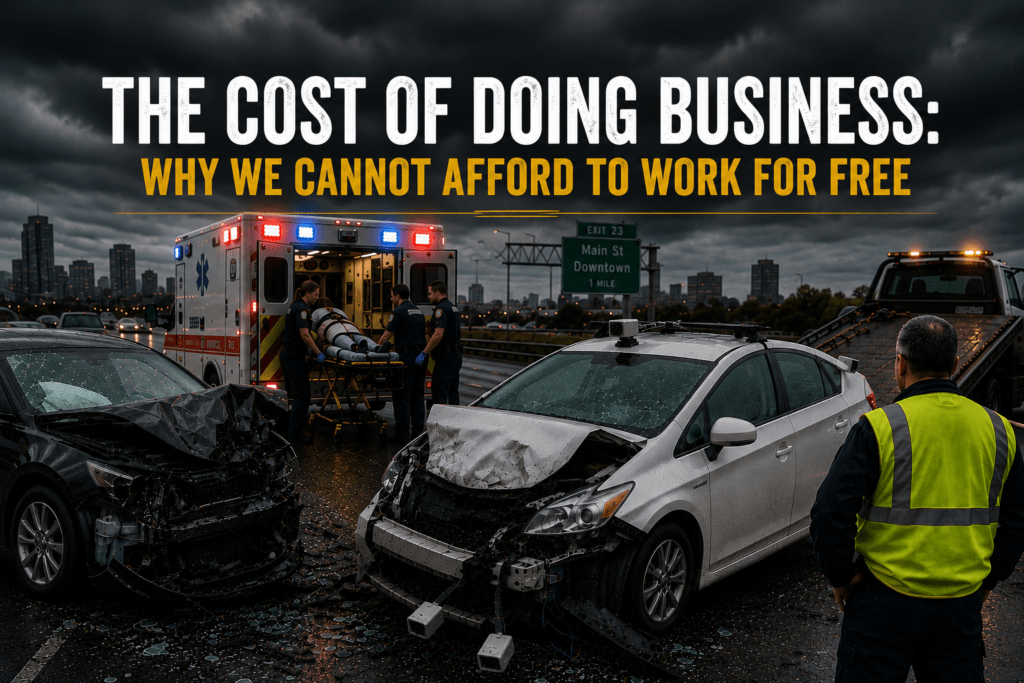
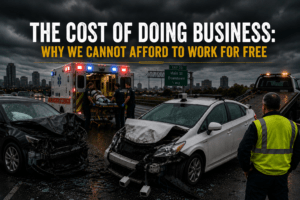
Recently, one of our spotter-car drivers was simply doing his job. He was traveling northbound on a busy six-lane highway, approaching a red light. He was in his lane, minding his own business, doing exactly what he was supposed to be doing. Then he saw something no driver expects to see. A vehicle was traveling southbound in his northbound lane, directly toward him.
There was nowhere to go.
Our driver did everything he could reasonably do. He slowed down. He stopped. He tried to protect himself and everyone else around him.
And then, BAM!
The other vehicle slammed directly into him. The airbags deployed. Our vehicle was totaled. Our employee was transported for medical treatment. Thankfully, he is going to be okay, but he suffered broken ribs and significant bruising from the airbags.
The other driver was arrested and taken into custody. There wasn’t much question about fault. Insurance information was provided at the scene, and the responding officer even went out of his way to verify that insurance information had been presented.
You would think that would be the end of the business’s financial concern.
The other driver caused the accident. She had an insurance card. Our employee did nothing wrong.
Except there was one problem.
The insurance wasn’t good.
The policy had lapsed in March 2026. Now our company is dealing with a totaled vehicle, medical expenses, an injured employee, lost productivity, downtime, administrative expenses, insurance involvement, replacement costs, and all the other expenses that come along with a serious accident.
What recourse do we realistically have? Sure, we can pursue the driver.
We can hire attorneys. We can spend more money. We can potentially obtain a judgment.
But a judgment against someone who has no assets and no ability to pay doesn’t replace a totaled company vehicle or reimburse the thousands of dollars a business has already spent.
You can’t draw blood out of a turnip. And THAT is the part of the cost of doing business that nobody wants to talk about.
Why Are We Working for Free?
Every time a repossession company accepts an assignment, there is a cost associated with working that account, whether we recover the collateral or not.
We pay for the truck.
We pay for the spotter car.
We pay for fuel.
We pay for insurance.
We pay the employee.
We pay workers’ compensation.
We pay for cameras, LPR technology, skip-tracing databases, dispatchers, compliance, training, GPS systems, software, office staff, facilities, maintenance, tires, repairs, licensing, taxes, legal expenses and countless other operational costs.
And sometimes, through absolutely no fault of the company, a vehicle gets totaled and an employee gets hurt. Yet our industry continues to accept a business model where we are expected to work assignments over and over again and, if the collateral isn’t recovered, receive little or nothing for the work performed.
Think about that. What other professional industry operates this way?
A plumber doesn’t come to your house five times for free because he wasn’t able to fix the problem on the first visit.
An attorney doesn’t spend 20 hours researching your case and decide those hours don’t count because you didn’t win.
A mechanic doesn’t diagnose your vehicle for three days and absorb all of his labor because the vehicle ultimately wasn’t repaired.
But repossession companies routinely dispatch employees, drive hundreds of miles, scan thousands of license plates, conduct investigations, pay for data, verify addresses, perform door knocks, update accounts and assume tremendous liability, with no guarantee of being compensated for any of it.
That is not a sustainable business model.
The Cheapest Provider Isn’t Always the Least Expensive
Clients understandably want to control costs.
So do we.
But there comes a point where continually pushing fees downward becomes counterproductive.
Professional repossession companies cannot maintain properly insured vehicles, qualified employees, compliant facilities, technology, training, safety programs and adequate supervision on rates that do not reflect the actual cost of providing those services.
And when a client asks an agency to work an account repeatedly without compensation unless a recovery occurs, the client isn’t eliminating the cost.
They are transferring the cost to the repossession company.
Someone still paid the driver.
Someone still bought the fuel.
Someone still paid the insurance premium.
Someone still purchased the LPR equipment.
Someone still paid for the data.
Someone still assumed the liability every mile that vehicle traveled.
The work wasn’t free.
The agency simply wasn’t paid for it.
Human Beings Are Part of This Business
There is another lesson in this accident that goes beyond money.
People are human. Humans make mistakes. Drivers make mistakes. Employees make mistakes.
Managers make mistakes. Clients make mistakes. Consumers make mistakes.
Sometimes those mistakes are small.
Sometimes they have enormous consequences.
The woman who drove the wrong direction that day made a terrible mistake. That mistake could have killed someone. Thankfully, it didn’t. Our employee went to the hospital instead of home.
A company vehicle was destroyed. Our business absorbed a loss we never planned for.
Yet every person involved will continue forward with a life that has been affected by what happened in a matter of seconds. Accountability matters. Safety matters. Training matters. Standards matter.
But there is a difference between holding someone accountable for a mistake and allowing one human mistake to unnecessarily change the entire trajectory of someone’s life.
That distinction matters in our industry.
We operate in a high-risk environment where employees make thousands of decisions in the field. We absolutely must investigate incidents, correct behavior, retrain when appropriate and take serious action when conduct is reckless, intentional or demonstrates an unacceptable pattern.
But we should also remember that perfection is not a reasonable standard for human beings.
A single mistake should be evaluated based on the totality of the circumstances: intent, training, history, severity, corrective action and whether the individual or company took responsibility and made meaningful changes.
Punishment should be proportionate.
Because companies are made up of people.
This is Why Your Fee Matters
When a professional repossession agency says it needs a fee increase, a close fee, a mileage fee, a door-knock fee or compensation for legitimate work performed, it isn’t necessarily trying to nickel-and-dime a client.
It may simply be trying to remain financially healthy enough to be there tomorrow.
Rates have to account for more than the successful repossession.
They have to account for the risk of performing the work.
They have to account for the account we worked six times and never recovered.
The employee who spent four hours investigating an address.
The truck that needed a $7,000 repair.
The insurance premium that increased again.
The compliance requirement that required another system.
The attorney who had to answer a complaint.
The employee who got hurt.
And sometimes, the spotter car that was sitting at a red light doing absolutely nothing wrong when an uninsured driver came traveling the wrong direction down a six-lane highway and totaled it.
That is the cost of doing business.
There will always be things we cannot predict.
There will always be accidents.
There will always be mistakes.
There will always be expenses we cannot recover.
That is precisely why we cannot intentionally give away the work we can charge for.
Our industry needs to stop being afraid to say:
Our work has value.
Our employees have value.
Our equipment has value.
Our time has value.
Our risk has value.
And professional, compliant repossession services have a real cost. If we want safer agents, better equipment, better training, better compliance, better technology and better results, then we have to build businesses capable of paying for those things.
We cannot demand professionalism while simultaneously driving professional companies toward unsustainable pricing. And as agency owners, we have a responsibility too.
We have to know our numbers.
We have to understand our cost per assignment.
We have to know what it costs every time a truck leaves the lot or a spotter car hits the road.
And most importantly: We have to stop working for free.
Because sometimes, despite doing everything right, shit happens.
And when it does, the bills don’t stop simply because it wasn’t our fault.
The Cost of Doing Business: Why We Cannot Afford to Work for Free – The Cost of Doing Business: Why We Cannot Afford to Work for Free – The Cost of Doing Business: Why We Cannot Afford to Work for Free
 Stephanie Findley
President
I R Services
Related by Stephanie:
Think Before You Post – Your Business Depends on It
The Repossession Merry-Go-Round
Leadership: A Privilege, Not a Position
The Cost of Doing Business: Why We Cannot Afford to Work for Free – Repossess – Repossession – Repossession Agency – Repossessor – Repossession – Repossession News – Compliance – Police – Arrest – Arrest


More Stories
The Insurance Barrier: When Tow and Repo Try to Cross the Line
Everyone Wants a Safe Repossession. Nobody Wants to Pay for One
The Industry We Built and the Standards We Must Protect
The Secret Recipe Isn’t Ours to Keep
What Happens When Repo Discovers Towing?
If Tow Is Coming Into Repo, Maybe Other Industries Should Start Looking at Repo Pricing Too