

For decades, recovery agencies have fought for better fees. Diversification may give them something even more valuable, the power to say no.
EDITORIAL
In my recent editorial, “The Tow Industry Is Coming into the Repo Space. Will It Make the Industry Stronger, or Absorb It?”, I looked at what could happen as a much larger towing industry begins taking a greater interest in professional repossession.
But somewhere in that conversation, another question emerged.
Maybe we’ve been looking at this backwards.
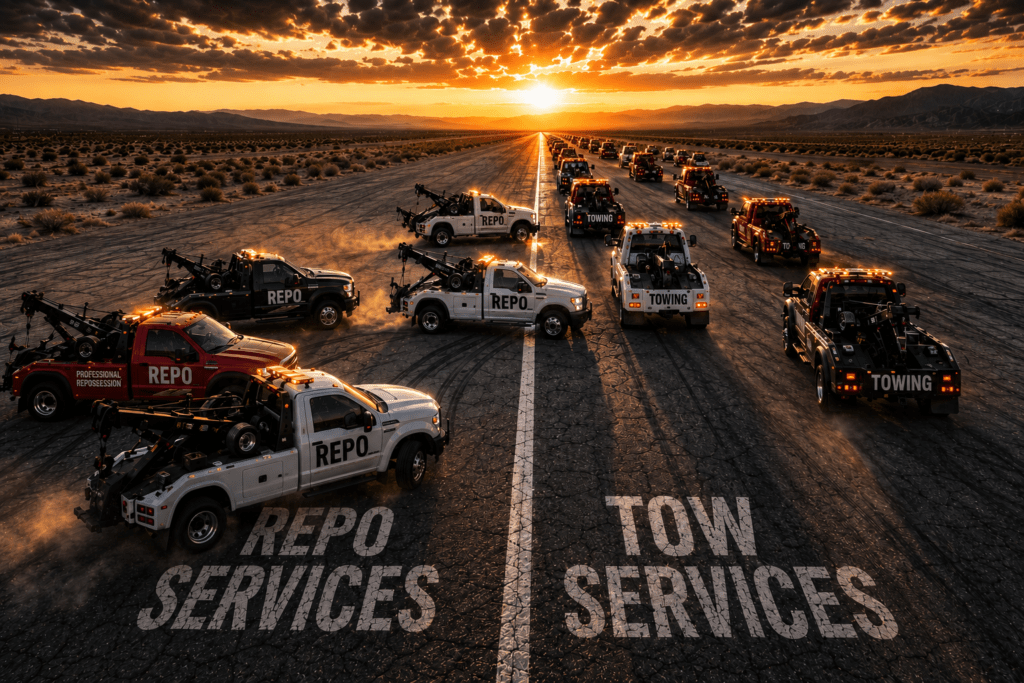
Instead of spending all our time wondering what happens when towing discovers repossession, perhaps professional repossession agencies should be asking what happens when repo discovers towing.
The more I think about it, the more compelling that question becomes.
For decades, repossession agencies have fought for better recovery fees, compensation for storage, reasonable contract terms and payment for services that increasingly seem to get bundled into the price of a successful recovery. Agencies complain. Associations advocate. Lenders listen, sometimes make adjustments, and sometimes don’t.
Yet the fundamental imbalance rarely changes.
Why?
Perhaps part of the answer is uncomfortable.
Dependency.
The Customer You Can’t Afford to Lose
Every business depends upon customers, but there is a tremendous difference between needing customers and being dependent upon a particular class of customers for virtually your entire livelihood.
Professional repossession has become an extraordinarily specialized business. That specialization created expertise, but it also created dependence.
A repo agency may own trucks, employ drivers, maintain a secure lot, operate dispatch around the clock, carry expensive insurance and invest heavily in technology and compliance. Yet most of those assets ultimately depend upon assignments originating from one customer class: lenders and the companies managing recoveries for them.
That creates tremendous purchasing power on one side of the relationship.
If a lender or forwarder changes its storage policy, what does the agency do? If it adds another administrative requirement without additional compensation, what does the agency do? If insurance requirements increase while the recovery fee remains unchanged, what does the agency do?
If an agency believes an account is no longer economically viable, the theoretically obvious answer is one I’ve advocated for years:
Just say no.
But saying no is considerably easier when there is something else for the truck to do tomorrow.
That’s where this conversation gets interesting.
Maybe the Problem Isn’t Just the Fee
We tend to discuss repo economics as a pricing problem.
Recovery fees haven’t kept pace. Storage has been surrendered or restricted. Administrative responsibilities have expanded. Compliance costs have increased. Insurance has increased. Equipment, wages, fuel, technology and real estate have all become more expensive.
Blah, blah, blah… the conversation has gone on for decades now. Regardless, they are legitimate problems.
But perhaps they’re symptoms of a larger one.
If one customer group controls access to most of the work your specialized equipment and employees can perform, that customer group has tremendous influence over what those services are worth.
The question therefore may not simply be how repossession agencies convince lenders to pay more.
Maybe the question should be why agencies have allowed lenders to determine so much of what their businesses are worth.
What the Tow Industry Does Differently
This is where looking at the towing industry through fresh eyes becomes useful.
Towing certainly isn’t an economic paradise. Tow companies face enormous insurance costs, expensive equipment, driver shortages, regulation and plenty of powerful customers capable of squeezing rates. Municipal contracts can be difficult. Motor clubs have enormous purchasing power. Consumer-facing towing creates its own headaches and liabilities.
But there is one fundamental difference worth examining.
Towing can have more places to sell its services.
A diversified towing operation might work with motorists, dealerships, repair facilities, body shops, commercial fleets, municipalities, law enforcement, insurance companies, roadside-assistance networks and property owners. It may provide towing, transport, roadside assistance, storage and specialized recovery.
No single revenue source necessarily has to define the entire company.
Compare that with a pure repossession agency whose trucks, employees and property exist primarily to service lender assignments.
That difference is leverage.
The Storage Lot Tells the Story
Storage may provide the simplest example of the cultural difference between the two industries.
A repossession agency may look at its secure storage facility primarily as something it needs to satisfy lender, insurance and compliance requirements.
A towing company looks at secured vehicle storage and sees an asset that produces substantial revenue.
Think about that difference for a moment.
The land costs money. Fencing costs money. Cameras cost money. Lighting costs money. Insurance costs money. Employees cost money. The company assumes responsibility for someone else’s vehicle while that vehicle occupies space that cannot simultaneously be occupied by another vehicle.
Yet portions of the repossession industry have gradually accepted restrictions on storage compensation that might look completely foreign to an established towing operator.
And storage isn’t the only example.
Personal property fees, closing fees, Mileage, multiple attempts, additional compliance, networks and additional administrative work.
A towing operator examining professional repossession may look at services recovery agencies have gradually absorbed into the cost of doing business and ask the ridiculously simple question:
Why aren’t you charging for that?
Perhaps that’s a question repo agencies should be asking themselves more often.
The Problem With “Just Say No”
I’ve used that phrase for years to the point it’s lost all value.
Don’t accept work that doesn’t make economic sense. Don’t agree to unreasonable contracts. Don’t give away services that have value. Don’t allow fear of losing an account to turn a bad business relationship into a permanent one.
Just say no.
It sounds so simple.
It isn’t.
An agency owner staring at payroll on Friday has a very different perspective from someone discussing pricing theory at an industry conference.
If one lender represents a significant portion of your assignment volume, saying no can mean idle trucks, fewer hours for employees and a lot full of equipment payments that don’t stop simply because you’ve taken a principled position.
That isn’t negotiating leverage.
It’s dependency.
And dependency has probably done more to shape repo pricing as anything else over the past several decades.
Maybe the solution to saying no isn’t finding more courage.
Maybe it’s having somewhere else to say yes.
Repo Already Owns Much of What It Needs
This is what makes towing such an interesting diversification opportunity for professional recovery agencies.
Look around a well-established repo operation.
Trucks.
Drivers.
Dispatch.
A secured lot.
Cameras.
Fencing.
Insurance relationships.
Vehicle-handling experience.
Transportation experience.
Office personnel.
Twenty-four-hour operations.
A professional repo agency offering light-duty towing isn’t necessarily starting another business from zero. In many cases, it already owns a significant portion of the physical and operational infrastructure.
That doesn’t mean the transition is effortless.
Towing regulations vary considerably by state and municipality. Police rotation programs can impose significant requirements. Roadside work requires different customer-service and dispatch capabilities. Insurance coverage has to be appropriate. Equipment requirements vary, and complex accident recovery or heavy-duty towing requires specialized knowledge that shouldn’t be confused with repossession experience.
A great recovery agent doesn’t automatically become a great accident-recovery operator any more than a great tow operator automatically understands breach of peace.
But the barriers aren’t necessarily insurmountable, particularly for agencies that begin with services adjacent to what they already know.
Light-duty towing. Dealer transportation. Repair-facility work. Roadside services. Commercial accounts. Storage. Vehicle transport.
The opportunity doesn’t have to begin with an overturned tractor-trailer on an interstate.
Put the Truck to Work for Someone Else
The economics of the truck itself may be the most important consideration.
A repossession truck waiting for assignments is still costing money. The payment continues. Insurance continues. Depreciation continues. The property where it sits continues costing money.
What if that same asset could generate revenue from several markets?
Perhaps it performs repossessions overnight and dealer transports during slower periods. Perhaps another truck handles roadside and light-duty towing. Perhaps the storage facility begins generating legitimate revenue from other vehicle-related activities where regulations and contracts permit.
The specifics will differ dramatically by agency and market.
The principle doesn’t.
An asset with multiple ways to earn revenue is more valuable than an asset dependent upon one source of work.
And a business with multiple revenue streams is harder for any single customer to control.
What If the Lender Became a Customer Instead of The Customer?
This may be the real opportunity.
Imagine a professional recovery company in which repossession remains a major specialty but no longer represents virtually all of the company’s revenue.
Perhaps repossession produces 50%. Towing, transportation, storage and other vehicle services produce the rest.
Now imagine a lender or forwarder proposes a contract that doesn’t make economic sense.
The agency can run the numbers and say: No.
Not angrily. Not emotionally. Not as part of an industry protest and certainly not through coordinated pricing among competitors. Simply as an individual business decision.
“That work doesn’t make economic sense for us at that price.” Then the truck goes somewhere else and earns money. That is a fundamentally different negotiating position.
The goal isn’t to stop needing lenders. They’re customers, and good lender relationships remain tremendously valuable. The goal is to stop needing every assignment at almost any price.
Diversification Doesn’t Guarantee Profit
There is an important warning here. Adding towing services to an unprofitable repossession company won’t magically create a profitable recovery company.
Bad diversification can destroy a business just as easily as excessive specialization can weaken one.
New services require capital. They require expertise, insurance, licensing, marketing, customer relationships and management attention. A repo agency that jumps blindly into towing because someone says the margins are better could discover an entirely new collection of problems.
The towing industry also has its own versions of the same power imbalance repo agencies know very well. Large roadside networks can dictate rates. Municipalities can regulate fees. Insurance costs can become crushing. Consumer disputes can be relentless.
Diversification only creates leverage when the additional business is itself economically sound.
The lesson isn’t “Become a tow company.”
The lesson is “Stop assuming repossession has to be the only thing your assets are allowed to do.”
Perhaps the Single-Service Era Is Ending
For generations, specialization was considered a strength. Become exceptionally good at one thing, build a reputation around it and create an organization specifically designed to deliver it.
There is still enormous value in specialization. But, as we see in the current environment, specialization becomes dangerous when it turns into dependency.
The modern recovery agency already sits at the intersection of transportation, technology, investigations, logistics, storage and asset management. Perhaps defining that entire enterprise around one transaction, the repossession assignment has become unnecessarily restrictive.
The towing industry’s growing interest in repo may be forcing us to reconsider that.
Tow companies are looking across the line and seeing another service they might perform.
Maybe repo companies should look across the same line.
Maybe We Have Been Looking at This Backwards
My first question was what happens when the towing industry comes into repossession and it’s still an important question. The towing industry is vastly larger, and increased participation could affect competition, training, associations, fees and the identity of professional repossession itself.
But perhaps there is another way to view what’s happening. Maybe towing isn’t simply coming for repo’s business. Maybe it’s showing repo agencies what their businesses could become.
A truck doesn’t know whether the vehicle behind it is a repossession, an accident tow, a dealer transport or a roadside call. A secured lot doesn’t inherently know whether the vehicle occupying a space arrived through a lender assignment or another lawful towing service.
Those distinctions matter enormously for licensing, compliance, insurance and operations.
But economically, the assets are still assets.
Maybe the opportunity is to make more of them.
Just Say No, But Give Yourself Somewhere Else to Go
I’ve believed for a long time that professional repossession agencies need to become more willing to say no.
No to work that doesn’t pay.
No to unreasonable contract terms.
No to giving away services that have value.
No to accepting every new expense simply because someone farther upstream has decided the agency should absorb it.
But perhaps I’ve underestimated something.
The ability to say no doesn’t begin at the negotiating table. It begins with the business model.
An agency dependent upon one customer class will always have difficulty walking away from that customer class.
Diversification changes the calculation.
Maybe towing isn’t the right answer for every repossession agency. Geography, licensing, capital, management capability and local competition will determine that. But the broader question deserves serious consideration.
Perhaps the day of the single-service repossession company is beginning to fade.
The towing industry is looking at repossession and seeing another way to put its trucks, employees and property to work. Professional repossession agencies should at least consider doing the same thing in reverse.
Because after decades of asking lenders for better economics, diversification could give recovery agencies something even more valuable than another fee increase.
It could give them the ability to say no and still have somewhere else to go.
What Happens When Repo Discovers Towing? – What Happens When Repo Discovers Towing? – What Happens When Repo Discovers Towing?
Kevin Armstrong
Publisher
Related:
The Tow Industry Is Coming into the Repo Space. Will It Make the Industry Stronger, or Absorb It?
If Tow Is Coming Into Repo, Maybe Other Industries Should Start Looking at Repo Pricing Too
What Happens When Repo Discovers Towing? – Forwarder – Transport – Repossess – Repossession – Repossession Agency – Repossessor – Repossession – Repossession News – Auto Loan






More Stories
WHEN IS ENOUGH, ENOUGH? A Question Worth Asking Across the Repossession Industry
Three Million Repossessions: A New Measure of America’s Recovery Industry
Why Fight LPR? Join It — But What Happens When the Car Repossesses Itself?
In The Future Will There Be Anyone Left to Recover Vehicles?
The Broken Bond Between Lenders and Agents – Positive Resolution
The Repos That May Never Come