



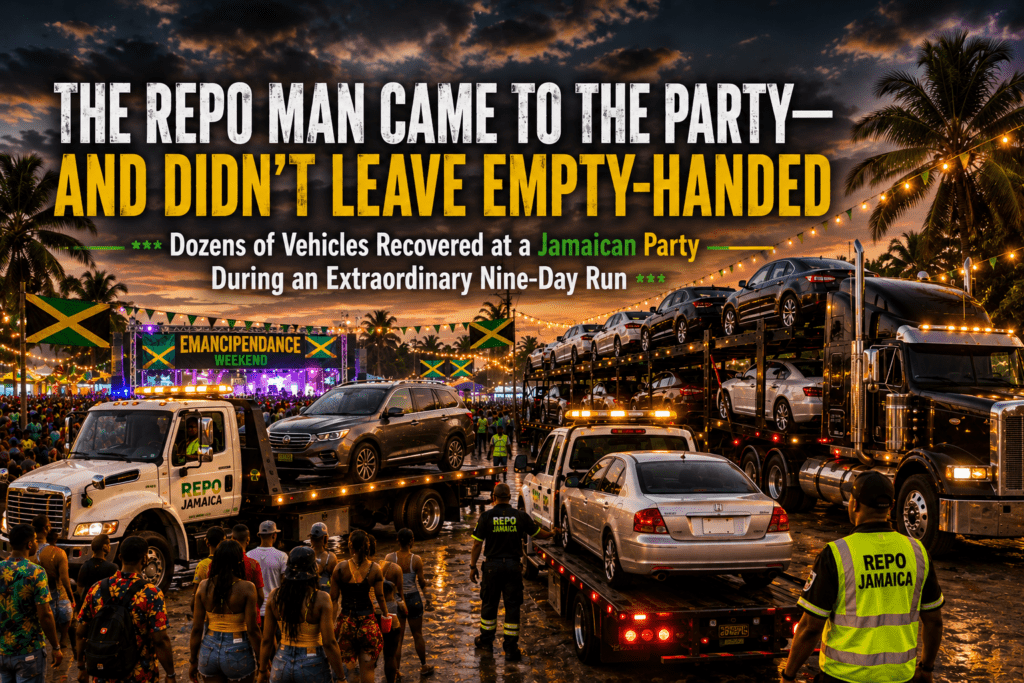
80 Vehicles Recovered at a Jamaican Party During an Extraordinary Nine-Day Run
KINGSTON, Jamaica — Most people heading out to a party worry about finding a place to park. For some Jamaican partygoers this month, finding their car when it was time to leave became the bigger problem.
A staggering 80 vehicles were repossessed between August 1 and August 9 while their owners were attending some of Jamaica’s biggest summer entertainment events in St. Ann and St. James, according to The Jamaica Star.
And this wasn’t a coincidence.
“We target anywhere there are large gatherings with a large number of vehicles,” a Repo Jamaica spokesperson told The Star.
For American recovery professionals, finding that many assigned vehicles gathered in a handful of locations might sound less like a difficult weekend and more like hitting the repo jackpot.
But behind the unusual story is something else: a glimpse into a Jamaican vehicle-repossession business that, despite different laws and terminology, may look surprisingly familiar to American repossessors.

80 Recoveries in Nine Days
According to The Star, Repo Jamaica recovered 45 vehicles in St. Ann during the first nine days of August, including 14 at a single event. Another 35 were recovered during Jamaica’s Emancipation and Independence holiday weekend in St. James.
Read the original Jamaica Star report.
Repo Jamaica, which The Star identifies as a subsidiary of Fair Debt Collections Processes Ltd., reportedly has bailiffs and spotters working island wide with banks and credit unions to locate vehicles connected to delinquent accounts.
Large entertainment events offer something particularly valuable to a recovery operation: thousands of vehicles concentrated in one place.
“We would know that this very exciting party weekend is where a lot of these cars will be, so our spotters were out in numbers, identifying these vehicles for us to pick them up,” the spokesperson said.
The company said June through August, along with October and December, are generally its busiest periods because large numbers of people gather for entertainment events.
Repo Jamaica reportedly recovered between 40 and 50 vehicles during August 2025. This year, it reached 80 during just the first nine days of the month.
Spotters Outside While the Party Goes On
The operation described by Repo Jamaica will sound remarkably familiar to many American recovery agents.
While thousands of people are inside enjoying an event, spotters and bailiffs work the parking areas looking for vehicles they have been instructed to recover.
Repo Jamaica stressed that it isn’t specifically targeting people because they’re attending parties. Large gatherings simply create what the company called “a very good source of finding the vehicles.”
Finding them, however, doesn’t always mean recovering them.
Crowded event parking creates an obstacle every repossessor understands: cars get boxed in.
“Sometimes we are not able to get in and get all of the vehicles,” the spokesperson explained. “But certainly the ones that we are able to get to, we definitely get to them.”
At one weekend series of events in St. Ann, Repo Jamaica reported recovering 29 vehicles, with nearly half coming from patrons attending a Sunday beach party.
For some owners, the first indication that anything had happened reportedly came when they returned to the parking area.
Some initially reported their vehicles missing to police before discovering that bailiffs had already repossessed them.
As the Repo Jamaica representative rather vividly described it:
“You are having fun and then come out to the empty spot.”
Jamaica Has Its Own Repo Rules
While the fieldwork may sound familiar, Jamaica has its own legal framework governing repossession.
For transactions governed by Jamaica’s Hire-Purchase Act, creditors face specific procedures before collateral can be recovered.
According to Jamaica’s Consumer Affairs Commission, a vendor must issue a Notice of Default, giving the consumer at least seven days to address the delinquency. A Notice of Repossession follows before the goods can be recovered.
Read the Consumer Affairs Commission’s explanation of Jamaica’s Hire-Purchase Act.
The timing can also depend on how much of the purchase price has already been paid. Consumer Affairs Commission guidance states that when less than two-thirds has been paid, repossession generally cannot occur until the consumer has been in arrears for two months, or a longer period stated in the agreement. Once two-thirds or more has been paid, that period generally increases to three months.
Then comes a term that can be misleading to American readers: bailiff.
Under Jamaica’s Hire-Purchase Regulations, a “vendor’s bailiff” is a person employed by a vendor to serve notices, collect money or recover possession of goods on the vendor’s behalf.
Read Jamaica’s Hire-Purchase Regulations.
The regulations require licensing, while the Consumer Affairs Commission says repossessions are generally conducted between 6:00 a.m. and 6:00 p.m., Monday through Saturday, excluding public holidays.
Different terminology, certainly. But the combination of assignments, spotters, locating collateral and licensed professionals physically recovering vehicles for financial institutions is recognizable territory to an American repossessor.
The Last Line of Defense
Repo Jamaica also pushed back against the idea that vehicles simply disappear from parking lots without borrowers having received prior warning.
According to the company, repossession generally comes only after financial institutions have attempted emails, telephone calls, letters and contacts through references in an effort to reach delinquent borrowers.
“Vehicles are not just repossessed — it is the final stage. The financial institutions are looking for them.”
The company said the vehicles being recovered aren’t necessarily older or inexpensive, either.
Repo Jamaica reported recovering virtually every type of vehicle, including “a lot of high-end vehicles.”
The spokesperson also claimed some delinquent vehicles are being rented to Jamaican residents and foreign visitors who may have no idea the vehicle they’re driving is subject to repossession.
And the company offered a simple piece of advice for borrowers falling behind: communicate with the lender before the account reaches recovery.
“The financial institutions are not there to repossess their vehicles,” the spokesperson said. “It is their last line of defense in securing their assets.”
Auto Finance May Look Familiar, Too
Jamaica has roughly the population of Mississippi packed into an island smaller than Connecticut. While 80 units repossessed is not a big number by US standards, Jamaica’s auto-finance market is tiny compared with the United States, but some of the financing terms being offered might surprise American lenders and recovery professionals.
JN Bank currently advertises auto loans offering up to 100% financing and as long as 10 years to repay on qualifying loans.
See JN Bank’s current auto-loan offering.
That’s potentially 120 months on a vehicle loan.
There is also evidence of meaningful repossession inventory beyond Repo Jamaica’s unusual August run.
Earlier this year, Jamaica’s National Commercial Bank offered 110 repossessed vehicles with a combined asking value of approximately J$437 million, according to The Jamaica Gleaner. The inventory ranged from ordinary transportation to luxury vehicles.
Read the Jamaica Gleaner report on NCB’s repossessed-vehicle inventory.
In other words, Repo Jamaica’s extraordinary nine-day run didn’t occur in a country unfamiliar with auto lending or collateral recovery.
Different Country, Familiar Business
There are still plenty of questions about how Jamaica’s professional repossession industry operates.
How are assignments transmitted? How large is the professional recovery industry? How are spotters compensated? What technology is used to locate collateral? Where are recovered vehicles stored? And how similar are the relationships between Jamaican lenders, collection companies and recovery contractors to those familiar in the United States?
CURepossession has reached out to Repo Jamaica seeking additional information about the company, the unusual party recoveries and the broader professional vehicle-repossession business in Jamaica.
But the account already provided by Repo Jamaica offers American recovery professionals a surprisingly recognizable picture.
Different country. Different laws. Different terminology.
Spotters looking for collateral. Recovery professionals waiting for an opportunity. Cars boxed in that can’t be reached. And cars that can be reached that aren’t there when their owners return.
Apparently, some things in the repossession business cross borders remarkably well.
And when the repo man comes to the party, somebody may be finding another way home.
The Repo Man Came to the Party — And Didn’t Leave Empty-Handed – The Repo Man Came to the Party — And Didn’t Leave Empty-Handed – The Repo Man Came to the Party — And Didn’t Leave Empty-Handed
Related:
Repossessors Needed in Brazil?
The Repo Man Came to the Party — And Didn’t Leave Empty-Handed – Repossess – Repossession – Repossession Agency – Repossessor – Repossession – Repossession News






More Stories
NO REPO SIGNS: Do They Actually Have the Force of Law?
Colorado-Bonded Repossessor Named in $2.5 Million Vehicle Theft and Towing Investigation
Dallas BHPH Dealer Accused of $207K in Illegal Repossessions and Hammer Assault
CFPB Gives Lenders a Lighter Touch. What About the Repo Agents?
NY Repo Agent Allegedly Beaten and Put in Chokehold
Two New LPR Bills in Congress, One Question for Repossession