



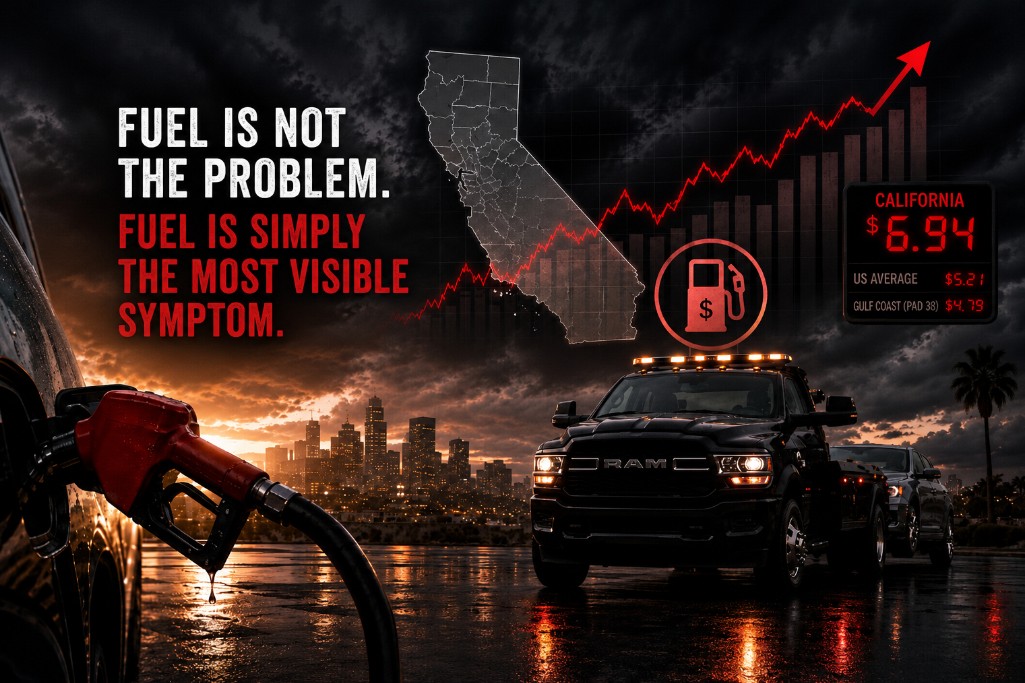
Fuel is not the problem. Fuel is simply the most visible symptom.
But Is It Enough for California? – Bridgecrest’s Fuel Surcharge Program a Step Forward—But Is It Enough for California?
EDITORIAL
The recent announcement of Bridgecrest’s fuel surcharge program has been welcomed across the repossession industry, and rightfully so. For years, recovery agencies have argued that operating costs cannot continue rising indefinitely while compensation remains largely stagnant. Fuel prices, insurance premiums, labor costs, compliance requirements, equipment expenses, and virtually every other category of operating expense have moved upward.
But the simple reality is that repossession companies cannot absorb inflation forever.
In that context, Bridgecrest deserves credit for doing something many have discussed but few have implemented: creating a structured fuel surcharge mechanism tied to measurable costs. It represents progress and demonstrates a willingness to recognize the economic pressures facing the recovery industry.
But an uncomfortable question remains.
What happens when a national solution meets a uniquely California problem?
California recovery agencies operate in one of the most expensive business environments in the nation. Fuel prices routinely exceed national averages. Insurance costs are among the highest in the country. Labor expenses continue to climb.
Regulatory compliance requirements are extensive and growing. Property costs, facility expenses, and equipment replacement costs often bear little resemblance to what agencies experience elsewhere.
A fuel surcharge tied to a national benchmark may provide relief, but relief and sustainability are not the same thing.
Please get this straight; this is not a criticism of Bridgecrest. Nor is it a criticism of the American Recovery Association, which has worked diligently to advocate for surcharge programs and bring attention to rising operating costs.
Rather, it highlights a broader issue facing the industry.
For decades, recovery agencies have watched compensation structures move in the opposite direction of operating expenses.
Base repossession fees have remained flat or largely unchanged in many markets. Ancillary fees have been reduced, capped, or eliminated. Administrative requirements have increased. Documentation requirements have increased. Compliance obligations have increased.
Yet agencies are often expected to absorb those costs without corresponding adjustments to compensation.
Fuel surcharges address only one component of the larger equation.
The truth is that the industry’s overall pricing structure fails to reflect the actual cost of performing professional collateral recovery in 2026.
That truth is painfully obvious in California.
The challenge is not simply fuel. Fuel is merely the most visible symptom of a broader cost imbalance. An agency operating in Los Angeles, San Francisco, San Diego, Sacramento, or the Central Valley faces an economic reality that differs substantially from agencies operating in many other regions of the country.
National standardization has obvious benefits. Lenders and forwarders value consistency. Uniform programs simplify administration and budgeting. Predictability benefits everyone involved, that is with the exception of the repossession agencies themselves.
But consistency and accuracy are not always the same thing.
A pricing model that works reasonably well in a lower-cost state may still leave agencies underwater in California.
The industry should celebrate progress where it occurs. The Bridgecrest surcharge program is progress. It demonstrates that lenders are listening and that constructive dialogue can produce results.
At the same time, recovery professionals should not mistake a first step for the finish line.
The larger discussion is not about fuel.
It is about sustainability.
If lenders want a recovery industry that is professional, compliant, insured, and properly equipped and capable of serving lenders long-term, compensation must eventually reflect the true cost of providing those services.
In most regions, that discussion is already long overdue.
The question is not whether California is different. All states are different.
The question is whether the lenders and forwarders who set the industry’s compensation models are willing to recognize and address these differences for the long term sustainability of the repossession industry.
Bridgecrest’s Fuel Surcharge Program a Step Forward
Kevin Armstrong
Publisher
Bridgecrest’s Fuel Surcharge Program a Step Forward—But Is It Enough for California?
Bridgecrest’s Fuel Surcharge Program a Step Forward—But Is It Enough for California? – Repossess – Repossession – Repossession Agency – Repossessor – Repossession – Fuel Costs – Gas Prices – Lending – Auto Loan






More Stories
The Cost of Collecting LPR Data Has Gone Up. Why Hasn’t the Pay?
WHEN IS ENOUGH, ENOUGH? A Question Worth Asking Across the Repossession Industry
Three Million Repossessions: A New Measure of America’s Recovery Industry
Why Fight LPR? Join It — But What Happens When the Car Repossesses Itself?
In The Future Will There Be Anyone Left to Recover Vehicles?
The Broken Bond Between Lenders and Agents – Positive Resolution