

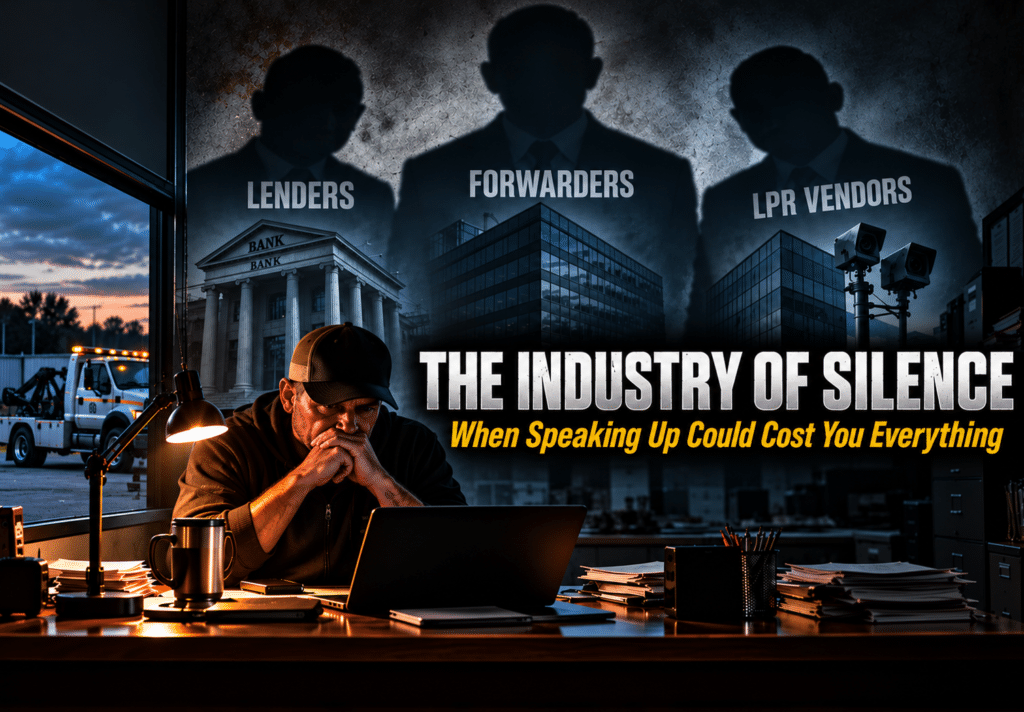
Repossession agency owners have plenty to say about lenders, forwarders, and vendors. But how many can afford to say it publicly?
EDITORIAL
For the better part of seventeen years, I’ve been watching the repossession industry from the sidelines, with relatively little to lose by speaking my mind. I can express pretty much any opinion I want without worrying about losing assignments, contracts, or access to the companies that keep a recovery agency in business.
And I suspect that’s one of the reasons many of you follow this site. I can say things publicly that a lot of people working in this industry feel they can’t. Of course, sometimes they do, but at what cost to their businesses?
The repossession industry has never been short on opinions. Attend almost any industry convention, sit down with a group of agency owners, or spend a few minutes in a private conversation, and you’ll hear plenty of them.
Complaints about declining recovery fees, increasing operating expenses, lender demands, forwarder practices, LPR costs, and the growing influence of major industry vendors are hardly uncommon.
But ask those same agency owners to put their names behind those opinions publicly, and the conversation can change rather quickly. Suddenly, there’s hesitation.
And perhaps for good reason.
In an industry where a handful of business relationships can determine whether an agency survives, speaking out can feel like a dangerous proposition.
The Fear of Losing Business
Consider the position of an independent repossession agency owner who depends heavily on assignments from a major lender or forwarder.
The owner may disagree with declining fees, excessive administrative requirements, unreasonable performance standards, or changes in vendor policies.
But what happens if that owner publicly criticizes the company responsible for a substantial portion of their business?
Could assignments suddenly decline? Could the agency lose preferred status? Could a contract simply not be renewed?
Perhaps nothing would happen.
But the owner doesn’t necessarily know that. And when payroll, truck payments, insurance premiums, and employee livelihoods are at stake, uncertainty alone can be enough to keep someone quiet.
The same concerns extend to LPR networks and other technology providers whose services have become increasingly important to recovery operations.
An agency owner might strongly disagree with pricing changes, data policies, or contractual restrictions but hesitate to challenge them publicly for fear of jeopardizing access to the technology.
The threat of retaliation doesn’t necessarily have to exist for the fear of retaliation to influence behavior.
And that distinction is important.
When Silence Becomes a Business Decision
Most independent recovery agencies don’t have the financial resources or bargaining power of the larger organizations they serve.
A major lender or forwarder might represent a significant percentage of an agency’s monthly revenue. Losing that relationship could be devastating.
For the lender or forwarder, however, replacing one agency might be relatively easy.
That imbalance creates an uncomfortable reality.
An agency owner may believe a policy is unfair, a fee is inadequate, or a business practice is damaging to the industry, yet decide that publicly challenging it simply isn’t worth the risk. It’s not necessarily a matter of lacking courage. It’s a matter of survival.
And when enough owners reach the same conclusion, the industry begins losing something valuable: honest feedback from the people actually performing the work.
I’ve heard these concerns repeatedly over the years. I’ve also heard credible accounts from industry professionals who believe speaking out has cost them business opportunities or damaged important relationships.
Proving retaliation is another matter. Assignments fluctuate, contracts end, and companies change vendors for any number of legitimate reasons.
But the fear remains.
And that fear has consequences beyond the individual businesses involved.
The Problem with Anonymous Voices
Over the years, I’ve heard from industry professionals who have important things to say but are reluctant to attach their names to their opinions.
Some are willing to speak privately. Others will share their concerns only if their identities remain confidential.
I understand their reluctance. When a business depends on a relatively small number of clients or technology providers, the consequences of publicly criticizing one of them can seem too great.
But anonymity creates another problem.
Recently, someone I’ve known and respected for years challenged me about anonymous editorials.
His argument was straightforward. If someone has something to say about this industry, they should be willing to put their name behind it.
He also told me that some readers simply scroll to the bottom of an editorial to see who wrote it. If the author is anonymous, they don’t bother reading.
I understand that perspective, too.
Without knowing who is expressing an opinion, readers cannot easily evaluate the author’s experience, credibility, or possible motives. A legitimate industry concern can be dismissed simply because the person raising it isn’t willing to identify themselves.
And an opinion that readers refuse to consider accomplishes very little, regardless of how valid it might be.
But there’s another side to that argument.
Some agency owners have publicly challenged lenders, forwarders, vendors, and established industry practices while knowing that doing so might damage their business relationships.
They’ve attached their names to unpopular opinions and accepted whatever consequences might follow.
Others may share those same concerns but have decided that the potential financial consequences are simply too great.
It’s understandable that those willing to take the risk might resent that difference.
But there’s a difference between being unwilling to stand behind your convictions and being unwilling to gamble your employees’ livelihoods on them.
Neither perspective should be dismissed.
And perhaps the larger question isn’t why some people insist on remaining anonymous, but why so many believe anonymity is necessary in the first place.
The Cost of Staying Quiet
The repossession industry is undergoing significant changes.
LPR technology is transforming how vehicles are located. Operating expenses continue to challenge recovery agencies, while lenders and forwarders demand efficiency, compliance, and competitive pricing.
These are legitimate subjects for debate.
But meaningful discussion becomes difficult when the people most directly affected are reluctant to participate.
If agency owners are afraid to question compensation structures, how will those structures improve?
If they hesitate to challenge vendor policies, how will vendors know when those policies are creating problems?
And if lenders and forwarders hear only from agencies willing to agree with them, how accurately can they assess the health of their recovery networks?
To be fair, criticism doesn’t automatically make an agency right, and disagreement doesn’t make a lender, forwarder, or vendor wrong.
Businesses have legitimate reasons to establish standards, select partners, and make decisions about their relationships.
Nor should every lost contract or reduction in assignments be interpreted as retaliation.
But there is a difference between legitimate business decisions and an environment where agency owners believe that expressing an unpopular opinion could put their livelihood at risk.
That perception alone can discourage the honest communication this industry needs.
An Industry That Needs to Talk
The repossession industry has plenty of challenges without adding a culture of silence to the list.
Independent agencies need the opportunity to raise legitimate concerns. Lenders, forwarders, and technology providers need honest feedback from the businesses they depend upon. And industry associations need to ensure that the voices of smaller operators aren’t lost beneath those of their largest commercial partners.
None of that requires everyone to agree.
In fact, disagreement is often where meaningful improvements begin.
But those conversations cannot happen if the people with the most to say believe they have the most to lose.
Perhaps the most troubling question isn’t whether retaliation has occurred. Over the years, I’ve heard credible accounts of it from people within the industry.
The bigger question is whether the fear of retaliation has become so deeply embedded in the industry’s business relationships that agency owners are censoring themselves before anyone even asks them to.
And while I understand the frustration of those who dismiss anonymous opinions, I would encourage them to consider their own willingness to speak publicly about the industry’s more uncomfortable problems.
Because there’s little value in demanding courage from others if we’re unwilling to demonstrate it ourselves.
How can an industry identify and correct its problems when the people most affected by them are afraid to speak?
And perhaps an equally uncomfortable question:
How many agency owners are reading this right now, agreeing with every word and have strong opinions about their clients or vendors, but wouldn’t dare say so publicly?
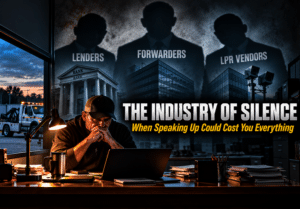
The Industry of Silence: When Speaking Up Could Cost You Everything – The Industry of Silence: When Speaking Up Could Cost You Everything – The Industry of Silence: When Speaking Up Could Cost You Everything
Kevin Armstrong
Publisher
The Industry of Silence: When Speaking Up Could Cost You Everything – Repossess – Repossession – Repossession Agency – Repossessor – Repossession – Repossession News – Forwarder – LPR





More Stories
The Self-Inflicted Wound: Repo-Averse Lenders and the Decline in Recovery Rates
Without Change is the Risk worth the Reward?
The Repossession Industry Is Eating Its Own
Twelve Years, Seventy-Five Dollars
The LPR Arms Race: How Many Cameras Are Enough?
The Cost of Collecting LPR Data Has Gone Up. Why Hasn’t the Pay?