

…if this movement continues to expand we may find ourselves in a situation full of consequences way worse than the federal CFPB ever caused.
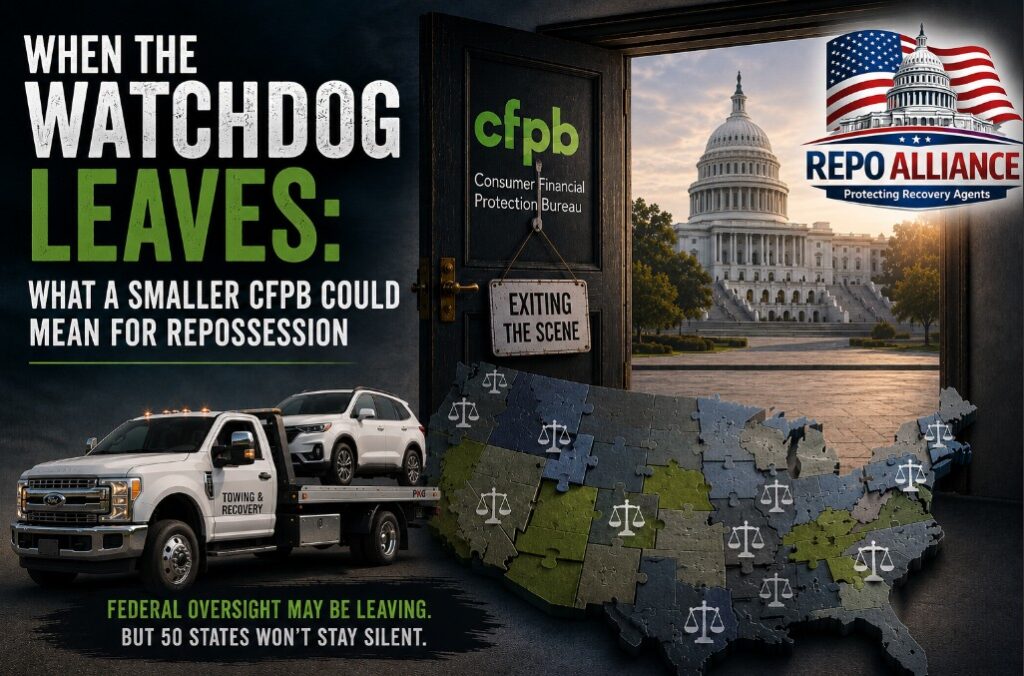
When the Watchdog Leaves: What a Smaller CFPB Could Mean for Repossession
For years, the CFPB has been a frequent source of frustration for lenders and recovery professionals. However, the agency’s rapid downsizing raises questions that extend far beyond Washington politics. The Repo Alliance argues that the real threat may not be federal regulation itself, but what happens when that oversight disappears and fifty states begin filling the void.
From an Article in a Collection News Site
The Consumer Financial Protection Bureau just told roughly 450 employees scattered across the country to pack their bags and report to Washington, D.C. The agency is shuttering regional offices in San Francisco, Atlanta, Chicago, and New York, centralizing all operations at its headquarters.
Remote work? That’s done too. Every employee will be required to show up in person once the relocations take effect later this year.
The CFPB was established in 2010 with a straightforward mandate: protect consumers in financial markets. It became the primary federal watchdog for everything from predatory lending to credit card fees. Under Acting Director Russell Vought, the agency’s trajectory shifted dramatically starting in early 2025.
Initial plans reportedly aimed at reducing staff by up to 90%. That number alone would have been unprecedented for a functioning federal agency. While those extreme cuts haven’t fully materialized, the cumulative effect of more than a year of downsizing pressure has been significant.
Staff resignations have steadily climbed as employees read the writing on the wall. Now, with the relocation mandate, the administration appears to be betting that a meaningful number of those 450 regional employees will simply choose to leave rather than uproot their lives.
The CFPB’s regional offices weren’t just satellite locations for administrative convenience. They served as the agency’s eyes and ears in major financial centers. San Francisco meant proximity to Silicon Valley’s fintech ecosystem. New York put regulators within arm’s reach of Wall Street. Chicago and Atlanta offered coverage of the Midwest and Southeast banking landscapes.
The CFPB has historically engaged with fintech companies and digital asset firms on consumer protection issues. A weakened, understaffed, centralized agency is far less equipped to identify and respond to emerging risks in those rapidly changing markets.

Many individuals may applaud the downsizing of the CFPB but as your team watching and commenting on events in Washington DC so we don’t get caught in a political maneuver against our industry here is what to think of.
State attorneys general have already shown a willingness to step into federal regulatory vacuums. If the CFPB’s enforcement capacity continues to deteriorate, expect a patchwork of state-level actions that could create a more complex compliance environment for crypto firms operating across multiple jurisdictions The creation of the CFPB itself in 2010 was a direct response to the 2008 financial crisis and the consumer protection failures that preceded it.
Initial plans reportedly aimed at reducing staff by up to 90%. That number alone would have been unprecedented for a functioning federal agency. While those extreme cuts haven’t fully materialized, the cumulative effect of more than a year of downsizing pressure has been significant.
Staff resignations have steadily climbed as employees read the writing on the wall. Now, with the relocation mandate, the administration appears to be betting that a meaningful number of those 450 regional employees will simply choose to leave rather than uproot their lives.
The CFPB’s regional offices weren’t just satellite locations for administrative convenience. They served as the agency’s eyes and ears in major financial centers. San Francisco meant proximity to Silicon Valley’s fintech ecosystem. New York put regulators within arm’s reach of Wall Street. Chicago and Atlanta offered coverage of the Midwest and Southeast banking landscapes.
The CFPB has historically engaged with fintech companies and digital asset firms on consumer protection issues. A weakened, understaffed, centralized agency is far less equipped to identify and respond to emerging risks in those rapidly changing markets.
Many individuals may applaud the downsizing of the CFPB but as your team watching and commenting on events in Washington DC so we don’t get caught in a political maneuver against our industry here are some points to think of.
CFPB Takes Action Against Wrongful Auto Repossessions and Loan Servicing Breakdowns
October 7, 2024 / Source: CFPB
Borrowing to buy a vehicle is one of the largest sources of household debt for American families. The CFPB will take action against auto-finance companies that charge fees for nonexistent services,( Does this sound like a problem we have, not getting paid even though the lender or forwarder charged a fee.) or repossess cars after borrowers make payments.”
- Lenders Improperly Applied Payments and Wrongly Repossessed Automobiles
The exams found servicers wrongfully repossessed vehicles due to service providers failing to cancel orders to repossess vehicles when consumers had made payments or had obtained a loan deferment, loan modification, or extensions that should have prevented repossessions. CFPB examiners also found servicers repossessed vehicles without having a valid recorded lien to the vehicle. Although it is getting better still the number one reason for wrongful repossession lawsuits.
- Examiners also found that lenders were knowingly placing inaccurate loan information on thousands of consumers’ credit reports. This included incorrect amounts past due for charged-off accounts, inaccurate dates of when borrowers fell behind on payments,
- The CFPB has previously taken action against companies for illegal practices in auto finance. Toyota Motor Credit paid $60 million for withholding refunds and tarnishing borrower credit reports. The CFPB also took action again Wells Fargo for illegally assessing fees and interest charges on auto and mortgage loans.
- The CFPB took action against Fifth- Third bank regarding the bank’s auto-finance servicing activities, requiring a $5 million penalty and full redress to roughly 35,000 harmed consumers. This included forcing unnecessary vehicle insurance on borrowers and sending flawed letters that wrongfully triggered auto repossessions for over 1,000 consumers.
In addition, the Consumer Financial Protection Bureau (CFPB) took a major enforcement action against Ally Financial Inc. and Ally Bank for discriminatory auto loan pricing in 2013. The agency ordered Ally to pay $80 million in damages to harmed consumers and $18 million in civil penalties to resolve claims of illegal lending practices.
Overview of the 2013 Action
The Allegation: The CFPB and the Department of Justice (DOJ) found that Ally violated the Equal Credit Opportunity Act (ECOA). Ally’s indirect auto lending program allowed auto dealers to increase or “mark up” the interest rates on auto loans, incentivizing dealers to charge higher rates to minority borrowers.
The Impact: Approximately 235,000 African-American, Hispanic, and Asian/Pacific Islander borrowers were charged higher interest rates than similarly situated non-Hispanic white borrowers. The Settlement: Ally Bank was ordered to pay $80 million to directly compensate the affected consumers and $18 million in civil penalties. Ally also agreed to monitor its lending programs and adjust policies to ensure compliance with fair lending.
A Target For Abuse
If there is no Federal regulatory body the lending space that fell under regulatory supervision will go back to being unmonitored. From history in the finance world the old saying power corrupts and absolute power absolutely corrupts will be seen again.
Our industry that is subject to overreach by some lenders and indemnification clauses that put the burden of defending actions even when we did not cause harm, may find ourselves even an easier target to abuse. We run from oversight, why I am not sure. Regulation when done right with a well-educated and evidenced voice at the table will help protect our interest.
States have shown a desire to start their own CFPB’s, if this movement continues to expand we may find ourselves in a situation full of consequences way worse than the federal CFPB ever caused.
The Repo Alliance and those who support us and recognize the need for a voice on Capital Hill . Knowledge is power.
WHO IS REPO ALLIANCE?
How and when was the group formed?
The initiative started several weeks ago with an invitation from ARA to all National and State Associations and other major industry leaders.
Is the Repo Alliance another association?
NO! The Repo Alliance is a collaborative effort of the groups which decided to answer the call and develop a fundraising program to further the interests of OUR industry and provide a voice at both National and State levels.
Which organizations came together?
American Recovery Association (ARA), the California Association of Licensed Repossessors (CALR), Texas Accredited Repossession Professionals (Texas ARP), and Harding Brooks Insurance.
How do you contribute?
- A Square account has been established.
- Click here to donate through Square.
- Champion, Promote and Spread the word about this industry initiative!
Can I use any other method to contribute?
YES, you can mail a check, payable to Repo Alliance at 1400 Corporate Dr., Suite 175, Irving, TX, 75038.
Will funding reports and expenditures be available for review?
- YES, this initiative will be completely transparent on monies raised with information available on the website.
- One hundred percent of all monies raised will be used to pay for lobbying efforts. Everyone involved other than the lobbyist is a volunteer.
Why hire a dedicated lobbyist instead of just working with other lobbying groups?
We are working with other industry lobbyist groups but have realized without OUR OWN VOICE, we would be trusting the future of the Recovery Industry to the priorities of others. Riding the coattails of these other groups, puts our agenda as simply an afterthought.
What are the GOALS?
- Change the negative, reputational image of the Recovery Industry.
- Educate legislatures of the vital role we play.
- Fight against language in bills or guidance from agencies that would decimate the recovery industry.
Contact Us
833-737-6255
833-REPOALL
When the Watchdog Leaves: What a Smaller CFPB Could Mean for Repossession – When the Watchdog Leaves: What a Smaller CFPB Could Mean for Repossession – When the Watchdog Leaves: What a Smaller CFPB Could Mean for Repossession
Related:
Repo Alliance – Washington Shifts Could Reshape Repo Volume and Compliance Risk
Washington in Motion: What New Federal Actions Mean for Auto Finance and Repossession
Repo Alliance – This Week in Washington – March 2026
The Repo Alliance: Giving a Voice to a ‘Ghost’ Industry in Washington
Repo Alliance Progress & Updates from May DC Meeting
Repo Alliance – Let’s Not Lose our Minds
How Does the “One Big Beautiful Bill Act” Affect the Repo Industry?
When the Watchdog Leaves: What a Smaller CFPB Could Mean for Repossession – Compliance – Repossess – Repossession – Repossession Agency – Repossessor – Repossession – Consumer Financial Protection Bureau – CFPB – CFPB






More Stories
The Broken Bond Between Lenders and Agents – Positive Resolution
The Repos That May Never Come
A Repossession Is a Repossession
State Repossession Associations Support ARA and Allied Finance Adjusters Call for Industry Dialogue
When “Partner” Is Just Another Word for Vendor
Welcome to the Repossession Casino — But Who Is Really Paying the Losing Bets?