
Rethinking Risk, Due Diligence, and Vendor Accountability in the Recovery Industry
GUEST EDITORIAL
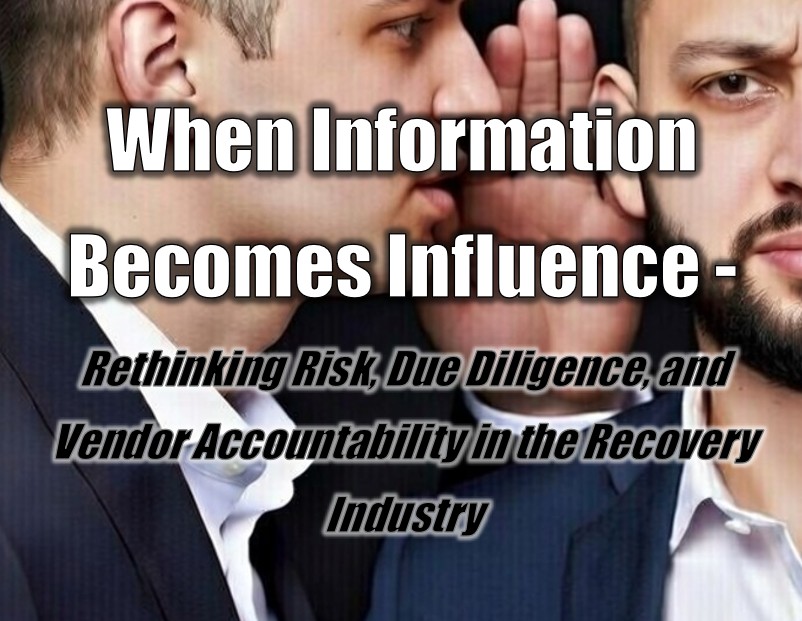
In today’s recovery and collections environment, information moves quickly. Emails, screenshots, forwarded messages, and informal communications can spread across networks of lenders, forwarders, and vendors in a matter of hours. In many cases, that information is presented with urgency and framed as a risk that requires immediate action.
But speed and accuracy are not the same thing.
There is a growing need within the industry to take a more deliberate look at how information, particularly when originating from anonymous sources or competing vendors, is introduced, evaluated, and acted upon. The way these situations are handled has implications not only for vendor relationships, but also for compliance integrity, consumer protection, and overall market fairness.
The Risk of Acting on Unverified or Interested Sources
At its core, the issue is not whether information should be taken seriously—it should. The issue is whether it is being evaluated properly before action is taken.
When information is:
- Provided anonymously, or
- Distributed by a competing vendor, or
- Presented in a way that blends fact with narrative
…it carries inherent risk.

An anonymous source removes accountability. A competing vendor introduces the possibility of bias or financial motive. A selectively framed narrative can create the illusion of completeness while omitting critical context.
In any regulated environment, these are not minor concerns. They are signals that additional scrutiny, not immediate action, is required.
Bypassing Compliance Frameworks: An Unintended Consequence
Most lenders, forwarders, and recovery networks have invested heavily in compliance infrastructure. They maintain:
- Vendor management programs
- Complaint and escalation protocols
- Legal and compliance review teams
- Defined procedures for investigating allegations
These frameworks are designed to ensure that decisions are made based on verified, documented, and balanced information.
However, when external information, particularly from informal or unverified channels, triggers immediate operational changes, those frameworks can be unintentionally bypassed.
This creates a critical question:
If internal procedures are sufficient for regulatory review, why would they not be applied to external allegations before action is taken?
Allowing outside parties to influence decisions without going through established processes can undermine the very controls that organizations rely on to demonstrate compliance.
The Illusion of Risk Reduction
In many cases, swift action is taken with the intent of limiting exposure. Removing or suspending a vendor may feel like the safest course in the moment.
But from a broader perspective, that decision can actually increase risk.
When assignment flow is altered based on unverified or incomplete information, organizations should consider:
- Who benefits from the change?
- Is the information source independent, or does it have a commercial interest?
- Does the shift in assignments affect pricing consistency or competitive balance?
- Could it create the appearance of preferential treatment or influence?
If a vendor is able to influence assignment allocation through informal channels, it raises additional concerns around:
- Market manipulation
- Price inflation or “redlining” of fees
- Erosion of fair competition
These are not theoretical risks. They are the types of issues that regulatory frameworks, including those influenced by the Fair Debt Collection Practices Act, are designed to prevent.
The Role of Due Diligence: Both Sides of the Equation
When allegations arise, due diligence is essential. But it must be applied consistently and completely.
This means evaluating:
- The accused party, and
- The source of the information
If the party providing information stands to benefit from a change in vendor relationships, that context is relevant. It does not invalidate the information, but it does require that it be examined with appropriate care.
In many industries, this would be standard practice. Yet in fast-moving operational environments, that second layer of review is often overlooked.
The result can be decisions based on partial narratives, rather than fully developed facts.
Reputational Impact and the Reality of “Residual Doubt”
Even when allegations are later clarified, disproven, or resolved, the impact does not fully disappear.
There is often a residual effect:
- A hesitation
- A perception that “something must have happened”
- A reluctance to fully restore prior relationships
This dynamic, sometimes referred to informally as “cancel culture”, can have lasting consequences, even in the absence of wrongdoing.
For vendors, this creates a structural imbalance:
- Allegations can spread quickly
- Resolution takes time
- Reputational recovery is often incomplete
From a risk management standpoint, this should be a concern for all parties involved. Systems that allow reputational harm to occur without full verification can be exploited, intentionally or otherwise.
When Misdirection Becomes Strategy
There is also a more complex layer that cannot be ignored.
In some cases, the introduction of disruptive information, whether accurate, exaggerated, or incomplete, can serve as a form of strategic misdirection.
This may occur when:
- A vendor is facing its own operational or legal challenges
- A company is attempting to gain entry into accounts where it previously lacked traction
- Market positioning becomes more competitive
In these scenarios, creating confusion or shifting attention can be advantageous.
Again, this does not mean that all allegations are false. It means that context matters, and that context should be part of any responsible evaluation.
Consumer Impact and Regulatory Alignment
At the center of all of this is the consumer.
Recovery agents and forwarders operate within a framework designed to ensure:
- Fair treatment
- Consistent practices
- Accountability
If assignment decisions are influenced by factors outside of those frameworks, particularly by parties with competing interests, it can disrupt that balance.
Allowing vendors to indirectly influence market dynamics through unverified information can lead to:
- Inconsistent pricing
- Reduced oversight
- Incentives for aggressive or non-compliant behavior
These are precisely the types of outcomes that regulatory standards are intended to prevent.
A Path Forward: Slow Down to Get It Right
None of this suggests that concerns should be ignored. On the contrary, they should be taken seriously.
But seriousness should lead to process, not bypass it.
A more effective approach includes:
- Verifying the source of the information
- Gathering facts from all involved parties
- Applying existing compliance procedures consistently
- Avoiding immediate operational changes until facts are established
In short: slow down enough to get it right.
Conclusion
The recovery and collections industry operates in a complex, regulated environment where trust, compliance, and accountability are critical.
Information, especially when urgent or alarming, can influence decisions quickly. But when that information is unverified, selectively presented, or provided by interested parties, it introduces a different kind of risk.
The challenge is not whether to act. It is how to act responsibly.
By relying on established processes, maintaining balanced due diligence, and resisting the pressure to react without full context, organizations can protect not only their operations—but the integrity of the industry as a whole.
Anonymous
When Information Becomes Influence – When Information Becomes Influence – When Information Becomes Influence
When Information Becomes Influence – Repossess – Repossession – Repossession Agency – Repossessor – Repossession – Training – Compliance – Forwarder – Lending






More Stories
The Broken Bond Between Lenders and Agents – Positive Resolution
The Repos That May Never Come
A Repossession Is a Repossession
When “Partner” Is Just Another Word for Vendor
Welcome to the Repossession Casino — But Who Is Really Paying the Losing Bets?
The Cost of Doing Business: Why We Cannot Afford to Work for Free