




As Florida debates license plate surveillance, a privately operated camera helps police locate a missing minor and arrest a suspected trafficker.
Tallahassee, FL – October 21, 2026 – A privately operated license plate recognition (LPR) camera mounted on a tow truck helped Tallahassee police locate and rescue a missing child who authorities believe had been transported across several states for sexual exploitation.
The October 19 incident offers a compelling example of how privately operated LPR technology, commonly associated with vehicle repossession and collateral recovery, can also serve an important public safety function.
According to an October 20 statement from the Tallahassee Police Department, officers were contacted shortly before 1 p.m. by an out-of-state law enforcement agency seeking assistance locating a missing and endangered minor believed to be traveling with an adult male.
The requesting agency entered the vehicle’s information into an automated license plate recognition system. A privately operated camera mounted on a tow truck subsequently detected the vehicle in Tallahassee.
The information was relayed to Tallahassee police, who located the vehicle at a motel in the 2800 block of North Monroe Street.
Within minutes of arriving, officers apprehended 43-year-old Terrence Lee of Fort Lauderdale without incident. During a search of the motel, officers discovered the missing child hiding beneath a bathroom sink.

A Multi-State Human Trafficking Investigation
Investigators allege Lee traveled from South Florida to another state, where he picked up the minor before transporting the child through Louisiana, Mississippi, Alabama and Florida.
Police further allege Lee posted online advertisements offering the minor for sexual exploitation in exchange for money.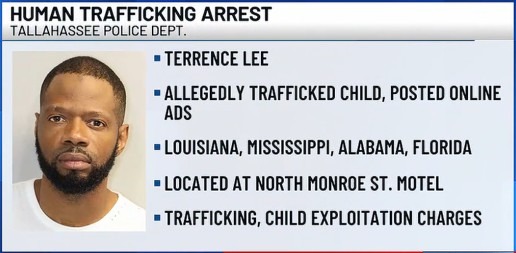
Lee was arrested on six charges, including human trafficking of a person under 18, lewd or lascivious battery, possession of child pornography, possession with intent to promote child pornography, promoting a sexual performance by a child, and interference with custody.
The charges remain allegations, and Lee is presumed innocent unless proven guilty.
The investigation remains active, with police indicating additional arrests are possible.
A Timely Example Amid Florida’s LPR Debate
The rescue comes amid growing controversy over automated license plate recognition technology in Florida.
On August 31, the Florida Department of Transportation announced it would end permits for privately operated LPR cameras installed along state highway rights-of-way, citing concerns surrounding the technology and its oversight.
In September, the Leon County Sheriff’s Office suspended its own LPR program amid questions involving privacy, accountability and public trust.
The Tallahassee incident, however, illustrates a different application of the technology: a privately operated mobile camera providing information that helped law enforcement locate an endangered child.
For the repossession and collateral recovery industry, which has played a significant role in deploying mobile LPR cameras across the country, the case offers a reminder that the information collected by these systems can have value extending well beyond locating delinquent collateral.
The Tallahassee Police Department did not identify the towing company, camera operator or LPR technology provider involved. It also did not indicate whether the tow truck was engaged in repossession activity when the vehicle was detected.
More Than Just Finding Cars
LPR technology remains the subject of legitimate debate over privacy, data retention and access to vehicle-location information. Those concerns are not eliminated by a successful law enforcement investigation. But neither should the technology’s public safety applications be overlooked.
In this case, law enforcement knew which vehicle it needed to find. A privately operated mobile camera detected that vehicle, and police used the information to locate and recover a missing child.
The camera did not replace police work. It helped make that work possible.
License plate recognition technology is frequently discussed in terms of surveillance, privacy and vehicle repossession. But on October 19, a camera mounted on an ordinary tow truck became part of something far more important: the recovery of a missing child.
LPR Helps Rescue Child from Alleged Human Trafficker – LPR Helps Rescue Child from Alleged Human Trafficker – LPR Helps Rescue Child from Alleged Human Trafficker
LPR Helps Rescue Child from Alleged Human Trafficker – Repossession Violence – Repossession History – Repossession – Repossess – Repossession – Repossession Agency – Repossessor – Police – Police – Arrest – Arrest – Repossession News – LPR






More Stories
Hooked, Lifted, and Still Not Yours: Federal Court Rules Against Georgia Repossessor
Myles Weiss: Remembering a Man Who Helped Build the Repossession Industry
Five Charged in $3 Million Houston Luxury Vehicle Theft and Export Scheme
Texas Repo Turns into Armed Standoff, Two Arrested
Car-Mart Buys Another Week. But Is It Running Out of Road?
NO REPO SIGNS: Do They Actually Have the Force of Law?