



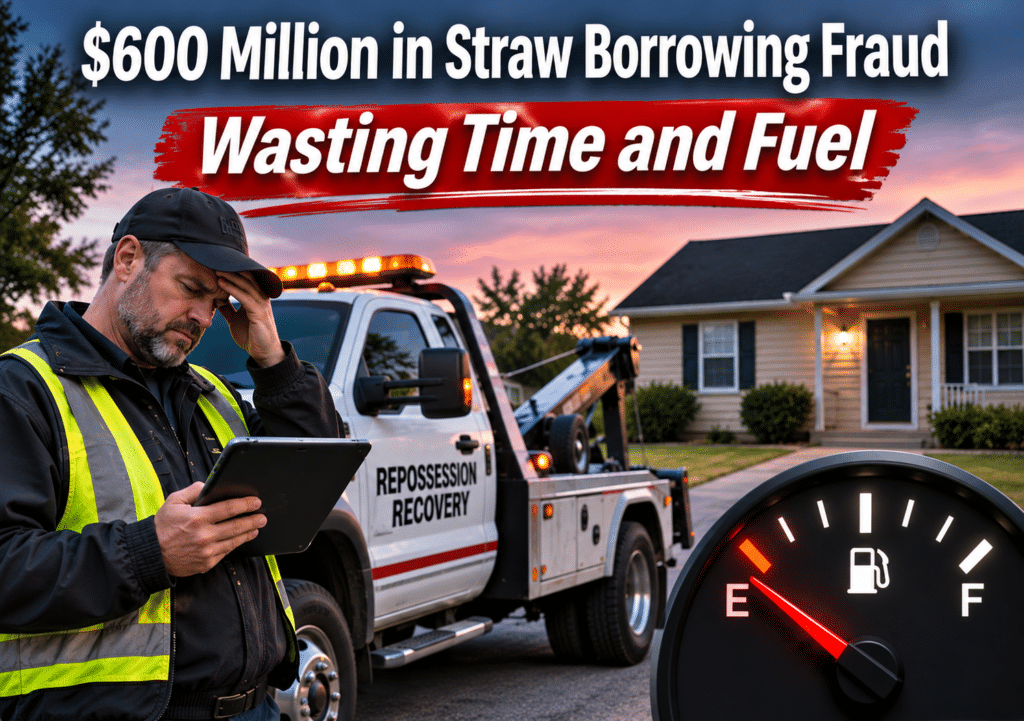
Real borrowers, fraudulent loans, and missing vehicles create new headaches for lenders and repossession agencies.
November 20, 2026 – For repossession agencies, one of the biggest frustrations is wasting time and fuel running bad addresses. New research from Point Predictive, warns that this problem is only getting worse as organized straw borrowing schemes have increased 37.6% since August 2023. For lenders, that means potential losses. For recovery agencies, it means a lot of bad addresses
A growing number of auto lenders are discovering that some of their most convincing borrowers may not be the people actually taking possession of the vehicles they finance. New research from fraud detection firm Point Predictive suggests that organized straw borrowing schemes have reached historically high levels, creating an estimated $600 million in annual fraud exposure and potentially leaving repossession agencies with collateral that is difficult, if not impossible, to locate.
According to Point Predictive’s latest fraud intelligence research, its Master Straw Borrower Index increased 37.6% between August 2023 and July 2026, reaching an all-time high in December 2025. The findings suggest that organized fraud rings are increasingly exploiting borrowers with legitimate identities and acceptable credit histories to obtain vehicles for individuals who might otherwise be unable to qualify for financing.
Unlike synthetic identity fraud or traditional identity theft, straw borrowing can be particularly difficult to detect because the person signing the loan documents is real, the credit history is legitimate, and the identification may be perfectly valid.
The deception lies in who is actually acquiring and controlling the vehicle.
Real Borrowers, Missing Vehicles
In a typical straw borrowing arrangement, an individual with acceptable credit agrees to finance a vehicle on behalf of someone else. In organized schemes, that borrower may receive compensation for allowing another person or group to use their creditworthiness.
The vehicle is then transferred to the actual intended user, who may have no contractual relationship with the lender.
Some arrangements involve individuals attempting to help family members or friends obtain transportation. Others are organized operations involving multiple borrowers, dealerships, and vehicles acquired for resale, rental operations, or export.
For lenders, the problem often becomes apparent only after the first payments are missed.
By then, the vehicle may be hundreds or thousands of miles from the address listed on the original loan application.
For repossession agencies, the consequences can be especially frustrating. The borrower may acknowledge signing the loan documents but have little knowledge of the vehicle’s whereabouts, its current operator, or whether it remains in the country.
A 37.6% Increase in Risk
Point Predictive’s research identified a sustained increase in straw borrowing warning indicators over the past three years.
The company’s index reached 142.0 in December 2025, its highest recorded level, before settling at 137.6 in July 2026. Despite the slight decline, the index remained substantially above its August 2023 baseline.
The company estimates approximately $600 million in annual auto lending exposure associated with straw purchases, representing roughly 5.8% of the $10.4 billion in overall auto finance fraud exposure identified in its 2026 annual analysis.
These figures represent estimated fraud exposure rather than verified lender charge-offs, and the increase in the index should not be interpreted as a corresponding increase in actual losses.
Nevertheless, the findings suggest that straw borrowing remains a significant vulnerability for auto lenders.
Sixteen Borrowers, Approximately 90 Vehicles
One particularly troubling example described in Point Predictive’s research involved approximately 90 vehicles financed through just 16 borrowers.
The vehicles were reportedly acquired for what was presented as a car-sharing investment opportunity.
Such arrangements can initially appear legitimate. Borrowers are told that vehicles will generate rental income sufficient to cover their monthly loan payments, potentially providing additional profits without requiring them to operate the vehicles themselves.
However, when the underlying operation fails or proves fraudulent, the individuals who signed the loan agreements remain responsible for the debt.
Meanwhile, the vehicles may be scattered across multiple locations, rented to unknown drivers, or otherwise beyond the borrowers’ control.
For lenders and recovery agencies, identifying the person legally responsible for the loan does not necessarily establish who possesses the collateral.
That distinction can turn an otherwise routine repossession assignment into a complicated investigation.
Organized Fraud Rings Exploit Gaps Between Lenders
Point Predictive also identifies loan stacking and coordinated applications across multiple lenders as significant warning signs.
In these schemes, fraud organizers may recruit several individuals with favorable credit profiles and arrange vehicle purchases over a relatively short period.
Because lenders generally evaluate applications using their own underwriting information and available credit bureau records, multiple loans can sometimes be funded before newly originated obligations become visible to other creditors.
Each lender may believe it is financing an ordinary individual vehicle purchase.
Collectively, however, those loans may represent a coordinated effort to acquire numerous vehicles with little intention of repayment.
The company’s broader research indicates that organized bust-out fraud has also accelerated, with estimated exposure reaching $250 million annually.
Although bust-out fraud and straw borrowing are distinct categories, the two can overlap when legitimate borrowers are used to obtain vehicles for organized criminal operations.
The Repossession Problem Begins After Funding
For the asset recovery industry, straw borrowing creates a problem that traditional repossession procedures are not necessarily designed to resolve.
A recovery assignment ordinarily begins with the lender providing identifying information about the borrower, vehicle, and known addresses.
In a straw borrowing case, that information may lead to someone who never regularly possessed the vehicle.
The borrower may have no keys, no current address for the vehicle, and no reliable contact information for the person operating it.
Even license plate recognition technology may offer limited assistance when vehicles have been moved to unfamiliar markets, stored out of sight, or exported.
Recovery agencies can spend considerable time investigating these assignments without locating the collateral, particularly when the lender’s information has not been updated since the original transaction.
There is also a financial consideration. Assignments requiring extensive investigation can consume significantly more resources than conventional recoveries, while compensation arrangements may not reflect the additional difficulty.
Point Predictive’s research does not quantify repossession assignment volumes, recovery rates, or losses specifically attributable to these schemes. However, the collateral-location problems are a foreseeable consequence when the contractual borrower and actual vehicle operator are different people.
A Growing Challenge for Lenders and Recovery Agencies
The findings also raise questions about whether lenders are adequately identifying straw borrowing before funding.
Point Predictive identifies several potential warning indicators, including repeated applications for expensive vehicles, unusual out-of-state purchases, changing borrower or co-borrower arrangements, and patterns connecting applicants to multiple transactions.
None of these circumstances independently establishes fraud. However, when several appear together, they may justify additional verification before the loan is funded.
The National Insurance Crime Bureau recently reinforced concerns about organized auto finance fraud, warning in an October 19 report that criminal networks are increasingly targeting vehicle financing through coordinated schemes involving legitimate and fabricated identities.
For repossession agencies, improved information sharing may become equally important after funding.
Identifying a suspected straw borrowing arrangement early could help lenders distinguish between an ordinary delinquency and a case requiring additional collateral investigation.
It may also prevent recovery agencies from repeatedly pursuing borrowers who have little useful information about the vehicle’s location.
Borrower Real, Collateral Gone
Auto finance fraud has traditionally focused considerable attention on false identities, fabricated income, and manipulated credit histories.
Straw borrowing presents a different challenge.
The borrower may be legitimate. The documents may be authentic. The loan may even pass conventional underwriting checks.
But the vehicle may have been intended for someone else from the beginning.
For lenders, that creates the possibility of significant losses on loans that initially appeared relatively safe.
For repossession agencies, it creates an increasingly familiar problem: a valid assignment, a legitimate borrower, a vehicle that doesn’t show and more wasted fuel and time with no offsetting income to compensate for it.
Sources: Point Predictive, Q3 2026 Fraud Risk Intelligence and 2026 Auto Lending Fraud Trends Report; Point Predictive, Perfect on Paper straw borrower research; National Insurance Crime Bureau, October 19, 2026 vehicle finance fraud report.
$600 Million in Straw Borrowing Fraud Leaves Lenders Exposed and Repo Agents Wasting Time and Fuel – $600 Million in Straw Borrowing Fraud Leaves Lenders Exposed and Repo Agents Wasting Time and Fuel – $600 Million in Straw Borrowing Fraud Leaves Lenders Exposed and Repo Agents Wasting Time and Fuel
$600 Million in Straw Borrowing Fraud Leaves Lenders Exposed and Repo Agents Wasting Time and Fuel – Point Predictive – Lending – Auto Loan – Skip – Skip – Fraud – Fraud – Fuel Costs – Gas Prices – Repossess – Repossession – Repossession Agency – Repossessor – Repossession – Repossession News





More Stories
Shopping Mom, Two Kids, and a Repo Gone Wrong
Repo Agent Stabbed, Tow Truck Carjacked During Massachusetts Repossession
Trapped and Under Fire: Texas Repo Agent Escapes Shotgun Attack
Texas Vehicle Owner Fires Shotgun During Repossession, Striking Tow Truck
Jury Convicts Killer of St. Louis Repossession Agency Owner Jesse Jones
The 30-Day Video Gap: Texas Repo Case Exposes Evidence-Retention Risks