

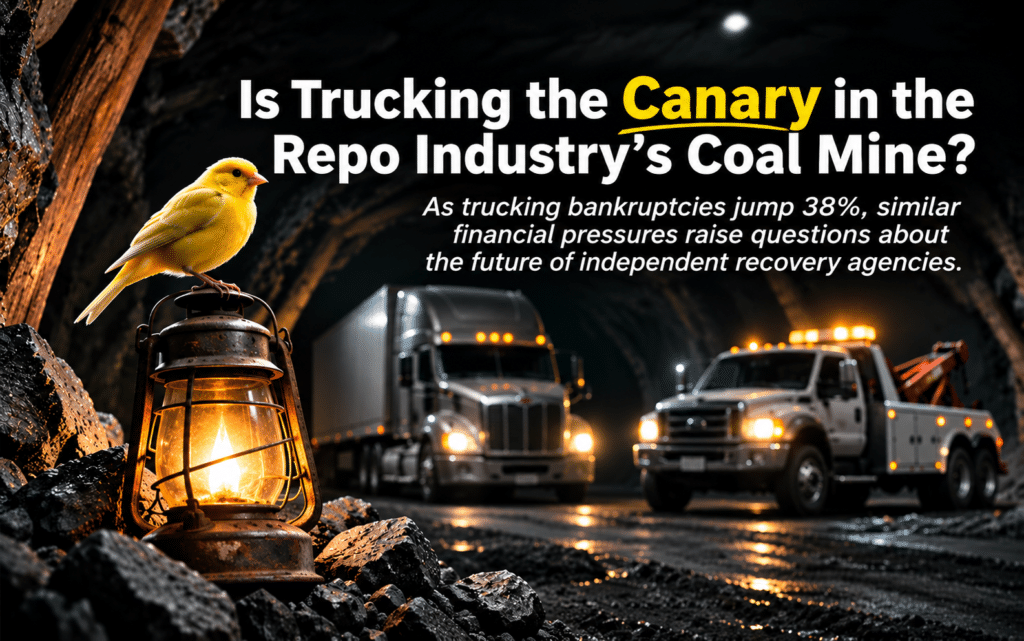
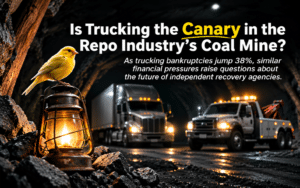
As trucking bankruptcies jump 38%, similar financial pressures raise questions about the future of independent recovery agencies.
November 8, 2026 — The American trucking industry is flashing a warning signal that independent repossession agency owners might want to pay attention to. According to November 3 reporting by The New York Times, summarized by Big Rig Daily, at least 40 trucking companies filed for bankruptcy in September, an increase of 38% from the previous year. High diesel prices, expensive equipment, rising insurance premiums and customers unwilling to pay enough to cover increasing operating costs are squeezing smaller operators.
Sound familiar?
While trucking companies and repossession agencies operate under very different business models, the financial pressures squeezing both industries are remarkably similar. Both depend on expensive commercial vehicles, substantial equipment financing, insurance coverage and employees operating in an increasingly costly environment. And both depend on customers who aren’t particularly enthusiastic about paying more for their services.
The trucking industry’s problems may be more advanced, but the similarities raise an uncomfortable question: Could trucking be the canary in the coal mine for the repossession industry?
Trucking Companies Are Running Out of Road
The September bankruptcy figures are only part of a larger problem. According to an October 28 Bloomberg report published by Transport Topics, 221 trucking companies had filed for bankruptcy during 2026, extending a multiyear period of financial distress.
A survey conducted by freight-management firm Truckstop and Bloomberg Intelligence found that approximately two-thirds of small trucking companies reported flat or declining revenue compared with the previous year. Nearly 40% expected to leave the industry within six months or were uncertain whether they would remain in business.
For smaller trucking operators, the problem isn’t simply a shortage of business. It’s the shrinking difference between what it costs to perform the work and what customers are willing to pay.
Diesel, commercial insurance, truck payments, maintenance and labor expenses continue consuming operating revenue. Meanwhile, freight rates have struggled to keep pace with those costs.
For operators carrying substantial equipment debt, the financial consequences can become devastating.
One California trucking company, A&B Transportation, reportedly grew to eight trucks before deteriorating freight economics contributed to its collapse. According to the November 4 Big Rig Daily report, owner Luis Escalante saw revenue from a Southern California-to-Texas round trip decline from approximately $8,000 to $2,600.
At the same time, filling a 150-gallon diesel tank cost approximately $900.
The company lost three trucks to repossession before filing Chapter 7 bankruptcy on September 11, with reported liabilities exceeding $500,000 and assets below $50,000.
The circumstances illustrate how quickly an equipment-dependent business can unravel when operating expenses exceed its ability to generate sufficient revenue.
And that brings us to the repossession industry.
Different Businesses, Nearly Identical Expenses
Independent repossession agencies face many of the same financial pressures.
A modern recovery operation requires substantial investment in wreckers, wheel-lift equipment, transportation vehicles, storage facilities, insurance, technology and trained personnel.
For agencies operating license plate recognition equipment, the investment can be considerably greater.
None of those expenses disappear when assignments slow down, recovery rates decline or clients refuse to approve higher fees.
Diesel prices don’t distinguish between a tractor-trailer hauling freight and a repossession truck searching for collateral. Neither do insurance companies, equipment lenders or repair shops.
And while a trucking company may negotiate with freight brokers and shippers over transportation rates, repossession agencies often face similar pricing pressures from lenders and national repossession forwarders.
The businesses are different, but the financial equation is familiar.
Revenue must exceed the cost of equipment, labor, fuel, insurance, financing and overhead.
When that equation stops working, additional volume isn’t necessarily the answer.
The Repossession Industry Has an Additional Problem
There is, however, one important difference between the two industries that deserves particular attention.
A trucking company generally knows it will receive payment for successfully delivering its freight.
A repossession agency frequently has no such assurance when it dispatches a truck.
An agent can spend hours driving between addresses, searching parking lots, investigating leads and attempting recoveries without producing a single billable repossession.
The fuel is consumed. The employee must be paid. The equipment continues depreciating. The insurance premium remains due.
But the revenue may be zero.
That makes the cost of an unsuccessful assignment particularly important.
An agency receiving more assignments might initially view the additional volume as good news. But if those assignments involve increasingly difficult recoveries, inaccurate addresses, unproductive mileage or vehicles that cannot be located, the additional work can actually reduce profitability.
More assignments do not necessarily mean more revenue. And more revenue does not necessarily mean more profit.
For an industry that has historically associated rising auto loan delinquencies with increasing business opportunities, that distinction is becoming increasingly important.
The Middleman Problem
There is another similarity worth examining.
Trucking companies frequently depend on freight brokers to connect them with shippers and available loads. Repossession agencies increasingly depend on national forwarding companies to distribute assignments from lenders.
The arrangements aren’t identical, and both types of intermediaries provide services that can have genuine value. But the economic pressures can look remarkably similar.
The company performing the physical work bears much of the expense of equipment, employees, fuel, maintenance and insurance. Meanwhile, the intermediary and ultimate customer exert considerable influence over the price paid for that work.
When costs increase, the company operating the equipment must either negotiate higher compensation, improve efficiency or absorb the difference. And when customers resist higher prices, the operator’s profit margin becomes the pressure relief valve.
The Bloomberg investigation, also published by Insurance Journal, highlighted how smaller trucking companies are particularly vulnerable because they lack the financial resources and pricing power of larger carriers.
That distinction should sound familiar to independent repossession agency owners competing for assignments against larger recovery operations or working under established forwarder fee schedules.
For agencies already operating on thin margins, even modest increases in fuel, insurance or equipment payments can have significant consequences.
The Danger of Chasing Volume
The trucking industry’s difficulties also offer another lesson. When margins begin shrinking, businesses frequently attempt to compensate by taking on additional work.
More freight. More routes. More assignments. More trucks.
But volume cannot solve a pricing problem when the additional work fails to generate sufficient profit. For repossession agencies, the temptation can be particularly strong when lenders and forwarders offer additional assignments.
Turning down business seems counterintuitive, especially when the trucks, employees and office staff are already in place. But accepting assignments that consistently cost more to work than they generate in revenue can accelerate the financial deterioration of an otherwise healthy agency.
The important measurement isn’t simply how many assignments an agency receives or even how many vehicles it recovers. It’s how much money remains after accounting for the total cost of producing those recoveries.
That includes the unsuccessful attempts, the empty miles, the equipment downtime and the administrative work that never appears on a recovery invoice. Recent trucking bankruptcies demonstrate just how dangerous the combination of declining revenue and substantial equipment debt can become.
An October 21 FreightWaves investigation identified 16 trucking and transportation companies entering bankruptcy proceedings over roughly a month.
Among them, Texas-based Site2Site Transport reported revenue falling from approximately $2.1 million in 2024 to $1.6 million in 2025 before filing Chapter 7. Chicago-based Midwest Expedited reported approximately $2.31 million in liabilities against just $108,351 in assets.
These are trucking companies, not repossession agencies. But their financial problems illustrate the danger of carrying expensive equipment and substantial debt when revenue can no longer support the operation.
Are Repossession Agencies Approaching the Same Crossroads?
There is no evidence at present that independent repossession agencies are experiencing a bankruptcy wave comparable to the one being reported in trucking. Nor should the industry’s challenges be mistaken for proof that such a collapse is inevitable.
Repossession agencies have different customer relationships, different revenue structures and different market dynamics. Rising vehicle defaults can create demand for recovery services even as other transportation businesses experience declining demand.
But greater demand does not eliminate rising operating expenses. In fact, it can disguise them.
An agency might be busier than ever while earning less on each successful recovery. A growing assignment inventory might look impressive until the owner calculates how much time, fuel and labor is being consumed by unsuccessful attempts.
And a fleet of expensive recovery trucks might create the appearance of a thriving business while the payments, insurance and maintenance quietly consume its cash flow.
The trucking industry’s experience demonstrates what can happen when those pressures persist long enough.
A Warning Worth Heeding
The repossession industry has endured economic downturns, lending contractions, rising insurance costs, regulatory changes and substantial shifts in how assignments are distributed.
Independent agency owners have repeatedly adapted.
But adaptation becomes increasingly difficult when nearly every major operating expense is rising while customers remain resistant to corresponding increases in service fees.
The trucking industry’s bankruptcy figures should not be interpreted as a prediction of what will happen to repossession agencies. They should, however, serve as a reminder that being busy and being profitable are two very different things.
For independent recovery agency owners, the most important question may no longer be how many assignments they can obtain, but how much it actually costs to complete each successful recovery.
The trucking industry may be the canary in the coal mine.
The question is whether the repossession industry recognizes the warning before its own financial pressures become impossible to ignore.
Is Trucking the Canary in the Repo Industry’s Coal Mine? – Is Trucking the Canary in the Repo Industry’s Coal Mine? – Is Trucking the Canary in the Repo Industry’s Coal Mine?
Is Trucking the Canary in the Repo Industry’s Coal Mine? – Forwarder – Fuel Costs – Gas Prices – Transport – Transport – Repossess – Repossession – Repossession Agency – Repossessor – Repossession – Repossession News – Bankruptcy





More Stories
Father and Son Charged After Repo Agents Come Under Gunfire in New Hampshire
Democratic Congressional Takeover Could Put Repossession Industry Back Under the Microscope
Subprime Auto Losses Hit Seven-Year High, But Lenders Keep Lending
Philadelphia Expands Electronic Repo Reporting to Eight Police Districts
Repo Agent Hospitalized After Being Pinned by Tesla
MAUCK RECOVERY MOVES FORWARD