

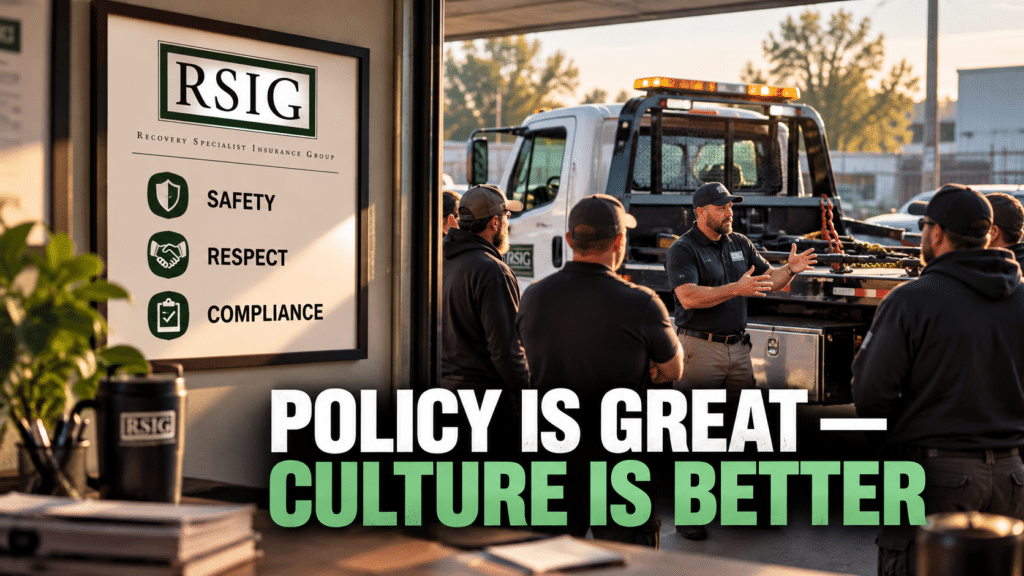
Policy is great – Culture is better
In today’s compliance driven world, there seems to be a policy for everything. Unfortunately many are treating policies as check boxes. Many believe as long as you can show you have a policy to address an issue, you’re good and everything moves on….and in some cases they’re right.
But if compliance is so important and it’s supposed to be more than getting a box checked, then while policy is great – culture is better.
Creating a culture around professionalism and safety and education is where policy meets action. If policy doesn’t have any sort of enforcement and business culture does not truly value things that policies are built around, then what’s really the point? Policy without culture is nothing more than lip service.
For example, in order to get insurance renewed you are required to show that you followed policy to provide training for all of your employees; but when renewal comes around you haven’t made your staff available for training, haven’t required any online courses and have no records of safety meetings. This is not a culture based on valuing training and education meeting. requirements for continued business relationships and honoring promises made.
Example 2: You have a policy regarding wrongful repossession. But you still only pay employees when they successfully repossess a vehicle, you tell your agents to take the vehicle even if police are present, you repossess out of a driveway (Mass and Rhode Island), you quickly follow(tailgating) a car accessing a gated community where you would not otherwise have access. This is not a culture of preventing wrongful repossession and breach of peace.
Example 3: You have a policy to treat all debtors with respect, to avoid confrontation and de-escalate. But rather than use your truck, body-cam or cell phone video to educate and train employees in these areas – you or your employees post them on social media to shame or embarrass a debtor or to attract likes and attention. These are not the actions of a company with a culture of respect.

Creating a culture that protects your business requires several things:
- Clear/Understandable/Communicated Expectations
- Consistent behaviors and action that support those expectations
- Leadership that not only enforces those expectations and disciplines behaviors that don’t support the expectations; but who models and lives them as well.
- Staff Buy-In. Those who work for the organization must be aligned with the organization’s culture.
Alignment happens in a multitude of ways.
- Businesses make the right hiring decisions. They evaluate personalities, they look at backgrounds, social media posts and content, driving records etc. Example: If a driver has multiple violations on their driving record it could mean more than just a lead foot – it could be a general lack of respect for the rules of the road. And if they don’t follow the rules of the road, will they follow your rules and expectations?
- When staff is brought on and the expectations are clearly communicated, hold staff responsible. If there is a problem and a continued working relationship is desired, coach/mentor/train for change. If the behavior doesn’t change or coaching/mentoring and training is met with resistance then you need to determine if this staff member is truly aligned with your culture and good for your business.
- Accountability Part 2: Recognize and reward those who are supporting your culture and are good for your business. A little recognition and positive reinforcement can go a long way. If part of your recognition and reward system is financially based – make sure that it isn’t the only way your staff can earn a living. If staff’s livelihood depends solely on successful repossession completion, then they will repossess like their lives depend on it. Consider rewarding things other than completed repossessions – things like
- the most thorough pre/post trip vehicle inspection (so you’re catching maintenance issues before they happen)
- when you’re reviewing driver facing truck camera footage – least distracted driver. The driver that handled distractions the best… pulling over to take calls, not eating in the vehicle, who constantly checked their mirrors, didn’t drift between lanes, didn’t respond to aggressive or bad drivers around them
- when you’re reviewing body-cam/outside truck footage – most respectful driver. Recognize who kept their cool in what could have been a bad situation, whose language, tone and body language supported and reinforced the culture of respect you’re trying to build and maintain
- the driver who did just drive away – who evaluated the situation and said, “Mr./Ms. Debtor – I’m going to drop the vehicle or I’m going to leave and give you an opportunity to deal with this with your lender. Have a nice day, hope this gets resolved.”
In the repossession industry, professionalism, safety, and compliance are not achieved through policy alone. They are achieved when everyone from the top down understands the expectations, believes in them, and consistently acts on them.
Organizations that build a culture of accountability, respect, safety, and continuous improvement do more than avoid claims and complaints. They earn the trust of clients, lenders, can earn the respect of regulators, law enforcement, and the communities they serve.
Policies provide framework, but culture provides foundation. When culture supports policy, compliance stops being a requirement and becomes a competitive advantage. That’s the difference between checking a box and building a business that lasts.
Anyone can write a policy. There are people out there who hang their hats on creating policies just for the sake of doing so and making money. The real test is whether the organization who buys it actually lives it.
A policy on safety means little if unsafe behavior is tolerated. A policy on wrongful repossession means little if employees are rewarded for cutting corners. A policy on respect means little if leadership fails to model respectful behavior.
The most successful businesses understand that compliance is not a document. It is a mindset. It is demonstrated through decisions, actions, accountability, and leadership every day. Policy may satisfy a requirement, but culture drives results. That’s why policy is great, but culture is better.
Policy is great – Culture is better – Policy is great – Culture is better – Policy is great – Culture is better

Policy is great – Culture is better – Recovery Specialist Insurance Group – RSIG – Training – Compliance – Repossess – Repossession – Repossession Agency – Repossessor – Repossession – Repossession News





More Stories
ARA Calls Industry Leaders to the Table Amid Historic Fuel and Operating Cost Pressures
The Fuel Emergency
Talk Is Cheap, Repossession Isn’t. Get Off Your Knees: The Eagles Draw a Line on Repo Fees
Westlake Answers the Call
State Repossession Associations Support ARA and Allied Finance Adjusters Call for Industry Dialogue
$8 Diesel and Rising: CALR Calls for Immediate California Fuel Relief