


Mileage, Voluntary Assignments and Rising Costs: ARA Calls for a New Look at Recovery Compensation
September 16, 2026 – Over the past several months, we have continued to discuss the impact rising fuel costs are having on the collateral recovery industry. Some of our lender and forwarder partners have listened and responded by implementing fuel surcharges, and I want to start by saying that those efforts are appreciated.
However, the situation has continued to escalate, and I believe we have reached a point where we need to have a broader conversation about the actual cost of servicing assignments.
Crude oil has once again climbed above $100 per barrel. Diesel prices have risen dramatically across the country. Here in the Midwest, we are seeing diesel prices approaching, and in some areas exceeding, $7 per gallon. California has experienced even more extreme pricing, with reports of diesel exceeding $9 per gallon in some areas.
And fuel is only part of the equation.
We are now seeing increased costs and supply concerns involving motor oil and other petroleum-based products. Tires, parts, insurance, wages, equipment, maintenance, technology, training, compliance, property, utilities, and nearly every other expense associated with operating a professional recovery agency have increased substantially over the last decade.
Unfortunately, in many cases, the compensation paid to recovery agencies has not kept pace with those increases.
That is the larger issue we need to address.

Fuel Surcharges Are a Start—But They Don’t Address the Entire Problem
We sincerely appreciate the partners who have implemented fuel surcharges. An additional $10, $15, or even $20 per recovered unit certainly helps.
But we also must recognize the fundamental problem with that model: recovery agencies don’t only incur expenses when we recover a vehicle.
Our trucks consume fuel whether the collateral is recovered or not. Our employees are paid whether the debtor is home or not. Tires wear, oil is consumed, maintenance intervals come faster, and trucks depreciate with every mile traveled.
Yet much of our industry’s compensation remains contingent upon a successful recovery.
That is why I believe it is time for our industry and our partners to begin a serious discussion about standardized non-contingent mileage compensation for assignments outside an agency’s basic coverage area.
The Case for Non-Contingent Mileage
The words non-contingent are important.
If an agency is asked to travel 25, 50, 75, or more miles to service an assignment, the expense of making that trip exists regardless of whether the collateral is ultimately recovered.
Mileage compensation should recognize that reality.
There should be a reasonable basic coverage area included within the standard recovery fee. Once an assignment requires an agency to travel beyond that established area, there should be reasonable non-contingent mileage compensation associated with servicing that assignment.
If the vehicle is recovered, the mileage applies. If the vehicle is not recovered, the mileage still applies.
The agency still traveled the miles. The fuel was still burned. The employee was still paid. The equipment was still used.
Those costs do not disappear simply because the assignment did not result in a recovery.
It’s Also Time to Revisit Voluntary Surrender Compensation
While we are examining the economics of our industry, perhaps this is also the appropriate time to ask a question that has existed for years:
Why are voluntary surrender assignments routinely compensated at a lower rate than involuntary recoveries?
There may have been reasons historically for establishing that pricing structure, but we should ask whether those reasons still make sense under today’s operating conditions.
A voluntary assignment still requires a recovery truck. It still requires a trained and insured employee. It still requires fuel. It still puts miles on the truck, wears tires, requires maintenance, and consumes the agency’s time and resources.
The agent still has to travel to the location, locate and identify the correct collateral, verify the VIN, properly secure the vehicle, transport it, complete the required documentation, process the collateral, and return it to the agency’s facility.
And anyone who has worked voluntary assignments knows that voluntary does not always mean simple.
Appointments are missed. Vehicles are not where they are supposed to be. Keys may not be available. Collateral may be inoperable or difficult to access. Additional phone calls and coordination may be required.
In some circumstances, a voluntary assignment can consume as much, or even more, time than an involuntary recovery. Yet in many cases, agencies are compensated substantially less for completing that assignment.
Again, this is not about demanding that every fee immediately change. It is about asking whether compensation structures created years ago still accurately reflect the work, expense, responsibility, and risk involved in performing these services today.
If the same truck travels the same miles, burns the same fuel, requires the same insurance, and utilizes the same trained professional, we should at least be willing to ask why that work is valued differently.
This Is a Partnership—Not an “Us Versus Them” Conversation
That conversation belongs alongside the discussion about fuel surcharges and non-contingent mileage.
Because ultimately, this is about sustainability.
And I want to be very clear about something else: this is a partnership.
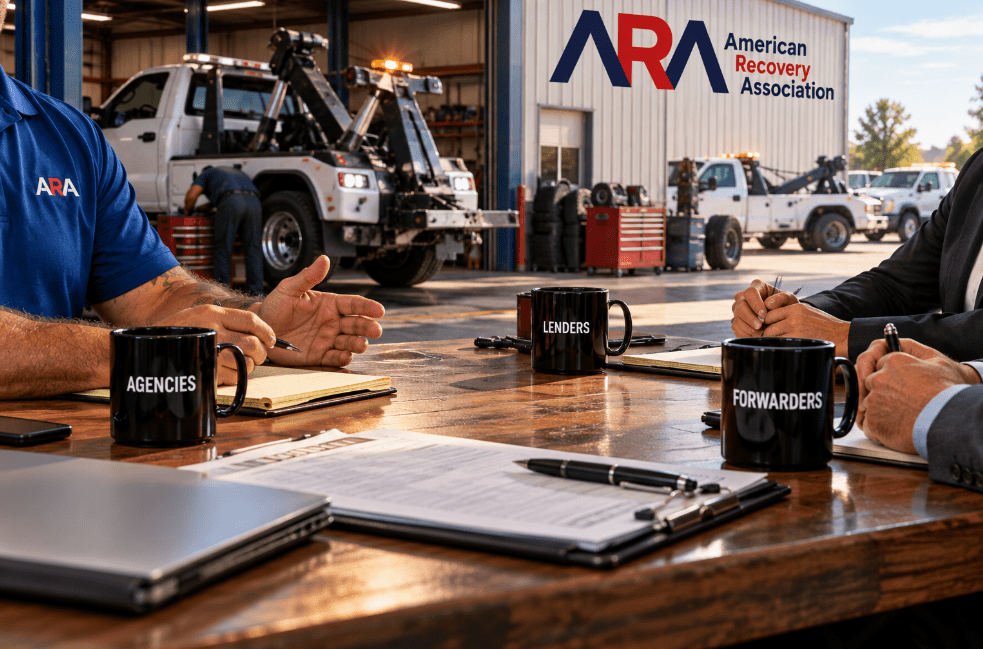
Lenders need strong recovery agencies. Forwarders need strong recovery agencies. And recovery agencies need strong lender and forwarder partners.
None of us can do this job without the others.
This cannot become an “us versus them” conversation. That accomplishes nothing.
We are all part of the same process, and ultimately, we share many of the same goals: servicing accounts efficiently, protecting collateral, reducing risk, maintaining compliance, and providing professional service.
When one part of that partnership becomes unsustainable, eventually every part of the partnership feels the impact.
A lender cannot successfully manage its portfolio without a reliable recovery network. A forwarder cannot provide nationwide coverage without qualified agencies in the field. And recovery agencies cannot operate without the assignments and relationships provided by lenders and forwarders.
We need each other.
That is exactly why these conversations need to happen now.
Looking at the Economics of the Entire Recovery Process
The answer cannot simply be for recovery agencies to absorb another increase.
At the same time, the answer cannot be to place unreasonable costs on our partners.
The answer has to come from sitting down together, looking at the actual economics of servicing these assignments, and finding solutions that are fair and sustainable for everyone involved.
We cannot continue asking recovery agencies to travel farther, invest more in equipment and technology, meet increasingly stringent compliance and insurance requirements, recruit and retain qualified employees, and absorb rapidly increasing operating expenses while compensation remains largely unchanged.
Eventually, something has to give.
And when strong, professional recovery agencies can no longer afford to service certain areas or certain assignments, that affects everyone—recovery agencies, forwarders, lenders, insurance providers, and ultimately consumers.
This is not about taking advantage of a difficult economic situation.
It is about recognizing economic reality and protecting the long-term health of the industry we all depend upon.
Our industry has adapted repeatedly. We have invested in better technology. We have increased training. We have improved compliance. We have strengthened safety standards. We have accepted greater oversight and greater responsibility.
Now we need to make sure the economic model supporting those expectations is sustainable as well.
The Time for This Conversation Is Now
I am asking our lender partners, forwarder partners, recovery agencies, and industry stakeholders to come together and have this conversation.
Fuel surcharges were an important first step, and we sincerely appreciate those who recognized the need and implemented them.
But with today’s costs, we need to look beyond temporary solutions.
We need to discuss reasonable basic coverage areas.
We need to discuss standardized non-contingent mileage outside those coverage areas.
We need to reevaluate whether voluntary and involuntary compensation accurately reflects the actual cost of performing the work.
And we need to discuss compensation that reflects the actual cost of servicing an assignment—not simply what our industry has historically accepted.
Most importantly, we need to have these conversations as partners. And we need to do it now.
Not another 30, 60, or 90 days from now.
The strength of the collateral recovery industry depends on having professional, properly equipped, properly insured, properly trained, and financially sustainable recovery agencies available to service accounts throughout this country.
But it also depends on strong lenders and forwarders who understand the challenges in the field and are willing to work with their recovery partners to find sustainable solutions.
We need each other.
This job cannot be done without each other.
So, let’s work together to find solutions that allow every part of this industry to remain strong.
We cannot expect tomorrow’s recovery industry to operate on yesterday’s compensation. It is time to have that conversation.
ARA Call for Industry Wide Discussion on Rising Costs and Sustainable Compensation – ARA Call for Industry Wide Discussion on Rising Costs and Sustainable Compensation – ARA Call for Industry Wide Discussion on Rising Costs and Sustainable Compensation

Todd Case
President
American Recovery Association
 About the American Recovery Association (ARA)
The American Recovery Association is the world’s largest association dedicated to the advancement and professional development of the recovery and remarketing industry. ARA provides compliance support, education, and advocacy for hundreds of recovery professionals nationwide. ARA is the founder and host of the annual three-day North American Repossessors Summit (NARS) — the largest repossession conference in the industry. For more information, go to repo.org or call (972) 755-4755.
ARA Call for Industry Wide Discussion on Rising Costs and Sustainable Compensation – American Recovery Association – ARA – Fuel Costs – Gas Prices – Repossess – Repossession – Repossession Agency – Repossessor – Repossession – Repossession News – Auto Loan –




More Stories
CFPB Still Under the Microscope
REPO2027 Heads to Texas: Now Open for Exhibitor Registration
Washington Takes Aim at the CFPB: What Auto Finance Needs to Know
Renewed and Ready: CURepo Directory Members Sign on for Another Year
NEW Episode of On Hook with James McNeil – What Lenders and Repossessors Get Wrong About Each Other
NEW Episode of On Hook with James McNeil – When a Repossession Claim Hits: What Your Attorney Sees First