


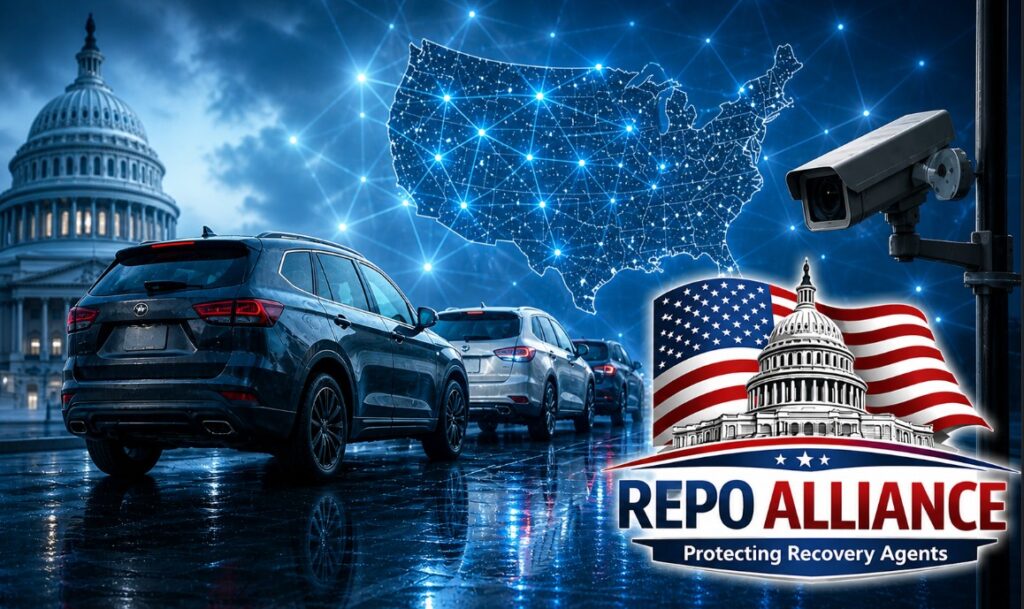
5.1.26: Auto Finance Update – As lawmakers debate surveillance limits and monetary policy steadies, the repossession industry faces critical questions about data access, strategy, and future stability.
Washington in Motion: What New Federal Actions Mean for Auto Finance and Repossession
Amid shifting federal policy debates and renewed scrutiny on surveillance and financial regulation, the auto finance and repossession industries are facing a rapidly evolving landscape. From interest rate uncertainty to proposed restrictions on license plate reader (LPR) data, these developments signal potential operational and strategic impacts that industry stakeholders cannot afford to ignore.
Senate Banking Advances Fed Chair Nominee Warsh
Last week, the Senate Banking Committee held a hearing on the nomination of Kevin Warsh to be the next chairman of the Federal Reserve Board of Governors, the powerful board which controls monetary policy. Republicans praised his economic experience and insight. Democrats criticized him for, according to them, placing the political interests of President Trump over the independent mission Congress gave the Fed to focus on the nation’s economy. The committee voted 13-11, along party lines, to advance Warsh’s nomination to the whole Senate.
The nomination was not without some drama. Senator Thom Tillis (R-NC) had previously pledged to oppose Warsh until President Trump ends the investigation of current Fed Chairman Powell for the cost overruns related to the renovations of the Fed’s headquarters. Last week, President Trump claimed he was ending the investigation of Powell, but later said “it’s not dropped.” Some speculated the move was a strategy to assuage Tillis, but that the charges could be refiled later.
It appears Warsh is on track to pass the Senate in the near future.
Federal Reserve Holds Interest Rates
On Wednesday, the Federal Reserve Board of Governors announced they were keeping primary interest rates unchanged. However, four governors did dissent, with one urging the Board to reduce rates and three urging the Board to increase rates out of inflationary concerns. The meeting was current Chair Powell’s final meeting as chair.
Congress Ends DHS Shutdown, Sets Up Reconciliation 2.0 Process
Last week, by a vote of 50-48, the Senate passed a concurrent budget resolution for FY2026 which initiates the budget reconciliation process Congressional Republicans hope to use to fund three years of Immigration and Customs Enforcement (ICE) and Customs and Border Protection (CBP) personnel and operations costs. The budget resolution directs the Judiciary and Homeland Security Committees in both the House and Senate to each recommend up to $70 billion in new spending under their jurisdiction for a reconciliation bill, which could combine for $140 billion. More realistically Republican leadership is looking around $75-80 billion.
When the budget resolution arrived in the House, several House Republicans were unhappy Reconciliation 2.0 was so narrow in focus. They want a more ambitious agenda. Those rank and file Republicans considered trying to amend the budget resolution to address more priorities. This would have sent the budget back to the Senate and slowed down the clock further. There was enough concern that House Republican leadership feared they might lose the vote on the budget resolution, as well as multiple other major bills on the House floor this week. However, House Republican leadership had a very successful week and was able to flip votes on all major legislation. When the budget resolution finally came to the House floor, it passed 215-211.
By adopting the Senate-passed budget framework for FY26, the table is now set for the Reconciliation 2.0 effort. Based on the parameters set in the budget resolution, Reconciliation 2.0 will be restricted to immigration enforcement funding (or potentially some other matters associated with the Departments of Justice or Homeland Security.) Republican leaders are telling rank and file Republicans that any of their priorities not included in Reconciliation 2.0 can be addressed later in the year when they will move a Reconciliation 3.0 bill.
After adopting the budget resolution, the House separately passed the DHS appropriations act previously passed by the Senate, which funds the entire Department of Homeland Security except for ICE and CBP. The President signed that into law Thursday night. This ends the DHS shutdown which had lasted for 76 days.
Massie Introduces Anti-Surveillance Bill
Rep. Thomas Massie (R-KY) introduced the Surveillance Accountability Act of 2026. The legislation primarily requires a judicial warrant for any search conducted by federal law enforcement agencies. The legislation appears to be in response to the ongoing difficulty in Congress to pass an extension of Section 702 of the FISA Act, which allows the Attorney General to get search electronic material without a warrant.
Specifically to the repossession industry, Subsection C of the legislation deals with privacy rights related to one’s automobile movement. Under the bill, federal law enforcement cannot access third-party data unless the subject of the investigation gave expressed informed and voluntary consent to the third-party to share such data. The data includes “license plate images, vehicle metadata, or vehicle movement patterns obtained through automated license plate readers or similar systems”.
At this stage, this is merely an introduced bill. It is unlikely in VSA’s experience that it will become law. However, we must analyze and understand this bill and its impact on your industry. Because the repo industry and the LPR companies work together, a bill which would (in our interpretation) prevent LPR companies from working with law enforcement, it could disrupt the industry.
WHO IS REPO ALLIANCE?
How and when was the group formed?
The initiative started several weeks ago with an invitation from ARA to all National and State Associations and other major industry leaders.
Is the Repo Alliance another association?
NO! The Repo Alliance is a collaborative effort of the groups which decided to answer the call and develop a fundraising program to further the interests of OUR industry and provide a voice at both National and State levels.
Which organizations came together?
American Recovery Association (ARA), the California Association of Licensed Repossessors (CALR), Texas Accredited Repossession Professionals (Texas ARP), and Harding Brooks Insurance.
How do you contribute?
- A Square account has been established.
- Click here to donate through Square.
- Champion, Promote and Spread the word about this industry initiative!
Can I use any other method to contribute?
YES, you can mail a check, payable to Repo Alliance at 1400 Corporate Dr., Suite 175, Irving, TX, 75038.
Will funding reports and expenditures be available for review?
- YES, this initiative will be completely transparent on monies raised with information available on the website.
- One hundred percent of all monies raised will be used to pay for lobbying efforts. Everyone involved other than the lobbyist is a volunteer.
Why hire a dedicated lobbyist instead of just working with other lobbying groups?
We are working with other industry lobbyist groups but have realized without OUR OWN VOICE, we would be trusting the future of the Recovery Industry to the priorities of others. Riding the coattails of these other groups, puts our agenda as simply an afterthought.
What are the GOALS?
- Change the negative, reputational image of the Recovery Industry.
- Educate legislatures of the vital role we play.
- Fight against language in bills or guidance from agencies that would decimate the recovery industry.
Contact Us
833-737-6255
833-REPOALL
Related:
Repo Alliance – This Week in Washington – March 2026
The Repo Alliance: Giving a Voice to a ‘Ghost’ Industry in Washington
Repo Alliance Progress & Updates from May DC Meeting
Repo Alliance – Let’s Not Lose our Minds
How Does the “One Big Beautiful Bill Act” Affect the Repo Industry?
Washington in Motion: What New Federal Actions Mean for Auto Finance and Repossession – Washington in Motion: What New Federal Actions Mean for Auto Finance and Repossession – Washington in Motion: What New Federal Actions Mean for Auto Finance and Repossession
Washington in Motion: What New Federal Actions Mean for Auto Finance and Repossession – Harding Brooks Insurance – American Recovery Association – ARA – Repossess – Repossession – Repossession Agency – Repossessor – Repossession





More Stories
REPO2027 Heads to Texas: Now Open for Exhibitor Registration
Washington Takes Aim at the CFPB: What Auto Finance Needs to Know
Renewed and Ready: CURepo Directory Members Sign on for Another Year
NEW Episode of On Hook with James McNeil – What Lenders and Repossessors Get Wrong About Each Other
NEW Episode of On Hook with James McNeil – When a Repossession Claim Hits: What Your Attorney Sees First
SkipGuru Hits Pause — But He’s Not Done Hunting Yet