

If the DRN Affiliate model had originally been presented in the form it operates today, how many agencies would still have chosen to participate? – Take Our Poll!
EDITORIAL
It’s now been 17 years since Todd Hodnett founded Digital Recognition Network (DRN) and over that time, much in the repossession industries use of license plate recognition (LPR) has changed. Starting as a repossession industry focused company, it has grown into one that feeds data to law enforcement, insurance companies and lenders directly. But do these changes still benefit the repo industry?
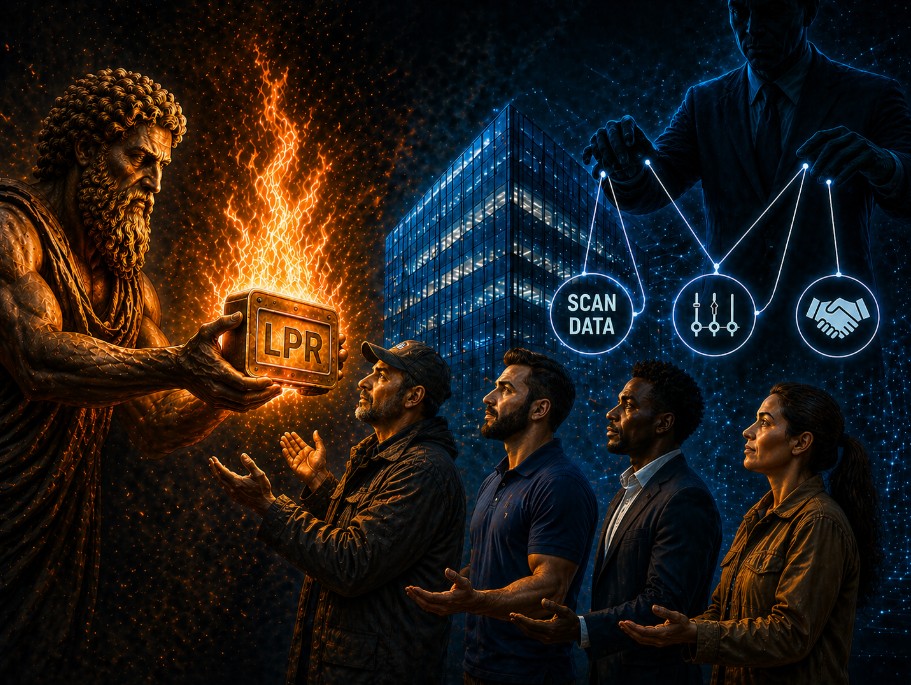
Prometheus
Like the mythological Greek Titan Prometheus, who brought fire to man, DRN brought LPR to the repossession world. But DRN did not invent LPR technology, it transformed it from a government and law enforcement tool into a private-sector model built on distributed data collection, revenue-sharing with repossession agents, and the creation of a massive historical vehicle-location database.
By the late 2010s, this affiliate model approach had helped DRN become one of the largest vehicle location databases in the United States and a dominant provider of LPR-assisted recoveries in the industry.
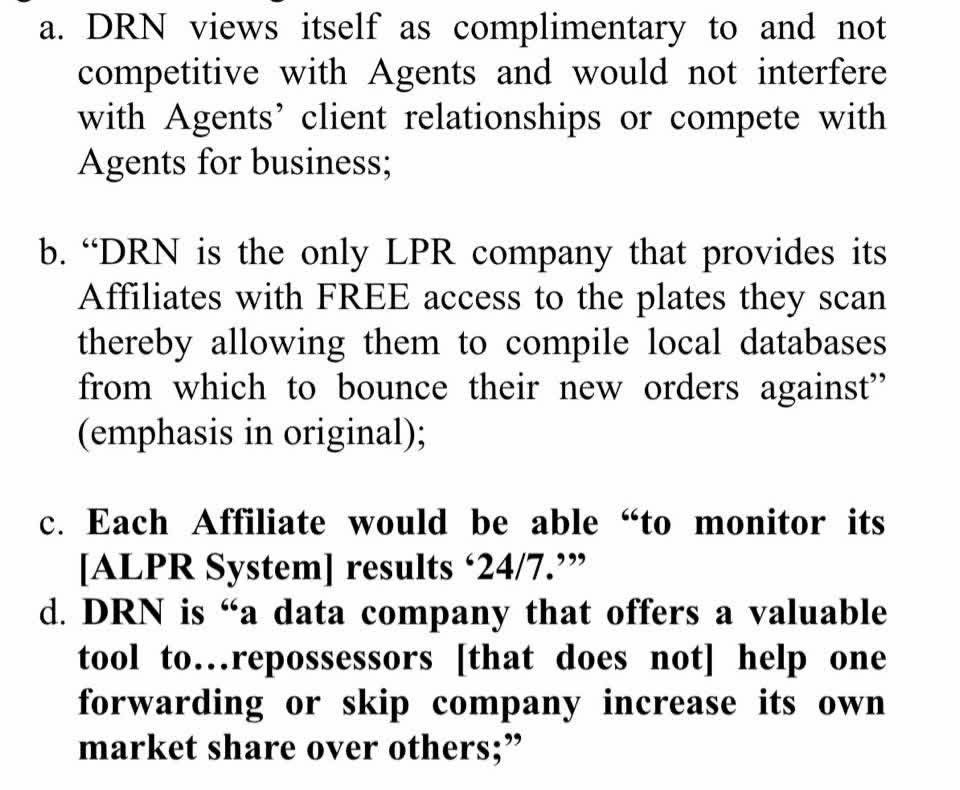
Early on, DRN represented the following value propositions:
- DRN views itself as complementary to and not competitive with Agents and would not interfere with Agents’ client relationships or compete with Agents for business;
- “DRN is the only LPR company that provides its Affiliates with FREE access to the plates they scan thereby allowing them to compile local databases from which to bounce their new orders against” (emphasis in original);
- Each Affiliate would be able “to monitor its [ALPR System] results ‘24/7.’”
- DRN is “a data company that offers a valuable tool to…repossessors [that does not] help one forwarding or skip company increase its own market share over others;”
In a 2012 press release, then CEO Chris Metaxas set forth the following:
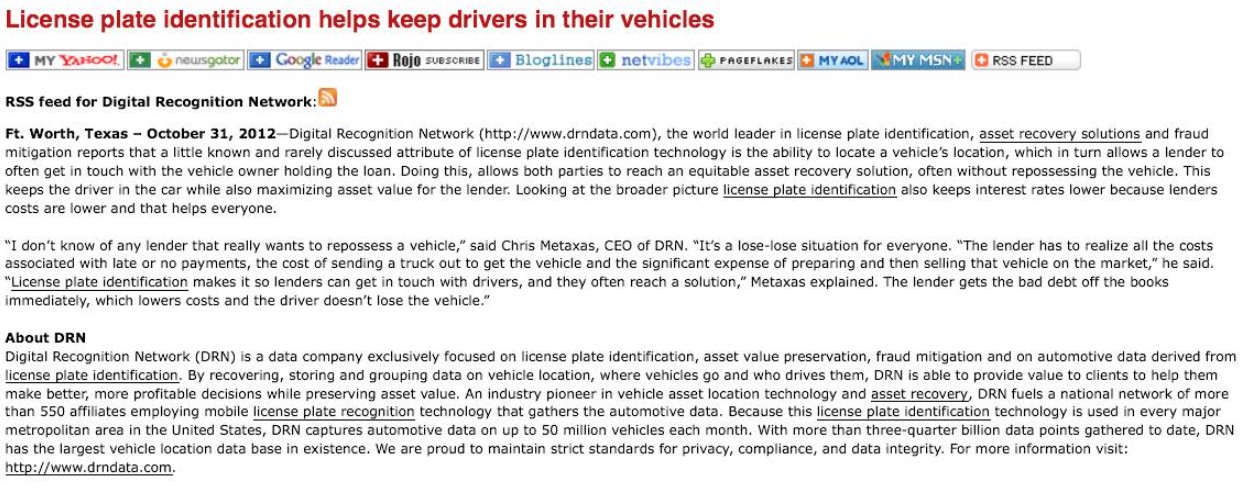
License plate identification helps keep drivers in their vehicles
Ft. Worth, Texas – October 31, 2012 — Digital Recognition Network (http://www.drndata.com), the world leader in license plate identification, asset recovery solutions and fraud mitigation reports that a little known and rarely discussed attribute of license plate identification technology is the ability to locate a vehicle’s location, which in turn allows a lender to often get in touch with the vehicle owner holding the loan. Doing this, allows both parties to reach an equitable asset recovery solution, often without repossessing the vehicle. This keeps the driver in the car while also maximizing asset value for the lender. Looking at the broader picture license plate identification also keeps interest rates lower because lenders costs are lower and that helps everyone.
“I don’t know of any lender that really wants to repossess a vehicle,” said Chris Metaxas, CEO of DRN. “It’s a lose-lose situation for everyone. The lender has to realize all the costs associated with late or no payments, the cost of sending a truck out to get the vehicle and the significant expense of preparing and then selling that vehicle on the market,” he said. “License plate identification makes it so lenders can get in touch with drivers, and they often reach a solution,” Metaxas explained. The lender gets the bad debt off the books immediately, which lowers costs and the driver doesn’t lose the vehicle.”
This statement was probably merely a lender facing press release which may or may not have illustrated a shift in market focus. Regardless, much was yet to change.
Fast forward to 2019, and through a series of additional acquisitions, DRN found itself alongside previously acquired competitors, MVTrac and Plate Locate, in an acquisition by from VaaS International Holdings who later sold them to Motorola.
Since then, even more has changed.
If You Knew Then…
This article and poll are not intended as a criticism of DRN. It is merely intended to open a constructive industry dialogue regarding the evolution of the DRN LPR “Affiliate” model and how it operates today compared to how it was originally presented.
Many agencies participated in the early adoption of LPR technology and the DRN platform based on representations that the system would:
- Support, not compete with, repossession agencies
- Enhance, not interfere with, existing client relationships
- Operate as a neutral data platform
Over time, the network grew significantly, driven in large part by the investment, scanning efforts, and participation of those same Affiliates.
Evolution at the High Level
As the platform expanded, many in the industry have observed what appears to be a shift toward:
- Increased centralized control over scan data and access
- Influence over which assignments can be matched or “bounced” against LPR data
- A system that may now function as an intermediary between agencies and their clients
- The presence of affiliated or aligned entities operating within the same ecosystem
These changes, whether intentional or the result of natural business evolution, have raised important questions about how the platform functions today relative to its original structure.
Key Questions for Industry Consideration
Considering the amount of time and investment so many agencies have expended in their participation in the DRN network and, in light of the constant threats of LPR inhibiting legislation, it is only wise for business owners to ask themselves some questions.
PLEASE! ONLY Agency Owners Who are Current or Recently Former DRN Affiliates Respond
Polls Close Wednesday May the 20th
Purpose of This Inquiry
The goal of this article and poll are not to assign blame, but to:
- Better understand the collective experience of Affiliates
- Identify whether there is a shared pattern across the industry
- Determine whether the current structure aligns with the expectations under which agencies originally participated
Closing
All things change and evolve over time. Businesses are not immune to this. This also pertains to how businesses relationships interact and feel about the benefit of these relationships.
The repossession industry played a significant role in building and scaling the LPR network as it exists today. As the platform continues to evolve, it is appropriate to ask whether the current structure reflects the same principles under which that participation was originally established and whether those current standards still serve its affilaites now.
This examination holds true for not only DRN’s network but with all business relationships.
Kevin Armstrong
Publisher
Evolution of the DRN “Affiliate” Model – Request for Industry Feedback – Evolution of the DRN “Affiliate” Model – Request for Industry Feedback – Evolution of the DRN “Affiliate” Model – Request for Industry Feedback
Evolution of the DRN “Affiliate” Model – Request for Industry Feedback – DRN – Digital Recognition Network – MVTrac – MVTrac – License Plate Recognition – LPR – Repossess – Repossession – Repossession Agency – Repossessor – Repossession





More Stories
The Cost of Doing Business: Why We Cannot Afford to Work for Free
The Insurance Barrier: When Tow and Repo Try to Cross the Line
Everyone Wants a Safe Repossession. Nobody Wants to Pay for One
The Industry We Built and the Standards We Must Protect
The Secret Recipe Isn’t Ours to Keep
What Happens When Repo Discovers Towing?