



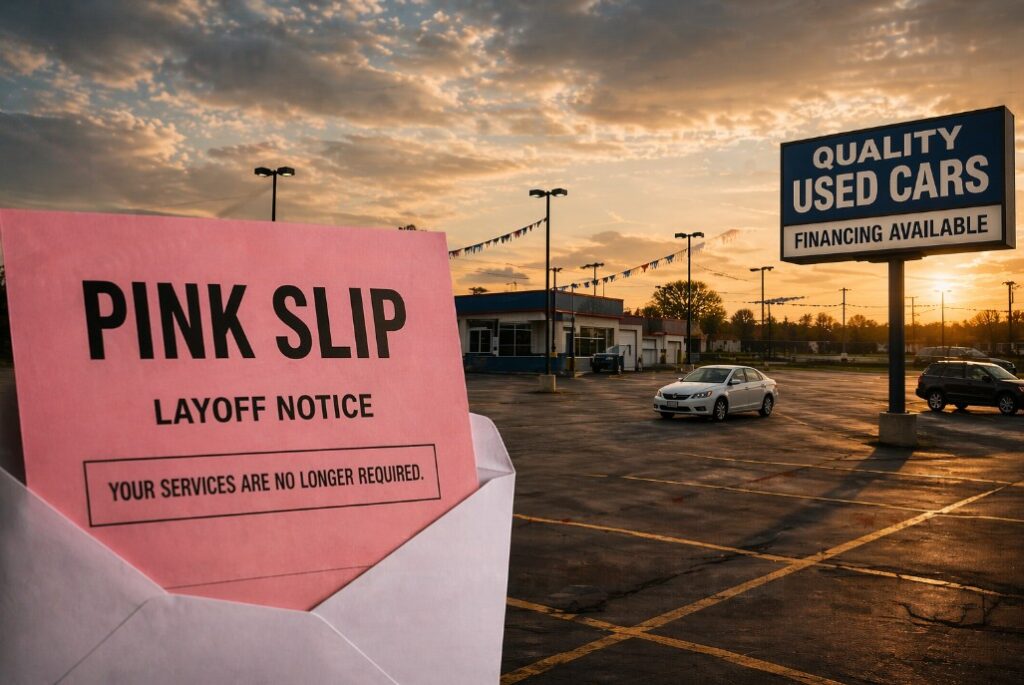
5% of Staff Laid Off Across Multiple Divisions
A quiet but significant workforce reduction at Credit Acceptance Corporation is raising new questions about the direction of the subprime auto finance market, and what it could mean for repossession volume in the months ahead.
According to industry reporting, the Michigan-based auto financier laid off approximately 5% of its staff, roughly 150 employees, on April 16, 2026, as first reported by Auto Finance News in its coverage:
The cuts were reportedly carried out across multiple departments, with affected employees notified the same day. The company has not issued a formal public press release regarding the reduction.
A Move Made Ahead of Earnings
The timing of the layoffs, just weeks before the company’s first-quarter earnings release, suggests a strategic effort to control costs amid shifting financial conditions.
While no official explanation has been provided, recent performance trends offer insight into the likely drivers behind the decision.
Declining Originations Signal Pullback

Credit Acceptance had already been experiencing a slowdown in loan originations leading into 2026. Quarterly data from late 2025 showed:
- A 9.1% decline in Q4 originations
- A prior 14.6% year-over-year drop earlier in the year
Detailed reporting on those declines can be found here.
Those declines point to a sustained contraction in lending activity rather than a temporary fluctuation.
For a lender operating heavily in the subprime space, reduced originations directly impact future revenue streams and typically signal tightening credit standards.
Loan Performance Weakens
At the same time, loan performance has shown signs of deterioration. Industry data indicates that subprime borrowers, Credit Acceptance’s core customer base, have been under increasing financial pressure.
Rising delinquencies and missed payments have contributed to a more cautious lending environment, forcing finance companies to balance risk exposure against growth.
Broader Market Pressure Builds
The company’s internal challenges mirror broader trends across the auto finance landscape:
- Delinquency rates have climbed across subprime portfolios
- Household debt pressure has increased
- Credit quality has softened in lower-tier borrower segments
These factors collectively create a more volatile operating environment, particularly for lenders focused on higher-risk consumers.
Cost Control Measures Expand Company-Wide
Unlike targeted layoffs tied to specific divisions, the reductions at Credit Acceptance were reportedly spread across the organization. That type of broad-based action typically reflects a need to align overall operating expenses with reduced business volume and a more conservative outlook.
Implications for the Repossession Industry
For repossession agencies, the developments present a mixed outlook.
In the near term, weakening loan performance and rising delinquencies could translate into increased repossession assignments, particularly as lenders work to manage risk and recover collateral.
However, the longer-term picture may be more complex.
A sustained decline in originations means fewer loans entering the pipeline. If lending activity continues to contract, agencies could eventually see downward pressure on assignment volume, even as near-term recovery activity rises.
A Familiar Cycle Taking Shape
The situation reflects a pattern the industry has seen before:
- Borrower stress increases
- Delinquencies rise
- Lenders tighten credit
- Originations fall
- Cost structures adjust
Credit Acceptance’s workforce reduction appears to be an early indicator that this cycle is once again underway.
The Bottom Line
The April 16 layoffs at Credit Acceptance underscore a broader shift in the subprime auto finance market, one defined by tighter credit, elevated risk, and recalibrated expectations.
As evidenced by the Tricolor meltdown and the recent wave of smaller subprime lenders ceasing loan originations, this lending sector is under some serious strain. For the repossession industry, short-term volume may rise, but the long-term pipeline is becoming less certain.
Considering the massive number of unpaid invoices created in earlier events, it might do the industry well to watch all subprime lenders closely for signs of slow payment or no payment. Or perhaps it is time that agencies and forwarders began requiring retainers from subprime lenders?
Related:
Another Subprime Lender Files for Bankruptcy
Subprime Lender Pauses Lending: Implications for Repossession Agencies
Hundreds of Repo Agencies Listed in Tricolor Bankruptcy
t Acceptance Layoffs Signal Subprime Slowdown – Credit Acceptance Layoffs Signal Subprime Slowdown –
Credit Acceptance Layoffs Signal Subprime Slowdown
Credit Acceptance Layoffs Signal Subprime Slowdown – Repossess – Repossession – Repossession Agency – Repossessor – Repossession – Subprime Auto Loans – Subprime Auto Loans – Auto Loan – Delinquency






More Stories
Hooked, Lifted, and Still Not Yours: Federal Court Rules Against Georgia Repossessor
LPR Helps Rescue Child from Alleged Human Trafficker
Myles Weiss: Remembering a Man Who Helped Build the Repossession Industry
Five Charged in $3 Million Houston Luxury Vehicle Theft and Export Scheme
Texas Repo Turns into Armed Standoff, Two Arrested
Car-Mart Buys Another Week. But Is It Running Out of Road?