


 For years, auctions handled most key replacements after repossession. Recover the vehicle, send it to auction, let them deal with keys.
That model is gone.
Repossession Has Changed
Repossessions are rising again and, in some segments, back to pre-pandemic highs.
At the same time:
- Push-to-start is standard
- Proximity keys dominate
- Immobilizer systems are more complex
- Recovery timelines are tighter
Today, repossession companies aren’t just recovering vehicles.
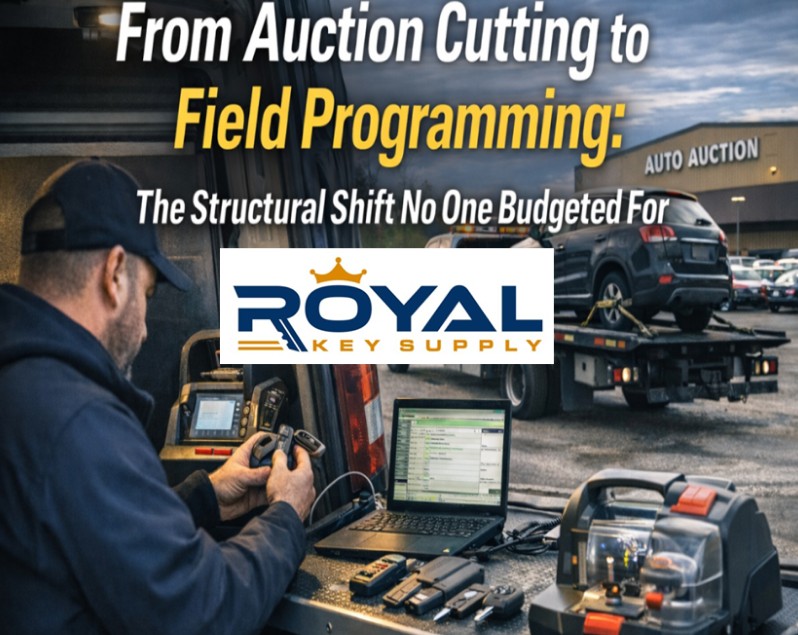
They’re cutting and programming keys in the field.
Not occasionally. Structurally.
Auctions Had Scale. Field Agents Don’t.
Large auction chains benefit from:
- Centralized programming equipment
- Bulk purchasing power
- Dedicated in-house technicians
- Volume-based efficiencies
Small and mid-sized repo companies do not have those economies of scale, they must:
- Carry a wide variety of key inventory on vehicles
- Invest in multi OEM programmers
- Pay subscription and token fees
- Absorb travel and on-scene labor time
- Invest in training
- Manage compliance and credentialing
The cost structure is fundamentally different. Yet many pricing models were built when auctions handled most key work.
That mismatch is where the friction begins.
The Oversimplification Problem
Some lenders are attempting to standardize pricing by “key type”:
- Mechanical
- Transponder
- Remote Head
- Flip Key
- Fobik
- Proximity
On a spreadsheet, that makes sense. In the field, it doesn’t.
Why?
Because within each key type, costs vary dramatically.
Two proximity keys can have completely different realities:
- One programs onboard in minutes.
- Another requires advanced diagnostics and security authentication.
- One has aftermarket options.
- Another only has new OEM, sometimes 2–3x the cost.
Older model years often allow refurbished or aftermarket options.
Late model vehicles often don’t.
Same “key type.”
Completely different economics.
Portfolio Mix Matters
A lender with a portfolio weighted toward newer, higher-end vehicles will naturally see:
- Higher part costs
- Greater programming complexity
- More OEM restrictions
Flat pricing ignores that exposure. And when pricing ignores reality, someone absorbs the gap.
In this case the repossession company will absorb that gap.
Keys Are No Longer a Line Item
They are:
- VIN specific
- Software driven
- Security controlled
- Supply chain sensitive
- Labor intensive
This isn’t the old shop key duplication. Its mobile technical service layered on top of recovery operations. The industry has already adapted operationally.
Now the economic model needs to catch up.
What Comes Next
The smarter direction isn’t oversimplified key-type pricing, it’s:
- VIN-level cost forecasting
- Data-driven complexity modeling
- Transparent reporting
- Pricing that reflects real-world variability
- Recognition that auction scale does not equal field scale
Repossession has evolved from recovery-only to recovery + technical locksmith service.
Once a structural shift happens, it doesn’t reverse. It becomes the new baseline.
The repossession industry has always adapted when conditions change. This shift toward field-based key programming is no different. But as someone who came from repossession and works closely with recovery agents, locksmiths, lenders, auctions, and technical service providers, I believe the next step isn’t simplification, it’s better data.
When we understand VIN-level variability, portfolio mix, and real-world programming complexity, we can build models that are sustainable for operators and transparent for lenders. That alignment benefits everyone involved in the asset recovery cycle.

Billie Jo Stoddard
Royal Key Supply

CONTACT
PHONE: 817-779-4758
WEBSITE: www.royalkeysupply.com
EMAIL: [email protected]
Related Articles:
Look Forward to Locksmith Day at the AFA Mid-Year 2024
Keys in the Repossession Industry
Royal Key Supply GM OEM Locksmith Training Next Thursday
From Auction Cutting to Field Programming: The Structural Shift No One Budgeted For – From Auction Cutting to Field Programming: The Structural Shift No One Budgeted For – From Auction Cutting to Field Programming: The Structural Shift No One Budgeted For
From Auction Cutting to Field Programming: The Structural Shift No One Budgeted For – Repossess – Repossession – Repossession Agency – Repossessor – Royal Locksmith – Royal Key Supply






More Stories
The Tale of the LPR Network
Fuel Crisis in Repossession: The Numbers Don’t Lie
When Information Becomes Influence
Lenders: A Repossession is a Repossession – Ignore This at Your Own Peril
Agent Advisory Boards: Valuable Dialogue, But Where’s the Structural Shift?
Rising Fuel Prices and the Urgent Need for Action in the Repossession Industry