



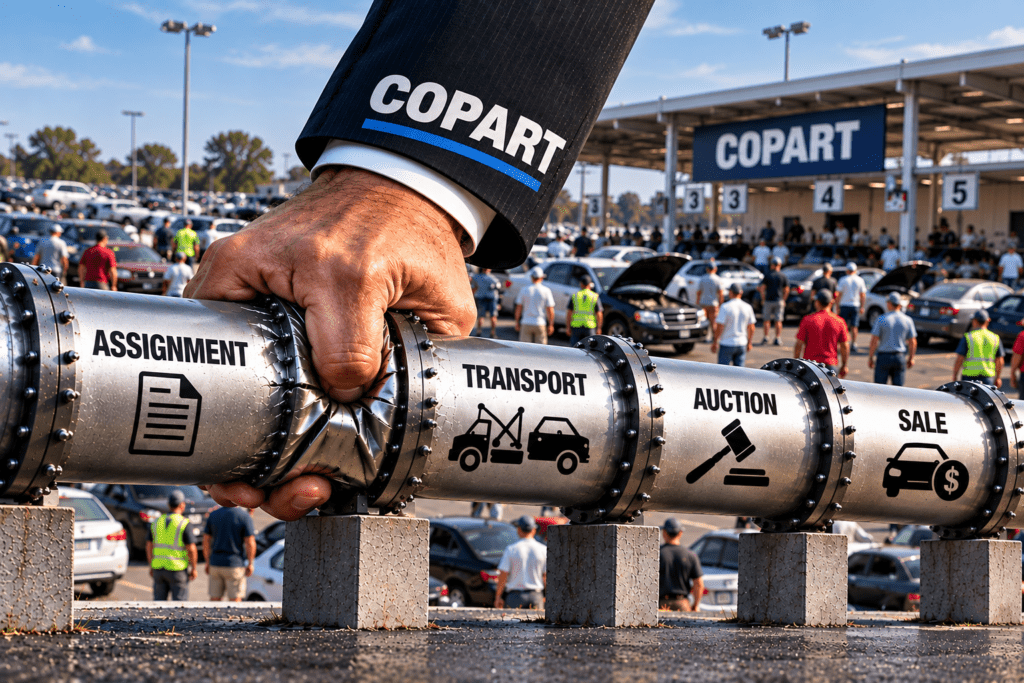
The ACV Acquisition Blurs the Line Between Recovery, Transport and Remarketing
Dallas, TX – September 12, 2026 – Copart’s planned $1.9 billion acquisition of ACV Auctions is being presented as a major expansion of its vehicle remarketing business. For the repossession industry, however, the more important part of the transaction may be what happens long before a vehicle reaches the auction block.
Copart announced September 10 that it will acquire ACV for $10.50 per share in cash, representing an implied equity value of approximately $1.9 billion. The combination gives Copart ACV’s dealer-to-dealer wholesale marketplace, vehicle-data and inspection technology and a substantial transportation operation. Copart describes the combination as creating a “full-spectrum” digital remarketing platform and strengthening its position across the “full vehicle lifecycle.”
That transportation network deserves the recovery industry’s attention.
ACV operates a nationwide vehicle transportation business built around thousands of carriers. For an industry already concerned about the line between transporting collateral and repossessing it, that is not an insignificant addition.
From Auction Company to Collateral Pipeline
Copart isn’t hiding its ambition to handle more of the vehicle lifecycle.
According to the Copart-ACV acquisition announcement, the combination spans dealer trade-ins, wholesale remarketing, salvage disposition and international resale, while creating commercial opportunities across the combined portfolio.
In their own words;
“Bank & repo vehicles
Sell repossessed and impound vehicles efficiently and at scale. Copart works with banks, auto lenders and credit unions to streamline the remarketing process from assignment to sale.”
More telling for lenders and recovery professionals is how Copart has already positioned its bank and repossession business: as a way for financial institutions to streamline the remarketing process “from assignment to sale.”
Those four words, from assignment to sale, should get the recovery industry’s attention.
What exactly do they mean by assignment? Transport assignment? Remarketing assignment? Repossession assignment?
A traditional repossession chain contains several distinct participants. A lender or forwarder assigns the account. A professional recovery agency locates and legally secures the collateral. The vehicle may then be transported, stored, inspected and ultimately delivered into a remarketing channel.
Vertical integration can compress that chain.
With ACV, Copart would add a massive transportation network, dealer marketplace, inspection and valuation technology and additional commercial relationships to its existing auction facilities, lender relationships and international buyer network.
The obvious strategic question is how many independent links in the traditional recovery chain will remain necessary if one company can increasingly manage the collateral from assignment through disposition.
The Industry Has Seen This Movie Before
That question isn’t theoretical.
In February 2025, the American Recovery Association met with Copart leadership over concerns that Copart was securing impounded vehicles on behalf of national lenders.
ARA’s position was straightforward: when collateral securing an installment agreement is taken into possession for the lender before completion of the agreement, the transaction can constitute a repossession regardless of whether someone describes the movement as a tow or transport.
Copart disagreed with that interpretation, according to ARA.
ARA also reported learning that Copart used employees and subcontractors to facilitate those recoveries. The association argued that professional repossession agencies are subject to insurance, personal-property, compliance and other requirements that should not disappear simply because the same activity is characterized as transportation.
CURepossession subsequently examined the issue more closely in “Like a Butcher With a Scalpel – Copart in Repossessions,” including concerns raised by ARA and Texas Accredited Repossession Professionals over the potential displacement of compliant recovery agencies and the risks created when recovery activity is characterized as towing or transportation.
The dispute subsequently spread beyond the national association.
In May 2025, the Florida Association of Licensed Repossessors called for a state investigation into alleged unlicensed repossession activity by Copart of Florida. FALR said lenders had confirmed assigning repossession accounts to Copart despite what the association said was a lack of required Florida repossession licensing.
Those were allegations and regulatory concerns raised by industry associations, not findings arising from this week’s ACV acquisition.
But the ACV acquisition changes the scale of the question.
Thousands of Carriers Change the Equation
The greatest competitive threat may not be from Copart acquiring repossession companies. It may be Copart no longer needing them for certain categories of assignments.
Consider an impounded vehicle, voluntary surrender or collateral sitting at another controlled location. If the lender routes that assignment directly into an integrated Copart system capable of securing or arranging movement of the vehicle, transporting it, inspecting it, valuing it and selling it, work traditionally handled by a licensed recovery agency, and frequently managed by a forwarding company, could potentially disappear from the conventional recovery pipeline.
Voluntary or impond, a repossession is a repossession. Changing the terminology to “transport” does not alleviate that distinction and the liabilities that come along with it no matter how much they desire to spin it that way.
Multiply that possibility across a transportation network numbering in the thousands and the threat becomes much larger than a handful of lost voluntary or impound repossession assignments and subsequent fees. It becomes assignment displacement.
According to the ARA’s earlier comments, Copart had already disagreed with their factual definition of what a repossession is. Unless this position has changed on their part, there is little reason to believe that they wouldn’t use this increase transport network to expand their market share of this lower hanging fruit.
That presents an obvious threat to independent repossession agencies. It also potentially threatens forwarders whose value is built around receiving lender assignments, selecting and managing compliant recovery vendors, monitoring the recovery process and moving collateral toward disposition.
An auction and technology company capable of offering lenders an increasingly integrated alternative could compete for pieces of both businesses.
And there is an important distinction here: ACV’s existing transportation business is not evidence that its carriers are performing repossessions. ACV markets the service as vehicle transportation.
The risk comes from what could happen when that transportation infrastructure is placed inside a company already involved in a dispute with the recovery industry over where transportation ends and repossession begins.
Cheaper Doesn’t Necessarily Mean Safer for the Lender
For lenders, consolidating vendors can be attractive.
One relationship, one technology platform, fewer invoices, faster movement, integrated condition reports and valuations. A direct path from collateral recovery to sale. But those efficiencies could become expensive if the activity crossing that platform legally constitutes repossession.
Repossession licensing varies considerably by state. Professional recovery agencies also carry specialized insurance, train employees in breach-of-peace avoidance, maintain personal-property procedures and operate under lender compliance requirements developed specifically around collateral recovery.
If a vehicle is merely being transported after possession has legally transferred, the distinction can be straightforward. If possession is actually being obtained on behalf of the creditor, the question becomes considerably more complicated.
Calling the transaction a “transport” does not necessarily determine what it is under applicable law.
That is why the Copart controversy has never been merely a fight over lost assignments. It is also a lender-risk issue.
If a creditor allows collateral recovery to be performed through a process that fails to meet applicable licensing or repossession requirements, the financial institution may ultimately have much more at risk than the cost difference between a recovery fee and a transportation charge.
OneMain Already Demonstrated Another Way
There is also evidence that lenders can preserve efficiencies without cutting professional recovery agencies out of the process.
Following discussions with ARA over impounds, OneMain Financial clarified its impound procedures and indicated that when a repossession assignment transitions into an impound situation, every effort is made to keep the assignment with the originally assigned recovery agency throughout the impound process.
That may become an increasingly important distinction.
The question isn’t whether Copart, ACV or any other auction and transportation provider should move vehicles. Transportation is an essential part of remarketing.
The question is when transportation begins.
Professional repossessors shouldn’t be displaced from a legitimate recovery assignment simply because collateral happens to become easier to secure. Forwarders shouldn’t necessarily become unnecessary because a remarketing company can provide transportation. And lenders shouldn’t allow convenience or price to blur the compliance line between moving a vehicle and legally taking possession of collateral.
Copart Is Building Something Much Bigger
Reuters reported that the $1.9 billion ACV acquisition marks Copart’s entry into dealer-to-dealer wholesale remarketing as the company expands beyond its core auction business amid slowing vehicle-volume growth.
For the repossession industry, however, the important word may be beyond.
Copart already has an enormous physical auction and international remarketing network and relationships with banks, finance companies and other commercial sellers. ACV brings another digital marketplace, vehicle data, inspection and valuation technology and a nationwide transportation network.
Put those pieces together and it certainly appears that Copart isn’t simply buying another auction company. It is assembling an increasingly complete collateral pipeline.
That doesn’t mean Copart is about to replace America’s repossession industry, and nothing announced in the ACV transaction establishes that ACV carriers will perform repossessions.
But the recovery industry has already spent more than a year warning about Copart’s movement toward the front end of the collateral process. Now the company is spending $1.9 billion to acquire transportation relationships and technology capable of moving, inspecting, valuing and selling vehicles nationwide.
For legitimate repossession agencies, the competitive threat is difficult to ignore. For forwarders, the potential disintermediation should be equally concerning.
And for lenders, the compliance threat could prove considerably more expensive than whatever efficiencies an integrated collateral pipeline promises to deliver.
Because when one company promises to handle collateral “from assignment to sale,” there is one question regulators, lenders and repossessors should insist on answering:
Who legally performed the repossession between those two points?
Copart’s Growing Grip on the Repo Pipeline – Copart’s Growing Grip on the Repo Pipeline – Copart’s Growing Grip on the Repo Pipeline
Copart’s Growing Grip on the Repo Pipeline – Repossess – Repossession – Repossession Agency – Repossessor – Repossession – Repossession News – Transport – Compliance – Remarketing – Auto Loan




More Stories
Jeep Repossession Turns into Armed Confrontation in Texas
Car-Mart’s Repo Pipeline Becomes a Cash Machine
When Karen Goes Batwoman: Minnesota Repossession Ends in Felony Charges
Gun Drawn During Cincinnati Repossession Attempt
Pepper Spray, a Damaged Repo Truck and Two Hours in the Car
Repo or Tow, The Tulsa Murders Expose a Dangerous Confusion